

Non-Woven Discs: The Grain Is Throughout the Web
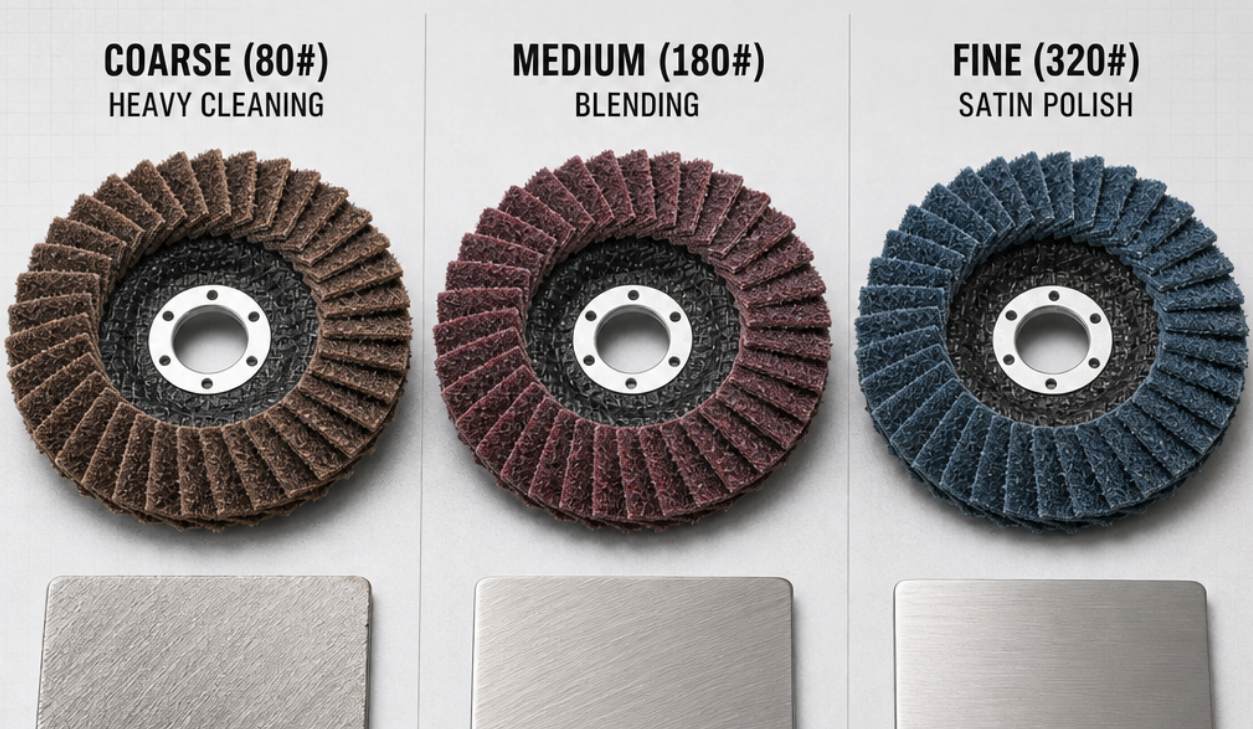
Our coarsest 115 mm non-woven polishing disc is quoted at about 3.7 times the coarsest 115 mm blue flap disc. Same diameter, same spindle, same machine. Against the ceramic flap disc in the same diameter it is still more than twice.
Then the weights. Per piece, the non-woven disc is the lighter of the two — 85 grams against 100.
So the money is not in the material, and it is not in the freight. It is in what the disc is. And the price only starts to make sense once you know that.
What it actually is
A non-woven disc is a web of synthetic fibre with abrasive grain bonded through the whole thickness of it, held by resin. There is no layer of grain sitting on top of a backing. The grain is in the web, distributed through it.
That one structural difference produces everything else — the price, the behaviour, and every way people misuse it.
Why it cannot remove stock
Put it next to a flap disc. On a flap disc, the grain is on cloth or paper and the cloth is stiff. Push, and the load concentrates along the contact line. That concentration is exactly what lets a flap disc take metal off.
A non-woven web is compliant. Press it against steel and the web compresses and spreads the load over a far wider area than the flap's contact line. Unit pressure at any one point stays low, and low pressure per grain means shallow scratches.
That is not a shortcoming. That is the product. A shallow uniform scratch pattern is what you want at the end of a sequence, because it is what produces a finish that reads as one consistent surface instead of a set of tool marks. It is also why the disc is so hard to gouge with. It will not dig a shoulder into a flat, because the pressure that would dig it never develops.
The grain renews itself
Because the abrasive runs through the web rather than sitting on its surface, wearing the disc down exposes fresh grain instead of dull grain. The outer web goes, and the layer underneath is already loaded with abrasive.
That is why the working life feels long, and more usefully, why the cut stays consistent from the first minute to the last. A flap disc changes character as the flaps wear back. A non-woven disc changes much less.
It belongs at the end, not the beginning
The mistake I see most often is a non-woven disc put on a weld that has not been shaped yet. It will not take the weld down. What happens instead is the operator leans on it, the web compresses, and the open structure — the thing that makes the disc work at all — closes up under the load.
Now you are not cutting. You are heating.
The disc keeps spinning and the surface keeps changing, which is what makes this failure hard to catch. It is not cutting, and it is also not doing nothing. It is smearing the surface and putting heat into the part. On thin sheet, or on anything heat-sensitive, that is the expensive outcome.
Past a certain pressure a non-woven disc changes job. It stops being a finishing tool and becomes a heat source. At that point the price of the disc has nothing to do with the cost of the operation.
The colour is not a grade
Yellow, red, blue. In our line: yellow is coarse, red is medium, blue is fine.
Look at what that is. It is our coding. It is not an industry standard. Non-woven colour codes are set by each manufacturer and they do not agree with each other. A red disc from one maker and a red disc from another are not necessarily the same grade, and the same three colours turn up in ranges built on different underlying abrasive.
If you specify this product across suppliers, specify the grade and the job, not the colour. Within one maker's range the colour is a useful shorthand. Outside it, it is a trap.
One more thing worth knowing before you assume the pattern from other products. In our line the fine grade is cheaper than the coarse, and lighter. At 115 mm, blue sits about 4.5% below yellow on price and about 13% below it on weight. Finer grade, less abrasive, less material — the two move together. So if you have been choosing coarse on the reasoning that it must cost more, this is one product where that reasoning leads you the wrong way.
The cost arithmetic, done properly
The 3.7 times is real, and it is also the wrong number to decide on.
The right number is what the disc does to your sequence. Count the operations. If the non-woven disc deletes a coarse pass plus a finer pass plus a buff, you are not comparing one disc against one disc. You are comparing one against three, on top of two tool changes and the labour attached to them.
I am not going to put a figure on that for you, because it depends entirely on the part. But the arithmetic is short, and you can run it on one job: count the operations the disc deletes, price the labour, divide.
For anyone importing this line
Per piece, the disc is light — about 85 grams against 100 for the flap disc at 115 mm. It is also packed 100 to the carton rather than 200, so a carton is lighter and carries half the pieces.
Freight is not what makes this disc expensive. It is a value-per-piece product, not a value-per-kilogram one. The inner box is 10 pieces and our MOQ is one box, which means a distributor can put ten pieces on a job before committing to a carton.
House-keeping
MOQ is one box. Stock lines ship within seven days; made-to-order runs take two to three weeks. Samples are free up to three pieces, freight collected. Payment is T/T 30% deposit and 70% before shipment, or through Trade Assurance. Quotations hold for fifteen days. OEM and private label are supported. The bonded range carries EN 12413, MPA and CE marking, with a three-year shelf life from production date and a traceability code marked on each piece.
One thing this piece does not do: it does not re-argue that productivity matters more than unit price. That argument has been made often enough and it is not what is interesting here. What is interesting is that this is the one product in the catalogue where the per-piece price is genuinely, structurally misleading — and where the reason for that sits in the construction, not in the margin.
If you are working through a finishing sequence and the last step is not landing, send us what the surface has to pass, the material, and the operation immediately before it. That tells us more than a part number will.


