

Mounted Points: The Price Is Flat, So Choose on Geometry
I have been selling abrasives for a long time. Mounted points are the one line where I see the same mistake in every market, and it is not the mistake you would expect.
It is not that people buy them cheap. Everyone buys everything cheap. The mistake is that the decision gets made on the one number in the catalogue that has almost no effect on the result.
Let me show you that number first. Then we can talk about what actually matters.
The line is priced almost flat
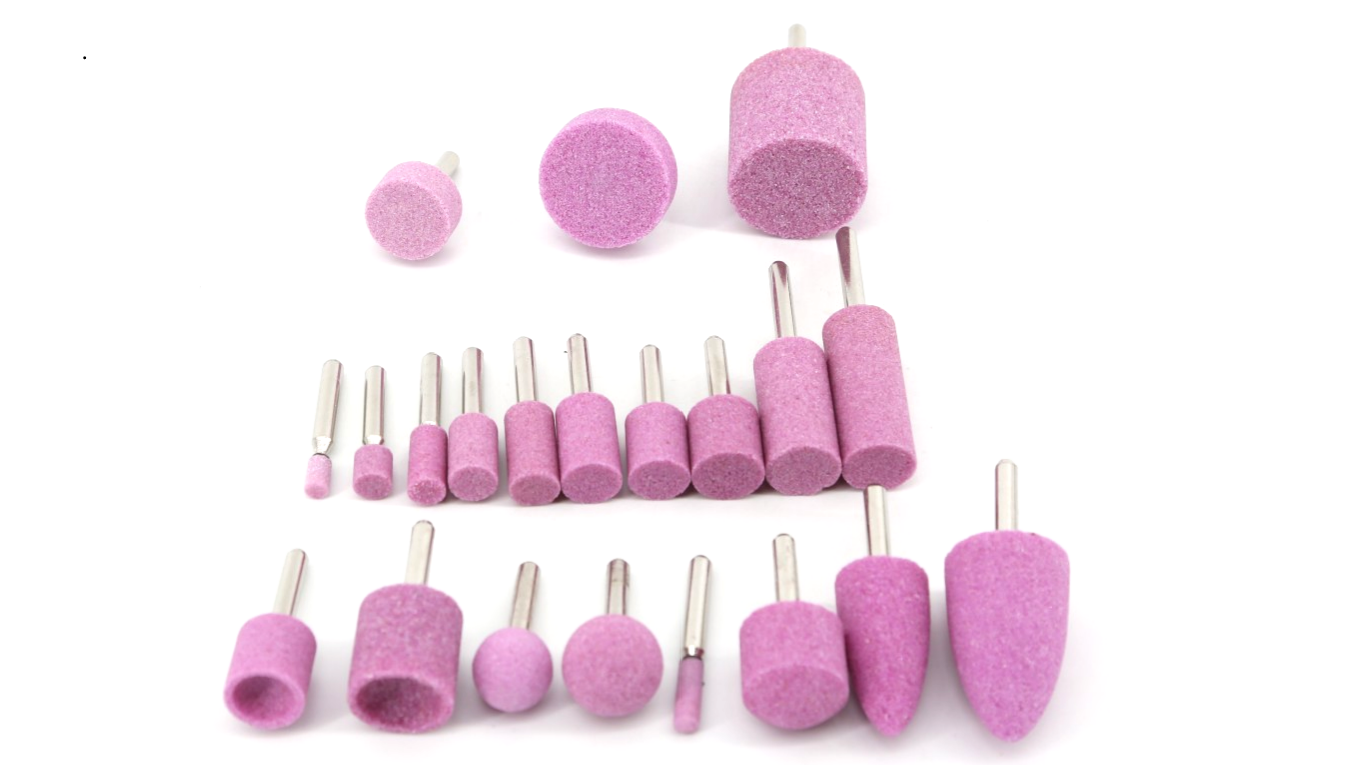
Our mounted point range has twenty-one shapes. All alumina, all on the same 6 mm steel shank: cylindrical, bullet, half-round, ball, and a cylindrical with a concave bottom for shoulders. Diameter runs 6 mm to 40 mm. Length, where the shape has one, runs 10 mm to 50 mm.
Lay the whole thing out in a single column and the pattern is hard to miss. A 6 × 10 mm cylindrical and a 13 × 20 mm cylindrical go out at the same figure. Work out the abrasive volume and the second one is roughly nine times the material. Same quotation.
Across the entire range, smallest head to largest, the spread is a little over three times. That is the whole price signal in the line.
If you are choosing between two mounted points by looking at the price, you are reading a column that has already stopped giving you information. More than half the range sits inside the bottom three price steps.
Why that happens
This part is my reading, not something I can prove from a price list, so take it as an opinion.
A mounted point is not priced on abrasive. The abrasive is the cheap part. What sits behind every SKU in that column is the same set of fixed steps: the shank pressed in and bonded, the same pressing cycle, the same cure, the same marking, the same boxing. Those steps cost money and they do not get cheaper because the head is 6 mm instead of 13 mm.
So the catalogue is telling you something true. The price is largely the cost of making a mounted point at all. Past that, head size is nearly free.
Two habits that column invites
A flat price column encourages two bad decisions.
The first is buying the largest head, on the reasoning that you get more abrasive for the same money. The second is buying the smallest, on the reasoning that you can always take more passes. Neither is a decision about geometry, and geometry is the only thing in this product that changes what happens where the abrasive meets the work.
Where the abrasive touches the work
Five shapes, five different contact patches. This is the part worth thinking about.
Cylindrical is the shape people misuse most. It is meant to be run on its side, on the corner it makes with the work — a line contact, and a narrow one. Lay it flat against a flat plate instead and the whole face touches at once. That is a different process. Full-face contact spreads the load across an area far larger than the head was designed to present, the middle of the face stops cutting and starts loading, and the shoulder does all the work and wears unevenly. If you have ever pulled a mounted point off a job with a loaded, polished face and a worn edge, that is the signature. The tool was not faulty. It was presented to the work at the wrong angle.
Ball (A25, A26) gives point contact. At the same hand pressure it produces the highest pressure at the contact point of any shape in the line, which is why it feels like it cuts hardest. Two jobs: blending a radius, and reaching into a corner where nothing else will go.
Bullet (A9, A11) contacts progressively. The nose works first, the flank joins as you lean it over. That behaviour suits slots, fillets and inside edges, where a cylindrical point tends to catch.
Half-round (A21, A24) is for curved surfaces and inside corners. Its useful property is that the contact patch stays roughly the same size as you change the angle of attack.
Concave-bottom cylindrical (A38, A39) contacts on the rim only — an annulus. That is deliberate. It lets you work a flat face or a shoulder without the centre of the point touching, loading and doing nothing.
The shank is not a handle
Every point in the range sits on a 6 mm steel shank. Past the collet, that shank is a cantilever with abrasive bonded to the free end.
Tip deflection goes with the cube of the overhang. Double the reach and, at the same side load, you get eight times the deflection at the tip. That single relationship explains why a long mounted point chatters and a short one does not, on the same grinder, with the same abrasive, with a shank of the same diameter.
So reach and control trade against each other, and you have to pick. If a bore is deep, you buy the reach and then you have to drop your pressure and accept a smaller head, because the shank will not carry a big head out there. If the work is on an open face, buy short and let the head do the work. What you cannot do is buy a long shank and a large head and push it the way you push a short one. The abrasive will survive that. The shank will not.
Speed belongs to the head
Peripheral speed is π × D × rpm ÷ 60. Same spindle, larger head, faster rim. A 40 mm point's rim travels about 6.7 times as fast as a 6 mm point's at the same rpm, and the maximum permissible speed is a property of the head — not the shank, not the grinder.
Which means the practical check is two steps, not one. Read the no-load rpm off the plate on your die grinder. Then look at what is screwed into it. Those two numbers have to agree, and only one of them is in the catalogue.
What to send us
For mounted points the useful information is short and specific:
a photo of the feature you are working on, with something in frame for scale
the material, and its hardness if you know it
the no-load rpm on the grinder you will use
whether the problem is reach or control
and what the operation actually is: blending, breaking an edge, or cleaning a corner
A photo of the feature tells us more than a part number does. We will match the shape to it.
House-keeping
MOQ is one box. Stock lines ship within seven days; made-to-order runs take two to three weeks. Samples are free up to three pieces, freight collected. Payment is T/T 30% deposit and 70% before shipment, or through Trade Assurance. Quotations hold for fifteen days. OEM and private label are supported. Bonded range carries EN 12413, MPA and CE marking, three-year shelf life from production date, with the expiry and a traceability code marked on each piece.
Mounted points are a different animal from the discs and the wheels. If you have read anything else we have published on grain fracture or backing systems, none of it transfers here. This line is decided almost entirely by shape and by reach.


