

Why Some Sanding Discs Curl, Tear, and Lose Control — The Hidden Science of Backing Systems.
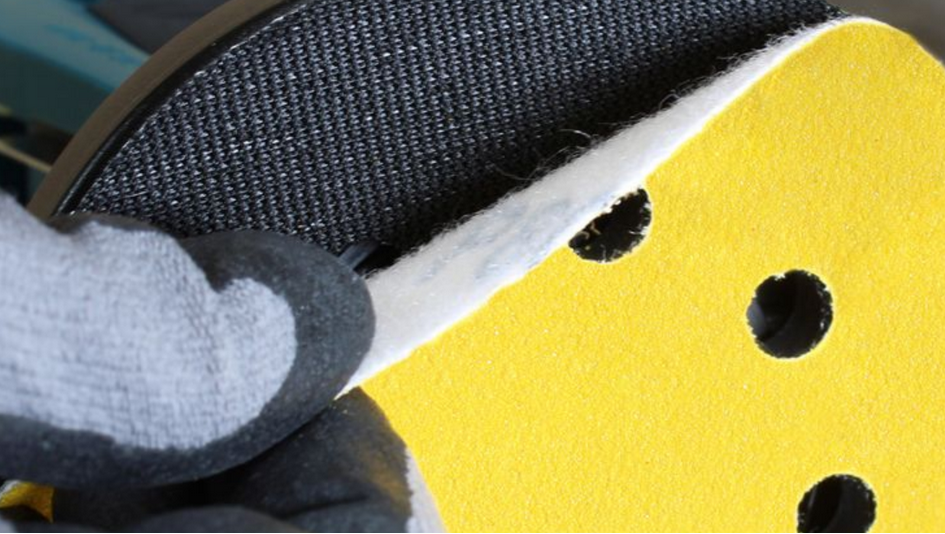
Every operator has experienced it:
A sanding disc starts smooth and stable…
then gradually begins curling at the edge, tearing under pressure, or leaving inconsistent scratch patterns.
In many cases, the abrasive grain is still sharp.
What failed first was the backing system.
In surface finishing, the abrasive gets most of the attention.
But the backing determines whether a sanding disc remains stable, predictable, and controllable throughout the sanding process.
Because even the best grain cannot perform consistently on an unstable foundation.
1. The Material Hierarchy: Film, Latex Paper, and Vulcanized Fiber
Different sanding applications demand completely different substrate behaviors.
• Film Backing — Dimensional Stability & Precision Finishing
Traditional paper backings are naturally hygroscopic. As humidity and temperature fluctuate, microscopic expansion and contraction can destabilize the sanding surface geometry.
Film substrates exhibit significantly lower hygroscopic expansion, allowing the disc to maintain planar uniformity even during long sanding cycles and changing environmental conditions.
→ Result: more uniform scratch patterns, reduced “orange peel” risk, and higher finishing consistency in automotive refinishing and precision surface preparation.
• Latex Paper — Controlled Flexibility & Elastic Recovery
Premium latex-impregnated paper is engineered not only for flexibility, but for elastic recovery — the ability to return to its original geometry after repeated deformation cycles.
This becomes critical during contour sanding, where the backing continuously flexes across curves, body lines, and irregular surfaces.
Low-grade paper gradually loses structural memory under cyclic stress, leading to edge cracking and unstable sanding behavior.
→ Result: smoother contour tracking, reduced edge fatigue, and more controlled finishing performance.
• Vulcanized Fiber — Thermal Stability Under Load
In aggressive grinding applications, the backing is exposed to sustained pressure, friction, and localized heat buildup.
Low-grade fiber substrates begin to soften as surface temperatures rise, causing backing drift, uneven pressure distribution, and edge instability.
High-density vulcanized fiber maintains rigidity and structural integrity even under elevated grinding temperatures.
→ Result: more stable stock removal, improved edge retention, and longer usable life during heavy-duty metalworking.
2. The Real Cause of Edge Curling and Premature Tearing
Most sanding discs are discarded while the abrasive is still usable.
The backing fails first.
In many cases, edge failure is not caused by a single overload event — it is the result of cyclic stress fatigue.
During orbital sanding, the backing undergoes thousands of continuous micro-flexing cycles per minute. Over time, weak substrate structures begin to fracture internally, leading to:
• Edge curling
• Premature tearing
• Geometry distortion
• Inconsistent scratch patterns
As the backing loses stability, sanding pressure becomes uneven across the contact surface.
→ The result: localized heat buildup, gouging, and reduced surface consistency.
A professional backing system must maintain geometry even under:
• High edge pressure
• Sharp corners
• Continuous thermal cycling
• High-speed orbital movement
When the backing remains stable, the sanding pattern remains controlled.
3. Engineering the Balance: Flexibility vs. Stability
Designing a professional sanding disc is a constant balancing act between competing mechanical properties.
Too soft → loss of edge control
Too rigid → poor contour adaptability
Too weak → tearing under pressure
Too heat-sensitive → warping during sanding
The challenge is achieving controlled flexibility without sacrificing structural stability.
Excessive backing compliance causes uneven pressure distribution across the sanding interface, leading to inconsistent scratch geometry and localized friction hotspots.
This is why professional-grade backing systems are engineered around four critical performance pillars:
• Flexibility
• Edge retention
• Tear resistance
• Thermal stability
The balance between these properties is what separates a sanding disc that merely “works” from one that feels stable and predictable from the first pass to the last.
The VEXA Standard
A premium abrasive is not defined by aggressiveness alone.
The best sanding discs maintain control, stability, and finishing consistency throughout the entire sanding cycle — not just during the first few minutes.
Because in professional surface finishing, consistency begins beneath the grain.
Next in the Series:
Anti-Loading Technology — Why Some Sanding Discs Stop Cutting Long Before the Grain Wears Out.


