

Why Some Sanding Discs Stop Cutting Long Before the Grain Wears Out.
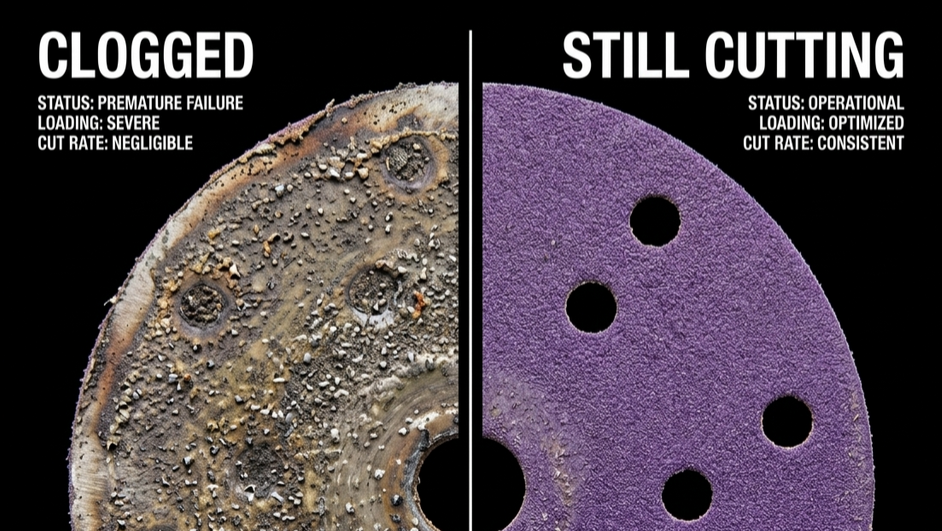
Most sanding discs do not stop cutting because the abrasive grain is worn out.
They stop cutting because the surface becomes loaded.
As sanding debris accumulates between abrasive grains, the disc gradually transitions from cutting to rubbing. Friction rises, surface temperature increases, and cutting efficiency collapses — even though the abrasive itself may still be sharp.
In high-volume sanding environments, loading is one of the primary causes of:
• Excessive heat buildup
• Inconsistent scratch patterns
• Paint scorching
• Premature disc replacement
• Reduced process stability
The challenge is not simply making a disc “aggressive.”
It is maintaining a stable cutting interface throughout the entire sanding cycle.
1. The Chemistry of Anti-Loading: Why Stearate Matters
Modern anti-clogging systems are not just surface coatings — they function as microscopic dry-lubrication layers at the sanding interface.
In professional sanding applications, zinc stearate top-coats help reduce adhesion tendency between sanding debris (swarf) and the abrasive surface, minimizing material buildup under elevated friction temperatures.
Without effective anti-loading chemistry, softened paint residue, filler particles, or metal dust begin compacting between active cutting points.
Once this occurs, the abrasive transitions from shearing material to rubbing against it.
→ Friction increases
→ Surface heat rises
→ Resin begins softening
→ Additional debris adheres even faster
This creates a thermal loading cycle that rapidly destabilizes sanding performance.
A properly engineered anti-loading layer helps maintain grain exposure, chip evacuation efficiency, and active cutting life throughout extended sanding cycles.
2. Open Coat Geometry: Engineering Chip Evacuation
Anti-loading performance is not determined by chemistry alone.
It is also a matter of abrasive geometry.
For softer materials such as automotive fillers, paint systems, aluminum, and wood, open coat structures improve chip evacuation efficiency by reducing particle congestion between abrasive grains.
Instead of densely packing the surface with abrasive particles, open coat configurations intentionally create evacuation channels that allow sanding debris to escape before compacting at the interface.
The result is:
• Reduced loading tendency
• Lower friction accumulation
• Cooler sanding temperatures
• More consistent surface finishing
By contrast, overloaded sanding surfaces generate unstable pressure zones and localized thermal hotspots, which directly affect scratch uniformity and operator control.
3. Friction & Heat Management: The “Cool Cut” Effect
Heat is often the first visible symptom of a loaded sanding system.
As debris accumulates, cutting efficiency decreases and friction energy rises sharply. Instead of cleanly shearing material, the abrasive begins dragging across the surface.
This transition from cutting to rubbing dramatically increases localized interface temperatures.
In automotive refinishing, this often leads to:
• Paint softening
• Surface smearing
• Uneven sanding patterns
• Premature resin degradation
In metalworking applications, excessive thermal buildup can contribute to discoloration, surface glazing, and unstable finishing behavior.
Professional anti-loading systems are ultimately designed as thermal management systems.
By controlling friction generation at the abrasive interface, the sanding process remains cooler, more stable, and more predictable under continuous operation.
Process Stability Is the Real Performance Metric
A premium sanding disc is not defined by initial aggressiveness alone.
The true measure of abrasive performance is how consistently the disc maintains cutting efficiency, temperature stability, and surface quality throughout its usable life.
Because in professional sanding, process consistency depends on maintaining a stable interface between the grain, the debris, and the workpiece.
Next in the Series:
Scratch Pattern Engineering — Why Different Sanding Discs Leave Different Surface Finishes.


