

Punched In at the Die: Why a Flat Disc Shakes at Speed
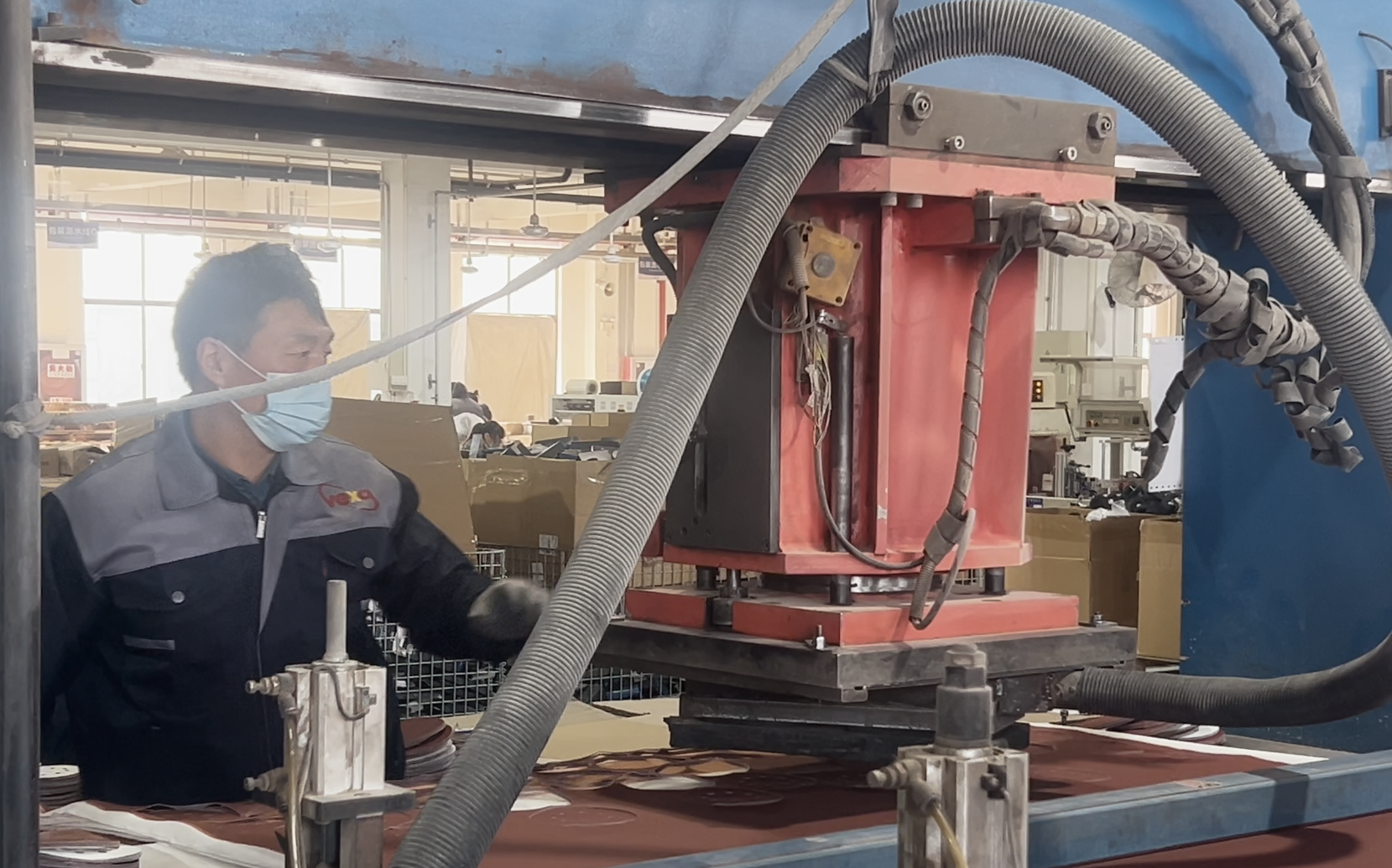
Lay a backing disc on a surface plate. It sits flat. Push the edge with a finger and it does not rock.
That is the check most people run. It also cannot see the defect that decides whether the disc runs smooth or shakes the tool in your hand. A coated disc is a punched part before it is an abrasive. The tolerance that matters is not flatness — it is how far the mass sits from the axis you bolt it to.
A tenth of a millimetre is worth nothing on a bench
Take a disc whose centre of mass sits 0.1 mm from its mounting hole. That figure is an illustration, not something I am reading off a drawing. The arithmetic is the point.
The unbalanced acceleration at an offset e is:
a = e · ω²
ω is angular velocity in radians per second. 12,000 rpm is 200 revolutions per second, so ω = 2π × 200 = 1,256.6 rad/s. Square it and multiply by 0.0001 m:
a = 0.0001 × 1,256.6² ≈ 158 m/s²
That is about 16 times the acceleration of gravity, produced by an offset you cannot see at arm's length.
Then the part that catches people out. Force is mass times acceleration, and acceleration goes with the square of speed. Double the speed and you do not double the vibration — you quadruple it. One and the same disc can feel calm on a slow tool and violent on a fast one. Nothing about the disc changed. The square changed.
Real discs are not rigid bodies on a rigid spindle. The backing pad damps some of it, the tool's own mass absorbs some more. None of that removes the scaling law. It only decides the speed at which the law starts to hurt.
Where the offset comes from
A coated disc is not turned on a lathe. It is punched.
One stroke of a die set cuts the outer circle, and on a dust-extraction disc the same stroke cuts the hole pattern through the same sheet — eight or fifteen holes, depending on diameter and range. The velour backing and the adhesive film come from a lamination sitting in the same stack. Three features, one hit.
They stay concentric only while two conditions hold: the die is aligned, and the sheet does not move between cycles. Both drift with use. Punch-to-die clearance grows as the die wears. Sheet creep, a register that is a fraction out, or a stack that shifts under the ram will move one cut relative to the other.
The result is a disc that measures correctly at the rim and carries its mass somewhere else. Diameter check: pass. Flatness check: pass. On the tool, at speed: fail.
There is a quieter second source. A coated abrasive sheet is not a homogeneous material. Grain distribution across the width is close to even, not perfectly even, and the backing lamination has its own thickness variation. A die that is geometrically perfect can still release a disc whose density is very slightly biased to one side. At rest that bias is worth nothing. At 12,000 rpm it is the same 16 g as above.
Why the bench cannot see any of this
Eccentricity is measured to the mounting hole, not to the table.
Set a disc on a flat surface and you have tested the relationship between the rim and gravity. What causes vibration is the relationship between the rim and the bore. Two different questions. Only the second one fails here.
And at rest, 0.1 mm is below what the eye resolves at arm's length. So the honest checks are a concentricity measurement between the hole pattern and the outer edge, or the disc mounted and spun. Neither of those is a flatness test — which is why a batch that passes incoming inspection can still generate complaints.
The speed is not yours to choose freely
Angular velocity is set by the tool. Rim speed is set by the tool and the disc diameter together, and the rim is what a rated maximum applies to.
VEXA's declared standard ceiling is 80 m/s. On a 125 mm disc that corresponds to roughly 12,200 rpm — and the no-load speed of a 115–125 mm angle grinder sits in the 11,000–13,000 rpm band. Run a 5-inch disc at 12,000 rpm and the rim travels at about 78.5 m/s. The tool class lives right at the ceiling.
Go up in diameter and the ceiling arrives sooner. The same 80 m/s on a 150 mm disc is reached at about 10,200 rpm. That is why the 6-inch disc belongs on a slower tool, not on the same grinder at the same setting.
Two things follow. First, there is no headroom at the rated speed for an offset to be absorbed — the disc runs at or near its limit by design. Second, force is mass times acceleration, and at the same eccentricity and the same speed a larger disc carries more unbalanced force simply because it carries more mass. Compare the 125 mm and 150 mm patterns in the same construction and the area ratio is 1.2², so the unbalanced force runs roughly 1.4 times higher on the larger disc before you change anything else.
What a process can actually control
This is where the punching method shows up, and it is not about holding a tighter number.
A hydraulic press gives a fixed stroke and a repeatable force. Punch-to-die clearance is set once and held; the sheet is registered the same way every cycle. The value of that is not a tight nominal. It is a stable one. A repeatable offset can be designed around — you know its size and its direction. Scatter cannot, because you never know which way it went today.
These discs are made in-house and punched on a hydraulic die-cutting press, with a manual check at the end of the line. That check is not there to re-verify grain; grain is specified on paper and settled at the coating stage. It is there for the failure modes a die can drift into without announcing itself — a hole pattern sitting off-centre, an edge that has torn instead of sheared, a backing bond that did not take. Those belong to the punching process, and only the punching process can catch them.
Why this belongs in a purchasing conversation
Grain specification is what every quotation quotes: 60 through 500 grit, alumina, backing type. Punching tolerance is what almost no quotation mentions, and it is the variable that decides whether the customer comes back with a vibration complaint or a repeat order.
Two discs can carry an identical grain specification and sit in an identical price band and still behave differently on the same tool. When someone reports vibration, the first suspects are the tool and the operator. The die is a third candidate, and it is the one that was set months ago, in a press, before anyone saw the disc.
A coated disc is a punched part before it is an abrasive. Judge it as a punched part.


