

One Layer, No Renewal: The Engineering of a Cut-and-Grind Diamond Disc
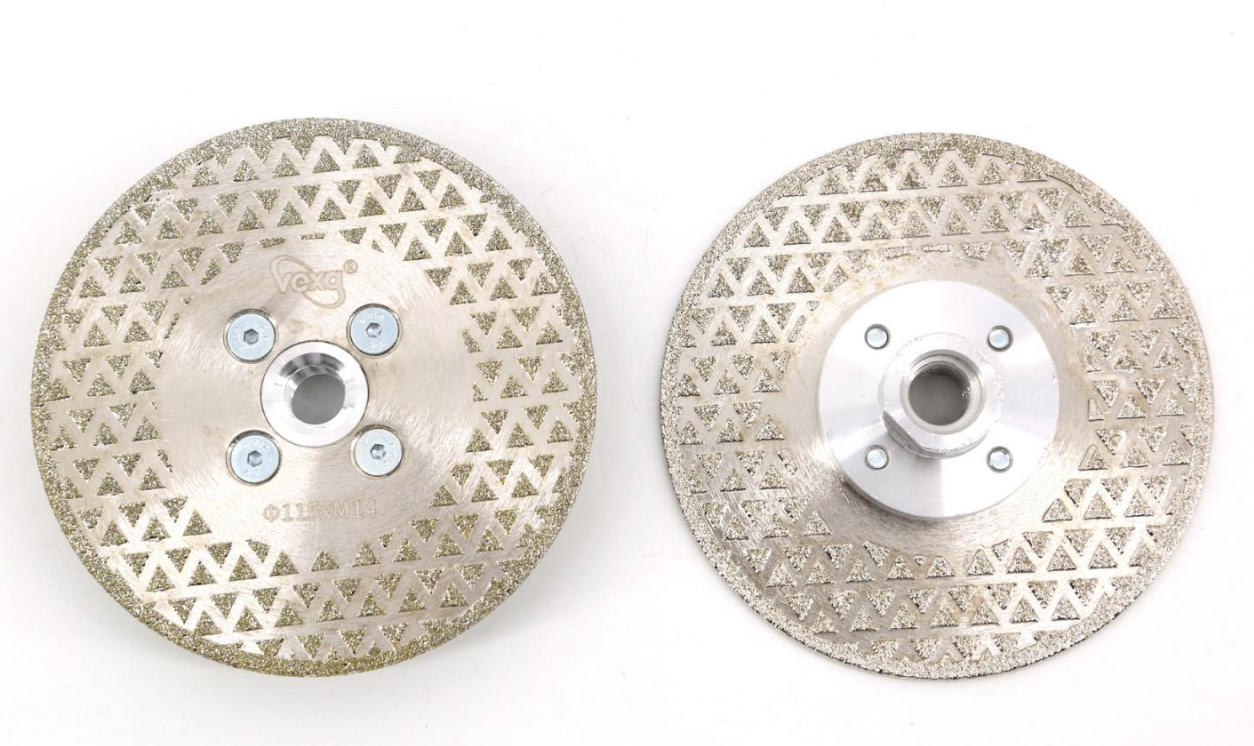
Two diamond tools stop cutting. It reads as the same complaint. It is not.
The first is a sintered blade that has glazed. The diamonds are still there, dulled and locked in place, and the bond that should have worn back has stopped wearing. The blade is not worn out. It is stuck. Dress it against something soft and abrasive and the next row comes up. The tool goes back to work.
The second is an electroplated tool. There is no second row. A single layer of diamond is held in a plated metal deposit on a steel body, and when that layer is gone the tool is gone. There is nothing to dress, because dressing assumes there is something underneath to expose. There is not.
That difference is not a quality gap. It is a design difference, and it decides what each tool is good at.
The difference is a reservoir
Sintered means diamond dispersed through a metal powder matrix, pressed and sintered into a solid body. The matrix is sacrificial by design: it wears back at a controlled rate, and each increment of wear exposes fresh diamond. The tool renews itself, and its entire operating logic depends on that renewal happening.
Electroplated means one layer of diamond, fixed in a plated deposit on the steel. There is no matrix behind the diamond, no reservoir, no next row. The diamond you can see is the entire inventory of that tool.
So the two failure modes are not comparable. A sintered tool fails when the renewal mechanism stops — glazing. An electroplated tool fails when the layer that anchors the diamond is worn through and the diamond is released. One is a mechanism that has stalled. The other is material that is no longer there.
Why that matters for a tool that does two jobs
Most diamond tools are arranged around one contact geometry. On a sintered blade everything points at the rim: bond hardness is matched to the material, the rim profile is chosen for swarf and heat, and the self-sharpening cycle is tuned to one way of engaging the work.
Use that blade off-design and you do not simply get a worse result. You take the cycle out of its window. Grind with the face of a blade meant to cut with its rim and the bond no longer wears back at the rate the design assumed. The diamonds dull, the bond stops retreating, and you get glazing — the exact failure the tool was built to avoid, produced by using it differently rather than harder.
An electroplated disc does not carry that constraint, and the reason is structural rather than positional. There is no wear-back cycle to preserve, so there is no cycle to take out of its operating window. The diamond is fixed, not suspended in something that is supposed to recede. Present the same disc as a cutting edge or as a grinding face and nothing about the tool's own mechanism is invalidated.
That is the engineering content behind a cut-and-grind disc. It is not two tools joined together. It is one tool whose working principle does not depend on a wear behaviour — which is precisely what allows it to be used two ways.
The price you pay for it
Renewal is not free, and neither is its absence.
On an electroplated tool, life and geometry are the same quantity. As the plated layer recedes, the tool changes shape, gradually and without announcing it. There is no moment when the tool tells you it is finished; the profile simply arrives somewhere you did not specify. On a tool whose value is its form, that is the thing to watch, and no dressing schedule brings it back.
So the exchange is explicit. A sintered tool trades shape for renewal: it stays in the cut longer because it is allowed to change. An electroplated tool trades renewal for a fixed geometry: it holds the form you specified, and it holds it for a definite, finite amount of work.
Neither is the better trade. They answer different questions.
The mount is part of the tool
An M14 direct mount puts the disc straight onto the spindle thread. No backing pad. No separate flange plate. No nut.
On a flexible coated disc the backing pad is doing real work: it is a spring, and the spring is what lets the abrasive conform to a curved surface. Take the pad away and the disc stops doing its job.
On a rigid diamond tool the same interface has the opposite role. Every layer between the diamond and the spindle is a place where an offset can live. A pad that compresses unevenly under load, a flange that does not seat squarely, a nut that backs off — each one moves the working face away from the axis. On a tool whose body is steel and whose diamond is a single fixed layer, runout is not absorbed anywhere. It is passed straight into the work.
There is a second reason the mount matters on a disc that is used two ways. Change how you present a tool — edge, or face — and you change the loads on everything holding it. Anything in that stack that can shift will shift, and it will shift first, because it is the compliant part. Removing the stack is how you stop the question being asked.
What the operator actually controls
On a sintered tool the operator's main variable is pressure, and the tool gives clear feedback: push too far and the cycle stalls, and the surface goes shiny.
On an electroplated tool the feedback is less generous. There is no bond to manage, so pressure goes straight into the layer. Over-pressure does not glaze the tool, it strips it — and it strips locally, at whichever part of the contact is doing the most work. The tool does not fail evenly. It fails where you leaned on it.
Heat is the other variable, and it is the one that shortens life. The plated layer is what anchors each diamond. Under enough heat and load the anchor fails before the diamond does, and once a diamond is released the layer underneath does not replace it. On a tool with no reservoir, heat is not a surface-quality problem. It is a consumption problem.
That is why coolant decisions carry more weight on a single-layer tool than the layer's thickness would suggest. You are not protecting the diamond. You are protecting the thing holding it.
How to choose
Two questions do the work.
First: does the job need the tool to renew? If you are removing stock and the geometry is simple, renewal is the whole point. A cutting tool is supposed to lose itself into the cut. Sintered belongs there.
Second: does the job need the tool to hold a form, or to reach somewhere a flat disc cannot go? If the answer is yes, renewal becomes a liability, because a tool that keeps changing shape cannot hold a specification. Electroplated belongs there.
A cut-and-grind diamond disc — 115 mm, direct on an M14 flange — sits in the second category, and its double function follows from that category rather than being bolted onto it. It is not a blade that also grinds. It is a tool that does not depend on wearing, and that is what makes both modes possible on one body.
Judge it on that, not on how long it lasts against a sintered tool. That comparison has no meaning, because they are not two answers to the same question.


