

Brazing Takes the Diamond Out of the Argument
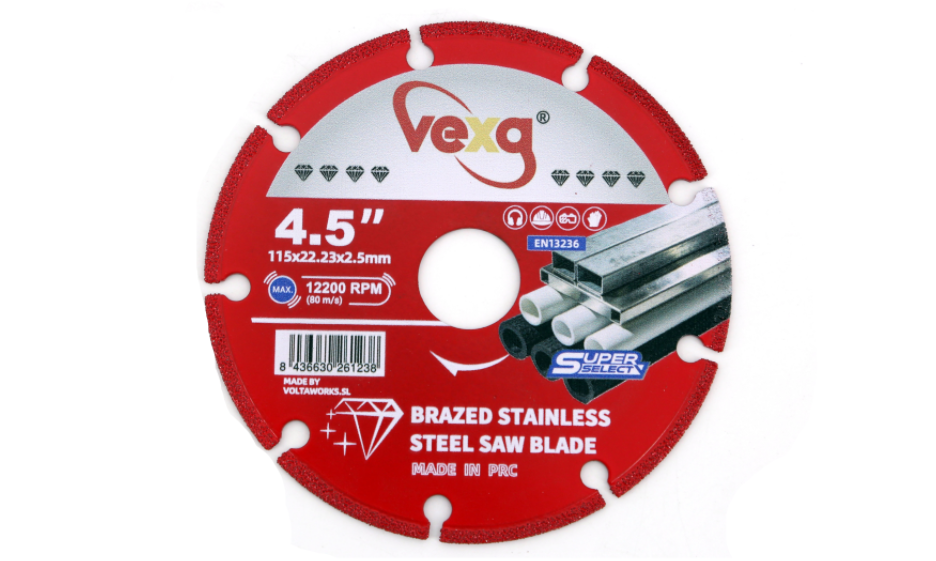
Five blades in this range are the same disc. One bonding technology, five different bodies — because brazing removes the abrasive from the list of things that can fail first.
Five blades in this part of the range share a body: 115 mm across, 22.23 mm bore, one hundred to the carton in the same 32 × 19.5 × 27.5 cm box.
One of them cuts glass. One cuts sintered slab. One cuts corrugated steel sheet. One cuts stainless. One cuts wood.
They share a bonding technology and very little else. Carton weights run from 10.5 kg to 13.1 kg — a spread of nearly a quarter across five blades of identical diameter, identical bore and identical pack count. These are not one blade sold five ways. They are five tools that happen to start from the same disc.
What makes that possible, and what makes the choice between them so easy to get wrong, both come from one property of how the diamond is held.
Two ways to hold a diamond, and they are not alike
Brazed and electroplated blades both carry a single layer of diamond on a steel core. Neither renews: there is no matrix to wear back and no second row behind the first. Treat that as the whole comparison and the two look like variations on one idea.
They are not, and the difference is what holds the grain.
An electroplated layer holds diamond mechanically. A metal deposit is grown around the grain and grips it. The grip is the deposit — so the deposit has to be there, around the grain and up its sides, covering enough of it to keep it in place under load.
A braze holds diamond chemically. The filler alloy wets both the diamond surface and the steel, and on cooling it forms a metallurgical joint to each. The grain is not clamped by something built up around it. It is attached.
The payoff is protrusion
Because nothing has to be grown around the grain to hold it, a brazed diamond can stand much further proud of the bond line than a plated one. More of each diamond is out in the cut.
That single change does three things at once.
There is more space in front of the grain, so the cut runs freer and needs less force for the same depth. There is more space around it, so swarf has somewhere to go instead of packing between the diamonds and glazing the cut over. And because each grain does more work with less of itself buried, the layer can be sparser — a brazed rim is often scattered single grit rather than a dense coating, and it cuts as well or better.
Which is why the limit moves off the diamond
This is the part that decides how the blade is built, and it is the part buyers skip.
Once the diamond is chemically held and standing well exposed, it stops being the weakest thing in the system. Barring mechanical loss, that grain will go on cutting. So "how much diamond is in it" loses most of its force as a question. What sets performance now is everything around the diamond.
The braze is the first of them. A braze is a joint, and a joint has a working temperature. Push the interface past it and the filler softens and the grain is gone — not worn out, released. So on a brazed blade the ceiling is usually a temperature at the diamond-to-steel interface, not the hardness of the diamond.
The core is the second. Because the abrasive no longer depends on the body to hold it, the body can be made for the job instead of for the load. Core stiffness and kerf width stop being defaults and become design decisions.
The swarf path is the third. High protrusion gives the cut more room, but a material that makes long chips, or work-hardens under the edge, will still need the rim opened up.
Three constraints — and every material loads them differently. That is where five bodies come from.
Five materials, five constraints that bind
Glass. Brittle, chipping-prone, and unforgiving of force. What it needs is a fine, low-force edge that does not spall the surface: the blade has to cut rather than push.
Sintered slab. Dense, thick, high in quartz, and it has to be cut in one pass without the blade wandering. What it needs is a cutting face wide enough to hold a line through the depth — which is why the widened body exists, and why it carries the heaviest carton in the group.
Corrugated steel sheet. Thin, profiled, and an interrupted cut from the first millimetre. Every rib is an entry and an exit, and the blade is asked to start a cut on a surface that is not flat. What it needs is a toothed edge that bites in thin material instead of skating across it.
Stainless and iron. Gummy, and it work-hardens under the edge. What it needs is clearance: an open rim that gets the chip out before the next tooth arrives. A packed rim on stainless does not cut. It rubs, and it hardens the surface it failed to cut.
Wood. Long stringy chips, and abrasive contamination in the material itself. What it needs is an edge that severs rather than abrades, on a body that can clear a chip far longer than any metal produces.
Same bonding technology throughout. Different material, different constraint that binds, different body.
The axis buyers get wrong
Most blade comparisons start with how much diamond is on the rim. On a brazed blade that is close to the least useful number available. Brazing's whole contribution is that it takes the diamond out of the argument — so past the point where the layer is intact and well exposed, additional diamond buys very little, and performance is sitting in the core, the kerf, the rim geometry and the heat at the joint.
Pick by the material and the constraint it imposes, not by how densely the rim is loaded. On a sintered blade, bond hardness is a genuine selection variable. On a brazed one, it is not a variable at all.
Closing
Five blades, one disc, one bonding technology. What separates them is not how much abrasive is on them. It is which of the three remaining constraints each material makes binding — the interface temperature, the stiffness of the core, or the path the chip has to take. Get that right and the blade follows. Start from the diamond count and you are optimising the one component the brazing already took care of.


