

The 3-Inch Cup Brush: Where the Price Ladder Stops Making Sense
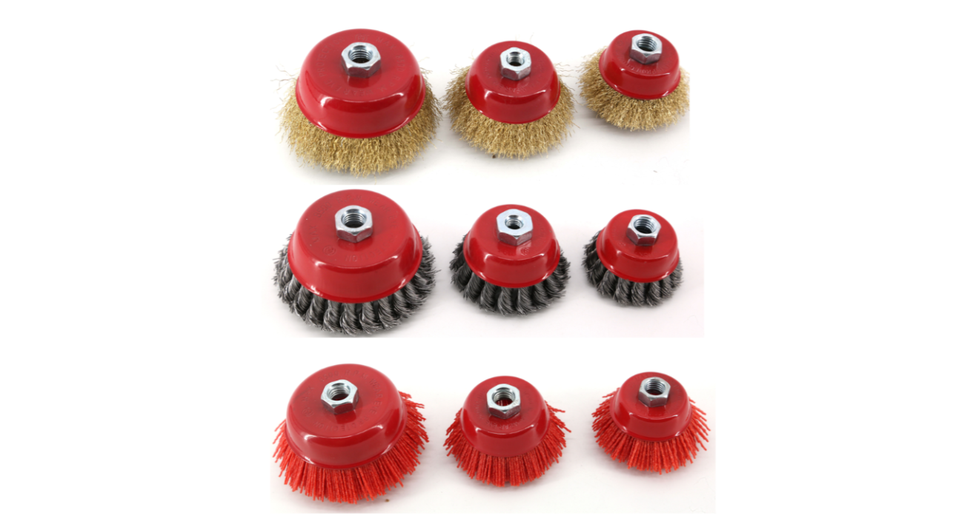
Nine cup brushes in the threaded range: three constructions, three diameters. Read down the price column and it looks like a ladder — small, medium, large, each one a step up from the one before.
It is not a ladder. It is a curve with a dip in the middle, and the dip sits in the same place in all three constructions. That is not a coincidence in the arithmetic. It is the arithmetic.
The thread changes the tool before it changes the price
A threaded cup brush does not mount like anything else in the range. There is no shank going into a collet, no flange, no nut at the end. The cup threads onto the arbor and stays there, and everything downstream follows from that one decision.
It turns about the arbor thread rather than about a three-jaw chuck, so the brush spins on the axis the machine was built around instead of the axis the chuck happened to close on. It comes off in seconds, which matters more than it sounds when the alternative is a changeover mid-run. And it puts the load into a hub rather than into a six-millimetre pin.
The hub is what you are paying for. In our range, the nearest threaded cup to a shanked cup of the same wire comes out at about 69% more, at essentially the same diameter. The two are not the same tool — a shanked cup goes in a drill or a die grinder, a threaded one on an angle grinder spindle — so read that number as what the mount costs, not as which brush to buy.
Then push the comparison to nylon and the gap collapses to about 13% — roughly a fifth of the premium, on the same thread, the same hub geometry. So the premium is not "threaded costs more". It is what a hub has to do when there are wire tufts in it: carry impact without letting the tufts walk.
That last sentence is my reading of the two numbers, not something the price list says. What the price list says is 69% and 13%, and the two do not agree with each other.
Crimped, knotted and nylon are three stiffnesses, not three grades
The three constructions are not a quality ladder with the cheapest at the bottom. They are three different tools that happen to share an arbor. Two of them are wire cup brushes. The third is not wire at all, and that is where most of the confusion starts.
Crimped wire — the wavy filament — is compliant. Under load the tufts bend and recover, the brush follows a contour instead of fighting it, and the cut is broad and shallow. It is the one that strips a weld without gouging the plate beside it.
Knotted wire is the opposite arrangement: tight twisted tufts, very little give. It does not follow anything. It hits, and that is the point — mill scale, slag, heavy rust, concrete, the things that only come off with impact.
Nylon is a different material wearing the same shape. Abrasive grain is loaded into the filaments, so it cuts without wires, which means no scratch pattern from wire tracks, no filament breakage, no stray bristle left in a bearing. It is what you reach for when the surface has to be deburred and still be a surface afterwards.
Pick by price and you have picked by stiffness, because that is the order the price column is in. Crimped is cheapest at every diameter. Knotted runs 8% to 26% above it. Nylon runs 83% to 115% above it. The order holds at 2.5 inch, at 3 inch and at 3.5 inch — which makes it a cost structure rather than a quotation quirk.
The mistake is buying knotted because it is "stronger" when the job needs the brush to follow a radius. A stiff brush on a curved surface touches on one edge, and that one edge does the whole job until it is gone.
Face area grows as the square. The price does not.
Here is where the ladder breaks.
A cup brush is a disc of working face, and face area scales with the square of the diameter. Price does not.
Going from 2.5 inch to 3 inch adds 44% more face. Going from 3 inch to 3.5 inch adds 36% — the second step is the smaller one.
Now the price. At the first step the three constructions ask 12.5%, 13.3% and 31.8% more. At the second step they ask 77.8%, 52.9% and 63.8% more.
Read those two lines together. The smaller increase in area carries the larger increase in price, in all three constructions, without exception.
Which is why the middle size wins
Convert price to price per unit of face and index everything to the 2.5 inch, and the shape of the range stops being arguable.
Crimped: 100 at 2.5 inch, 78 at 3 inch, 102 at 3.5 inch. Knotted: 100, 79, 88. Nylon: 100, 92, 110.
The 3 inch is the cheapest per unit of face in all three. Not marginally — the crimped 3 inch is 22% cheaper per unit of face than the 2.5 inch in the same construction, for 44% more brush.
And the 3.5 inch never wins. Measured against the 3 inch it costs 31% more per unit of face in crimped, 12% more in knotted and 20% more in nylon. The one place it rescues itself is knotted, where it comes in 12% cheaper per unit of face than the 2.5 inch — and still behind the 3 inch.
So at the top of the range you are buying 36% more face and paying 53% to 78% more for it.
The 3.5 inch still exists, and it is not a mistake to buy it
None of the above says the big one is bad. It says the big one is priced as a different animal, and there are jobs where that is exactly what you need: a large flat area where the extra face halves the number of passes, or a reach where the extra diameter is what gets the brush over the obstruction.
A larger cup is also a stiffer cup at the rim, which changes how it behaves on a deep weld toe — it digs rather than conforms. If that is what the job wants, the premium is the price of the tool doing it.
What the price list will not tell you is whether you wanted it. That part is the job.
How to buy it
Decide in this order, not in the order the catalogue is printed in.
First the stiffness, because that is set by what the surface has to end up as — crimped to follow, knotted to break, nylon to finish without wire marks. Getting this wrong is not a price problem, it is a rework problem.
Then the diameter, by the face area you actually need rather than by what the machine can spin.
Then check the step you just took. At 2.5 to 3 inch, the area grows faster than the price. At 3 to 3.5 inch, the price grows faster than the area. Same catalogue, opposite economics, one line apart.
And check the arbor thread on the machine before you order, not after. A threaded cup cannot be adapted to a thread it does not fit — that is the one advantage it gives up in exchange for everything above.
Closing
Nine numbers in a column look like a ladder because columns look like ladders. This one is a curve, and the curve says something the numbers do not: the middle brush is the one to standardise on. The two ends are for jobs that genuinely need them, not for jobs that are simply a bit bigger than the last one.


