

Sixteen Holes, Not Eleven: How Disc Extraction Is Sized
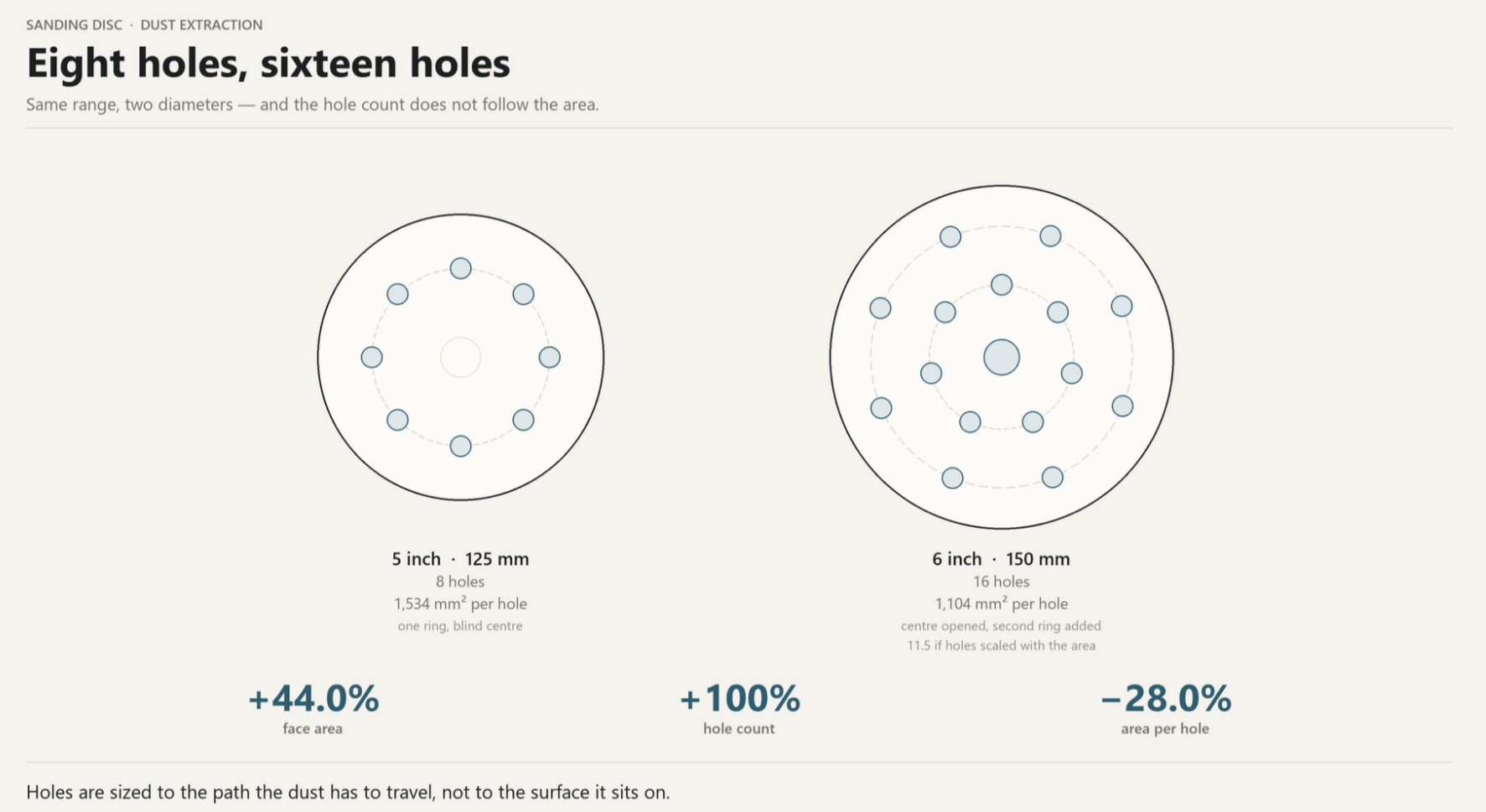
A 5-inch sanding disc carries 8 holes. A 6-inch carries 16.
If the holes followed the area, the 6-inch should have 11 or 12. It has 16. The face grew by 44 percent; the hole count doubled. That gap is the subject of this note. Extraction is not sized to the surface. It is sized to the distance the dust has to travel.
The arithmetic first
5 inch is 125 mm across, which is 12,272 square millimetres of face. 6 inch is 150 mm, or 17,672 square millimetres. Forty-four percent more area.
Eight holes against sixteen is exactly double.
Divide one by the other and the direction is unambiguous. On the small disc each hole serves 1,534 square millimetres. On the large disc each hole serves 1,104. The bigger disc is served more densely, not less. If you have been assuming the hole count is a fixed ratio to the face, that is exactly where the assumption breaks.
The count is only half of what changed. The 16-hole pattern is not the 8-hole pattern with eight more holes on the same circle. It opens the centre and adds a second ring, so the pattern stops being one pitch circle and becomes a field of openings. That is a different extraction design, not a scaled version of the same one — and it is the clearest evidence that nobody sizes these holes by area.
Why distance and not area
Dust does not migrate by area. It migrates by path.
Dust does not sit where it is made. On a rotating disc it is thrown outward, so the band beyond the last ring of holes collects swarf with no opening above it. Whatever does not migrate stays where the airflow is weakest — and on a single-ring pattern that is the blind centre.
Both ends are poorly served, for opposite reasons. The rim is fast and past the last hole. The centre is slow but has the longest way to go to reach any opening. That is precisely the geometry the 16-hole pattern answers: open the centre, add an outer ring.
So the diagnostic is symmetrical. Loading in a ring near the rim, or a centre that blinds while the middle stays clean, both say the same thing. The pattern does not reach where the dust is.
There is a second effect that matters more than most operators expect. Coarse grit produces more swarf per second, so the extraction has to move volume. Fine grit produces finer dust, which packs tighter and clogs the coating. At the coarse end the failure is "dust not leaving". At the fine end it is "dust embedded". Same hole, different job.
The pattern has to line up with the pad
The most common dust extraction failure is not the disc. It is a disc whose holes do not sit over the pad's holes.
When an 8-hole disc goes on a 16-hole pad, the two patterns do not add. They intersect. Air moves only where the holes coincide, and everywhere else the disc is sealing the pad. The result is not half extraction evenly distributed, it is patchy extraction with dead zones, and the dead zones load first.
This is why hole pattern belongs in the specification next to grit. Two sanding discs of the same grit, same backing, same diameter, with different hole layouts, are not interchangeable on the same tool. One of them is extracting, the other is mostly sealing.
The backing decides what happens before the hole
Under the coating, the backing sets the path the dust can take.
Hook and loop. The pile is not solid. Air can move a little laterally through it, and the loops compress under pressure so the disc conforms to the pad. That lateral path is small, but it is real, and it is why a hook-and-loop disc is more forgiving on a poorly matched pad than an adhesive one.
PSA. Full-face adhesive, no lateral path at all. Whatever the holes do not remove stays under the disc, and heat has nowhere to go either. It is the flattest and most dimensionally honest option, and the least forgiving of weak extraction.
Film, 775K. Thin, dimensionally stable, and the hole edges hold their shape better than on a softer backing, which matters when discs are changed hot and often. But film is smooth and non-porous: like PSA, no lateral path.
Mesh. There is no backing. The entire face is the hole. That is why the mesh range does not carry a hole count at all: the number would be meaningless. The structure is open by construction, and the dust path is through the sheet rather than to a set of openings in it.
That last point is the reason the mesh line exists as a separate product and not as an option. You cannot drill your way to an open structure. You have to remove the layer that was blocking it.
Reading the failure
Five signatures, five different causes:
Loading in a ring near the rim. Path too long for the hole count, or the pattern is misaligned at the outside radius where speed is highest.
Loading in patches that line up with the pad holes. Pattern mismatch. The sealed sectors load, the open sectors stay clean.
Burnishing with almost no dust in the extraction. Adhesive backing on a weak extractor: the swarf is being polished back into the surface instead of removed.
Edge fraying on film. Mechanical, not chemical. The edge is unsupported and the disc is being tilted. Film has high dimensional stability and low tear resistance; that is the trade it makes.
Mesh catching on edges and corners. The open structure has no continuous edge to run against a corner. It is a flat-surface tool, not an edge tool.
What to write down when you specify
Hole count is not a spec-sheet decoration and it is not a quality ranking. It is the extraction design, and it only works when disc, pad and tool agree.
So specify the pattern with the disc: how many holes, where they sit, and which pad it goes on. Those three travel together. Separating them is how a good disc gets blamed for a bad air path.
One more thing worth saying plainly. Suction is a system property, not a disc property. The disc opens the path, the pad must not close it, and the shroud and extractor have to be able to move the volume the grit is producing. Change any one of the four and the disc that worked last month stops working, with no change to the disc at all.


