

The Longer Bit Reaches Less Deep — Diamond Drill Bit Mounts
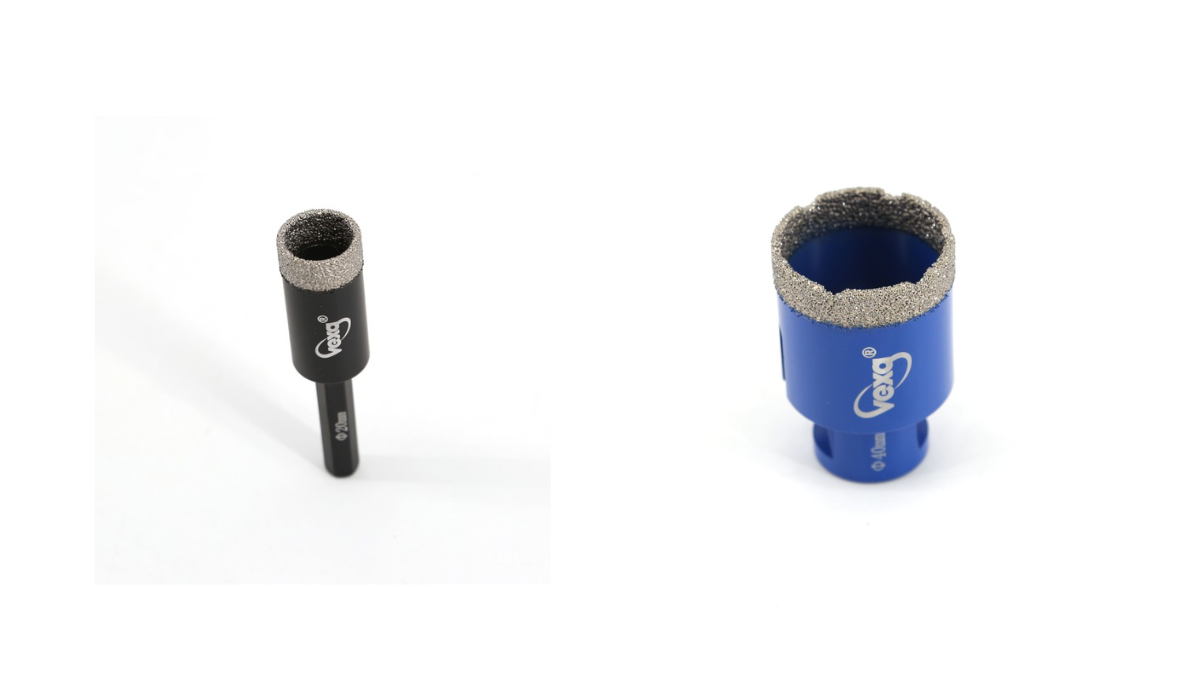
Two ladders sit in the same product family, and between them they list forty-one sizes. Every one of the forty-one carries the same 10 mm diamond height. Same braze, same single layer, same segment. Only the mount differs.
The quarter-inch hex shank runs ten sizes: 5, 6, 8, 10, 12, 14, 18, 20, 22 and 25 mm.
The M14 thread runs thirty-one: 5, 6, 8, 10, 12, 14, 15, 16, 18, 20, 25, 30, 35, 38, 40, 43, 45, 50, 55, 60, 65, 68, 70, 75, 80, 85, 90, 100, 110, 115 and 120 mm.
Read those two lines again. Both start at 5. Both reach 25. Above 25 the hex disappears and the thread keeps going for another twenty sizes. And the hex ladder is not a subset of the other one: it has no 15 and no 16, but it does have a 22 that the thread ladder does not.
So the tidy story is wrong. The mount does not decide the diameter. Up to 25 mm both mounts cover the same ground. What the mount decides is length. And it decides it the opposite way round from what most people assume.
At equal diameter the hex bit is the longer one. At 5 and 6 mm it is 67 mm against 62. From 8 to 18 mm it is 80 against 62. At 20 and 25 mm it is 80 against 60.
That is 18 to 20 mm of extra overall length, close to a third more, on a bit of identical diameter and identical diamond depth.
And the hex bit still reaches less deep. Both things are true, and the reason is where the length is spent.
A hex shank is not a connector. It is a grip. Six flats have to be swallowed by the chuck before the tool can drive anything, and the chuck itself is a bulky body sitting between the machine and the work. The bit has to be long enough for its rim to clear that body. Every millimetre of shank inside the jaws is a millimetre that never enters the hole.
A thread is a face. The flange seats on the spindle nose and only a shallow length is engaged, so nearly all of the 60 mm sits outside the machine and is available to the work.
Set them side by side at 25 mm: 80 mm of hex against 60 mm of thread. The hex bit is 20 mm longer, and depending on the chuck it is not 20 mm deeper. It may be shallower.
This is the mistake in comparing the two by overall length. Overall length is a catalogue number. Reach is what you drill with.
There are exactly two step changes in the length column, and they run in opposite directions.
The hex ladder steps up from 67 to 80 at 8 mm. Below that the rim is small enough that a compact chuck still clears the work. From 8 mm up the rim stands further out, so the body has to be longer to hold the chuck clear. That is clearance, not strength. Nothing about the shank got stronger at 8 mm.
The thread ladder steps down from 62 to 60 at 20 mm. Opposite instinct, and the correct one. As diameter grows, the same runout at the spindle sweeps a larger circle at the rim, and error at the rim is what chips a single layer of braze. Taking 2 mm out of the body is the cheapest way to remove some of that error. Two millimetres reads as nothing in a table. At the rim it is the difference between a bit that starts true and one that skips on entry.
So the thread ladder gets shorter exactly where the hex ladder gets longest. If you want the line where the two interfaces stop substituting for each other, it is not 20 mm or 25 mm. It is in the length column.
The hex ladder ends at 25 mm. Not at 20, as it is often assumed, but at 25. Above that the table stops and the thread carries twenty more sizes to 120 mm.
A quarter-inch hex is 6.35 mm across the flats. At 25 mm the bit is almost four times the width of the thing driving it, and the interface has not grown, because its size is fixed by the tool and not by the bit. Torque demand rises with diameter. The flats do not. Somewhere in the twenties the arithmetic stops being kind.
At the other end the table describes a different object. A 120 mm bit is 60 mm long, so its length is half its diameter. At that point it is not a bit, it is a ring with a thread on the back, run on a rig, wet, one pass, no levering. Set that against the 5 mm hex at 67 mm, where length is thirteen times diameter. Same product family, opposite geometry.
Three practical consequences.
Under 25 mm the mount is a reach and access decision, not a strength decision. Both will cut the hole. The hex comes out of the chuck in two seconds, and it will not go as deep for the same nominal length, because the shank is eating the difference. When there is a wall, a jig or a shallow cavity in the way, those 20 mm matter more than the changeover.
Over 25 mm the choice is made for you. Thread, always, because there is nothing else in the table.
And if the job calls for 15, 16 or 22 mm exactly, the choice is also made for you, in both directions: the hex ladder has no 15 and no 16, the thread ladder has no 22. Those three sizes are not interchangeable however the job is set up.
The adapter does not fix any of this. Threaded bit, chuck adapter, existing tool: the adapter puts a single-point clamp back into the load path and adds overhang at the same time, so you inherit both limits the thread was meant to remove, plus one more joint that can run out. If the tool has no spindle for the thread, the honest answer is a different tool.
Four failures, four causes, and only one of them is the bit.
Hex flats polished and rounded. The bit has been slipping, either because it is over-diameter for the shank or because the chuck is worn. A new bit will not fix a worn chuck.
Thread seized or galled. Not enough torque at fitting, swarf left in the thread, or rotation in reverse. Clean it and re-seat it. Do not force it.
Entry edge chipped on one side only. Runout: a bent shank, a worn chuck, or pressure applied at an angle through the first few millimetres.
Segment face glossy and dark with no exposed diamond. Heat. The braze has been overheated and a single layer has nothing behind it. Usually the water was missing and the pressure was too high, and those two arrive together.
An interface is not an accessory. It decides how much of the bit sits inside the machine, how straight the drive reaches the rim, and whether coolant can get to the centre of rotation. Two bits with the same diameter, the same diamond and the same 10 mm of depth are two different tools.
Specify the mount with the size, the way you specify the thread on a bolt. And read the length column before you trust the diameter.


