

Three Jobs, Three Discs: Rust Removal vs Weld Blending vs Mirror Polish
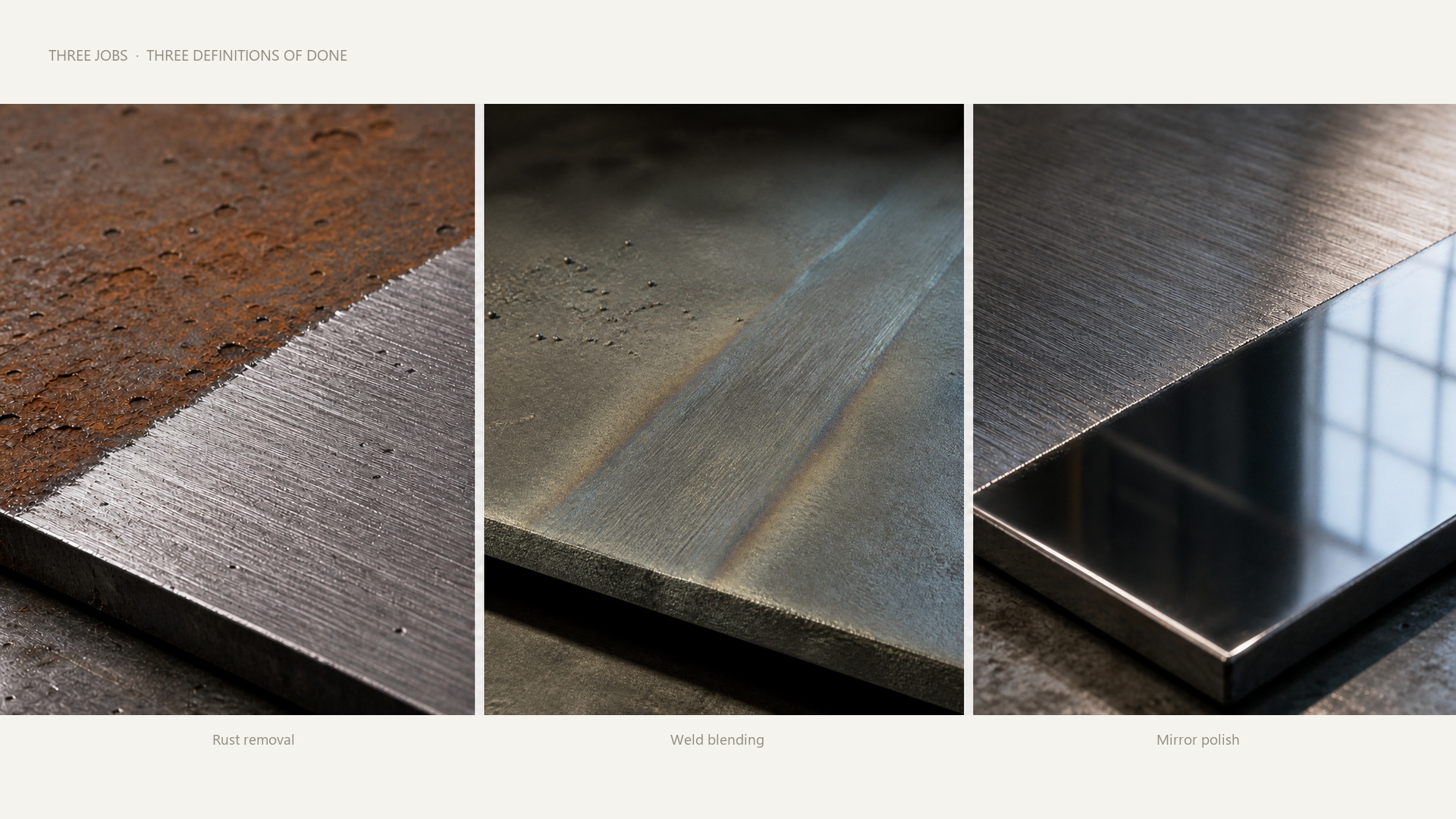
Three jobs land on the same bench. Strip the rust off a plate, blend a weld into it, take a stainless panel to mirror. Same grinder, same 115 mm disc, so all three get the same one. The machine really is the same. The job is not.
Those are not three grades of one operation. Each has its own definition of finished, and that definition decides the abrasive, the sequence, and the part everyone skips: when to stop.
Rust removal. Finished means no rust left, nothing embedded in the surface, and a profile a coating can key to. It is a removal job, not a finish job, and the first expensive mistake lives exactly there. Someone puts a 120 grit flap disc on rust because a coarse disc feels like it will gouge the plate. A fine disc does not remove rust. It burnishes it, flattening the oxide into the steel and turning the plate an even grey while the pits stay full. The surface looks clean. Six months later the coating lifts in a pattern that traces the original rust.
Rust also has two states that get treated as one. Surface rust sits on top and comes off with a 40 grit flap disc or a wire brush on the same spindle. Pitting has already gone into the plate, and no disc removes a pit. It cleans the inside of it. If the pit is deeper than the coating can bridge, the answer is not a finer disc; it is a different plate or a filler.
Weld blending. Finished means the crown is gone, the plate is flat across the weld, and the transition is flush. This is a geometry job, and it is judged with a straight edge, not with the eye. Two ways to fail it. Under-blend leaves a step that the paint telegraphs later. Over-blend dishes the plate beside the weld and thins the section, and that one is worse, because it passes inspection by eye and only shows up on a straight edge or in service.
Work along the weld, keep the disc flat, and check the straight edge every pass rather than at the end. Blending also generates the most heat of the three jobs, because you stay in one place. On stainless, staying too long is not a cosmetic problem: the colour change is chromium leaving the surface layer, and the corrosion resistance goes with it. A blend that looks right and rusts in service is a blending failure, not a material failure.
Mirror polish. Finished means no scratch at any angle under a raking light. It is a subtraction chain, and the chain only works if every step removes the previous step's scratch completely. A 240 grit scratch sitting under a 320 finish is invisible in the workshop, survives the polish, and appears the first time the part goes outside in sunlight. This is why the last step is almost never the one that failed. The failure was two steps earlier.
The shared mistake is sequence inversion. People go too fine on rust because they are afraid of the surface, and too coarse on polish because they want it finished today. Both are the same error: the disc is chosen by what the operator fears or wants, not by what the surface needs.
The practical control costs nothing. Work each step at ninety degrees to the previous one and the crosshatch tells you the truth. As long as the old scratches are still visible crossing the new ones, the step is not finished. Move up a grit only when the surface shows one scratch pattern, all of it running the same way. As a rule the steps run one and a half to two times the previous grit — 40, 80, 120, 180, 240 — and the temptation is always to skip one to save ten minutes. Those ten minutes come back as a re-polish of the whole panel.
Then the tools, because the three jobs do not use the same class of abrasive. Coated flap discs cut. They leave a scratch pattern and remove material at a rate you can see. Zirconia and ceramic grains are for steel that has to be cut fast; calcined alumina is the cheaper grain and does the same work more slowly, which is fine on a bench job and expensive on a production line. Non-woven discs do not cut a scratch pattern at all. The abrasive sits in a nylon web and the web blends, which is exactly what is needed between cutting and polishing: it takes out the previous scratch without putting a new deep one in. Wool with compound is not a grit in any sense. It is mechanical polishing, and it only works on a surface that is already scratch-free one step down.
Shape matters as much as grain. A conical disc reaches into a corner and a flat one does not. A flat disc holds a flat face on plate; a conical one will rock on it if you let it. Same abrasive, different geometry, different result, and that is a fitting decision, not a quality decision.
Colour codes deserve a warning. Non-woven discs are commonly sold as coarse, medium and fine by colour — yellow, red and blue in the range we stock. Treat the colour as a house convention, not a standard. Two suppliers' reds are not the same abrasive or the same density, and a buyer who specifies red has specified nothing. Specify the result instead: what scratch the last step left, and what this step has to remove.
Of the three failures, a burnished rust removal is the most expensive, because it is discovered by the end customer, after coating, after assembly, sometimes after installation. A skipped polish step hurts, but it is caught in the workshop or at incoming inspection. A dished weld blend sits in between: it passes the eye, fails the straight edge, and by then the part is usually finished.
So specify the job, not the grit. Rust removal to a coating profile, a cosmetic blend on a visible face, and a mirror on 304 are three different purchase orders, even when all three leave the store as 115 mm discs. The disc is the last decision in that sentence, not the first.
The machine was never the variable. Three jobs, three definitions of done, and the disc follows.


