

Why the 120 mm Bit Polishes and the 5 mm One Wears Out
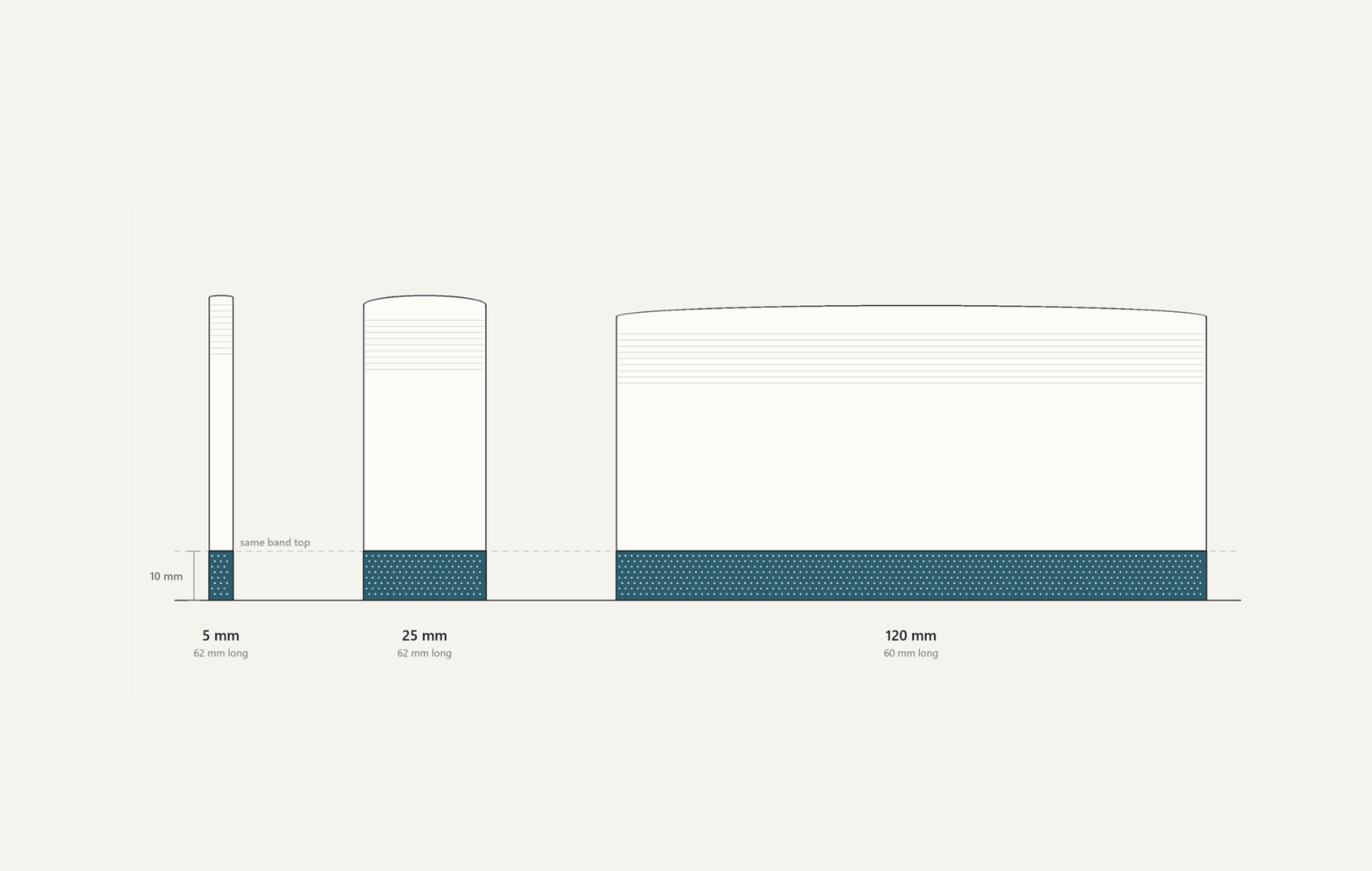
Forty-one brazed diamond drill bits sit in one product family, and between 5 mm and 120 mm they hold one specification in common: 10 mm of diamond height. Every size. The 5 mm bit and the 120 mm bit carry the same reserve of abrasive.
That is the first thing worth stopping on. The catalogue is not scaled. Nobody doubled the diamond depth when they doubled the diameter. There are thirty-two distinct diameters in the table, nine of them offered on both mounts, and the diamond height column reads 10 on all forty-one rows.
The second thing is what that constant does once the circumference starts moving, and it only makes sense if you fix the machine first.
Take the threaded ladder on its own: thirty-one sizes, 5 mm to 120 mm, all of them on the same M14 spindle, which on these tools means a hand-held angle grinder. Same motor, same grip, same dry cut. One spindle speed, because most grinders have exactly one.
At 5 mm the rim is 15.7 mm around and the diamond band on it is about 157 square millimetres. At 120 mm the rim is 377 mm around and the band is about 3,770. Twenty-four times the diamond, and the same ten millimetres of depth to spend it from.
Now the two things that scale with diameter, and the one thing that does not.
Rim length scales. Twenty-four times as much cutting edge to share the load between.
Rim speed scales too, and this is the part that gets left out. At a fixed spindle speed the rim travels its own circumference every revolution, so the 120 mm edge runs past the work twenty-four times faster than the 5 mm edge. Not twenty-four percent. Twenty-four times.
And the hand does not scale. Whatever the operator leans into the grinder is what a 5 mm bit gets, and what a 120 mm bit gets.
Put those three together. The 120 mm bit is being asked to work on a twenty-fourth of the load per unit of edge, at twenty-four times the surface speed. Both of those push the same way, and it is the wrong way once the diamond is already blunt.
Diamond does not cut because it is hard. It cuts because it fractures. A crystal held in the braze takes load at a point, cracks along a cleavage plane, and leaves a fresh edge standing slightly proud of the matrix. That is self-sharpening, and it is a load-dependent process. Take the load away and the crystal does not crack. It rounds off. It polishes the work instead of cutting it, and then it polishes itself.
At speed it also gets almost no time to do anything except rub, and rubbing is heat. Heat on a dry tool with one layer of braze and nothing behind it is the one thing this construction cannot absorb.
So the two ends of the threaded ladder fail in opposite ways, on the same grinder, with the operator doing nothing different.
At 5 mm the load is high and the rim is slow. The diamond fractures faster than the braze can hold it, protrusion drops, the matrix wears back ahead of the crystals instead of behind them, and the bit goes smooth and slow and then stops. It is worn out. The ten millimetres are gone, or the bond that held them is.
At 120 mm the load is low and the rim is fast. Nothing fractures. The crystals stay where they are, blunt, and what they produce becomes a polished ring rather than a cut. Look at the face afterwards and it is dark and glassy with no sparkle in it. That is not wear. There are ten millimetres of diamond left. It has stopped being sharp, and at that load and that speed it will not sharpen itself again.
The instinct at that point is to lean harder, and it is the most expensive instinct in the trade. Pressing does raise the load, and it will start the diamonds working again, briefly. It also raises temperature at the exact interface that holds them, on a tool that has no second layer to fall back on. The braze gives up before the work gets fast. You trade a bit that has glazed for a bit that has shed, and the second one is scrap.
So the correction is not more effort. It is less speed. Turning a variable-speed grinder down does more for a 120 mm bit than any amount of leaning, because it attacks the half of the problem the operator can actually reach. The other half, load per unit of edge, is set by the geometry and cannot be argued with.
If the face is already glassy, a few light passes into an abrasive block will open it again. The point is to break the glaze, not to press the diamonds out of the braze. Then run it slower than whatever produced the glaze in the first place.
That is the threaded ladder. The hex ladder is a different machine and a different story.
Ten sizes, 5 to 25 mm, on a quarter-inch shank that goes into a drill chuck, not a grinder spindle. It stops at 25 mm because that is where a hand drill runs out of what a diamond core needs: torque at the spindle and grip at the shank. Nothing about the diamond changes at 25 mm. The machine does.
Which is the useful way to read the whole table. It is not one product line with two fittings. It is two machines with two ceilings, and the sizes where they overlap are the only place the choice is real.
The last constraint is structural, and it holds for both. Ten millimetres is the whole reserve. It sits in one layer, on the surface, held by a film of braze. There is no second layer underneath to open up by dressing, the way there is on a sintered tool. Once those ten millimetres are spent, or once the braze holding them is gone, dressing does not bring the tool back.
So the size on the box tells you how big the hole is. It does not tell you what the diamond is being asked to do. A 5 mm bit and a 120 mm bit leave the factory with the same ten millimetres and the same braze, and they fail in opposite ways, because two things changed with the diameter and the one that did not was the hand holding it.
Fix the speed first. Then the load. Everything else in the table is downstream of those two.


