
P400 and F400 Are Not the Same Grain
A purchase order rarely fails on price. It fails on a number that looked unambiguous to both sides.
"120 grit, 115 mm, zirconia flap discs, 500 pieces." That is a normal line. Six suppliers read it, and they are not all quoting the same product — because "120" on its own does not say which scale it belongs to.
GRIT IS A GRADE, NOT A DIAMETER
Start with the correction that matters: a grit number is not a particle size. It is the name of a grade — a population of grain defined by a median size, plus permitted amounts of oversize and undersize.
That is why the standards are written as distributions rather than as single values. Every grade carries a coarse tail and a fine tail, both with limits. Two lots, both correctly labelled P120 and both inside the standard, can still differ in the tail enough that one scratches and the other finishes.
So the number is short for something longer. When the rest is missing, you are ordering an abbreviation.
TWO LETTERS, TWO STANDARDS
FEPA — the Federation of European Producers of Abrasives — publishes two separate grading systems. They are not the same system with a different cover.
FEPA F (42-1) grades bonded and loose grain: grinding wheels, sticks, blasting media.
FEPA P (43-1, mirrored in ISO 6344) grades coated abrasives: belts, sheets, fibre and velcro discs, flap discs.
Then there is the American convention, ANSI B74.18 — the CAMI numbers most English-language buyers grew up with — which is a third scale again.
In trade, all of them get written as a bare number. P120 becomes "120". G120 turns up on price lists, and G is not a FEPA letter at all. F120 exists, and means something else.
That is four different things wearing two digits.
WHERE THE SCALES AGREE, AND WHERE THEY STOP
At coarse sizes the two FEPA scales are close, which is where the habit of treating them as interchangeable comes from.
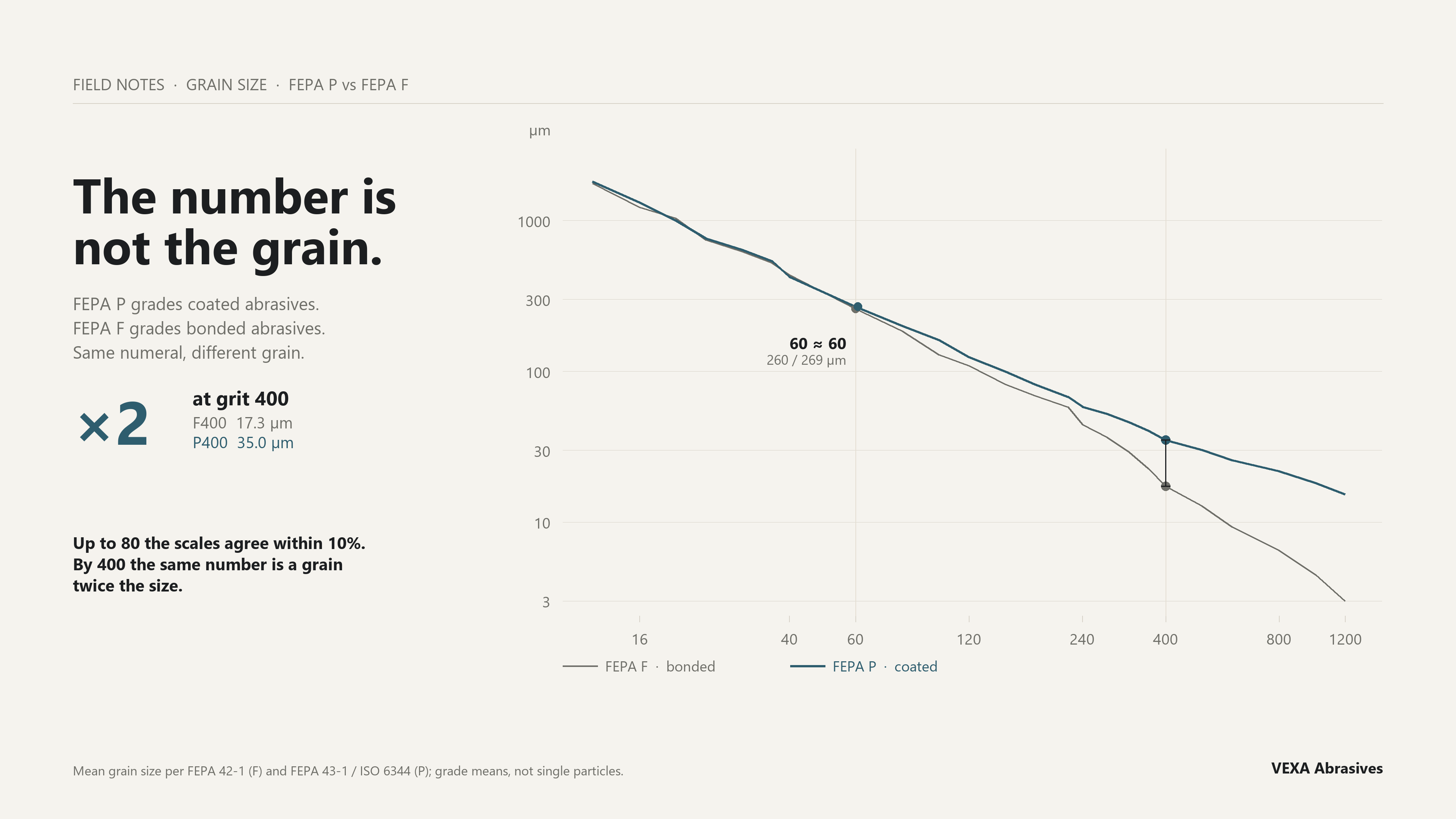
60 is nearly the same on both: 260 µm on the F scale, 269 µm on the P scale — about 3% apart.
400 is not. On the F scale, F400 is a 17.3 µm mean grain. On the P scale, P400 is 35.0 µm. The same three digits, twice the grain.
It keeps going. At 1200 the F scale is 3.0 µm and the P scale is 15.3 µm — a factor of five.
Up to about 80 the two scales sit within roughly 10% of each other. Above 240 they are describing different materials. Somewhere around 400, the sentence "I need the same grit in a grinding wheel" stops meaning anything.
THE TAIL IS THE PART THAT COSTS MONEY
The medians are the easy half. The half that shows up as scrap is the permitted coarse fraction.
In the published tolerance tables, an F-grade may carry roughly 3% of grain above its top sieve. A P-grade of the same number allows roughly 0.5% — something like six times tighter.
The reason is mechanical. A coated product is a surface made of hundreds of grains all meant to be doing the same job at the same depth. One oversize particle in that field cuts deeper than its neighbours and leaves a scratch the rest of the surface cannot hide. In a bonded wheel the grain sits in a matrix with space around it; a wider spread is tolerable, and the coarse fraction helps clear chips.
So the tighter tail on the P scale is not fussiness. It is what lets a coated product promise a finish at all.
It is also why "the same grit from a different supplier" is not a specification. You can buy an F-grade grain of the right nominal number and still change the scratch pattern, because you changed the tail.
THE THIRD TRAP: A SCALE THAT RUNS BACKWARDS
One more, because it catches people who have already learned the first two.
GOST 3647-80, still found on drawings and tooling from the former Soviet bloc, states the grain size in hundredths of a millimetre. The number is the size. So a larger number means a coarser grain — the opposite of every FEPA and ANSI scale.
GOST 80 is a nominal 0.80 mm grain. Under FEPA P, 80 is 201 µm. Under FEPA F, 185 µm. Four to five times apart, with the direction of the scale inverted as well.
If a drawing says 80, the drawing is not yet a specification either.
WHAT TO PUT ON THE ORDER
The fix is short and it costs nothing:
1. Write the scale letter: P120, F120, or the ANSI number with the standard named beside it.
2. Name the standard where the process is sensitive: FEPA 43-1 / ISO 6344 for coated.
3. Add grain type and backing. P120 zirconia on polyester cloth is a different product from P120 aluminium oxide on paper.
4. Add the operation. The scale tells you the grain. It does not tell you whether the disc survives the edge.
If the reply comes back as "120 grit" with no letter, ask. A supplier who cannot name the scale their own number is on has just told you something more useful than the price would have.
HOW TO CHECK IT WITHOUT A LAB
You do not need a particle-size analyser to catch this. Ask for the lot's size distribution — D50 plus the coarse tail, expressed as a percentage above the top sieve — and compare it against the grade you specified. If no distribution can be produced, that is the finding.
On the floor, one controlled trial settles it: one part, one machine, one operator, two discs whose only difference is the scale hiding behind the same number. Count scratches and finished parts. Not "feels sharper" — a count.
THE DISCS WE MAKE
Our flap discs are T29 mesh-backed, in 115 mm and 125 mm, quoted G40 to G120. That G is house shorthand — it means "grit" and nothing more, and it is not one of the FEPA designations. Where the scale matters to your process, put it in writing on the order and make us name it.
Three grain classes: the blue KX563 general-purpose series, the red KX721SQ ceramic series, and a calcined alumina grade for heavy low-cost stock removal. Ten per box, twenty boxes per carton, two hundred per carton. Beyond the flap disc the same range continues into non-woven surface conditioning discs, wool polishing discs and a black diamond finishing disc.
Coated abrasives carry EN 13743, MPA and CE marking, rated 80 m/s. MOQ is one box. Stock ships within seven days; custom production runs two to three weeks. Samples are free up to three pieces, freight at the buyer's account. OEM and private label supported.
Send the scale with the number. It is one letter, and it is the difference between a specification and a wish.


