
Eight Ways an Abrasive Disc Fails — and What to Change First
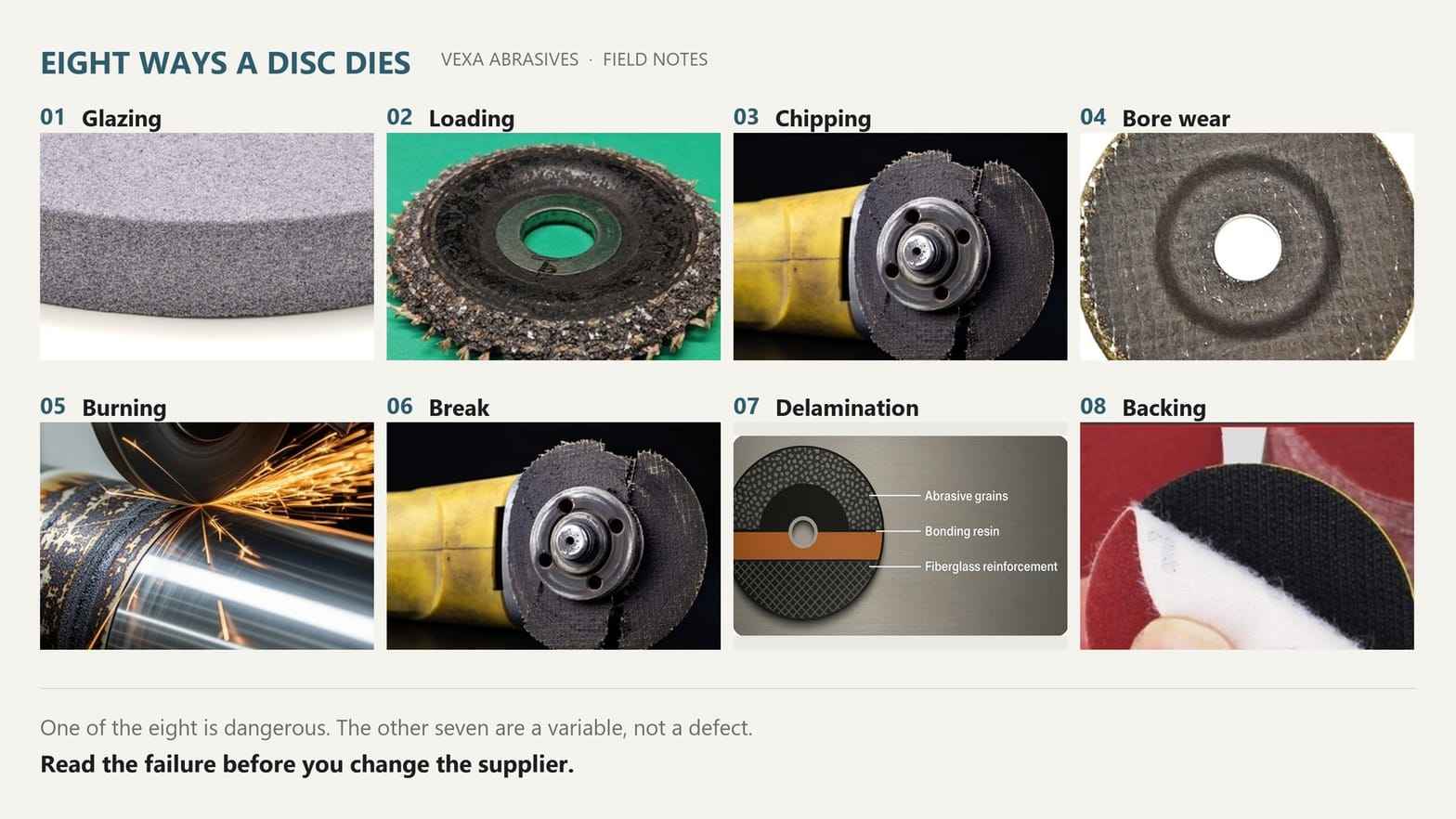
Abrasive failure is not always a product quality problem. A disc can stop cutting while it still has material, lose its grip on the grit without being worn, or come off the pad without the abrasive ever reaching the workpiece. Each of those has a different cause, and only one of them is worth a phone call to the supplier. This guide covers eight failure modes across cutting, grinding, flap and coated products: what each one looks like, what is actually happening, and the first variable to change before blaming the batch.
Why a disc fails instead of wearing out
Wear is controlled loss: grit blunts, the bond releases it, a fresh layer is exposed. That cycle is what keeps a disc cutting at a steady rate. Failure is anything that interrupts the cycle without removing material: the face closes over, the metal welds itself to the grit, the reinforcement lets go, the bore opens up.
The distinction matters because the two need opposite responses. A worn disc is finished and gets replaced. A failed disc is usually a record of what the job did to it, and that record is readable before the disc goes in the bin. Reading it correctly is the difference between changing a variable and changing a supplier for no reason.
Eight failures, three families
Grouping the eight by where the damage sits is more useful than listing them alphabetically, because the family tells you whether anything can still be done.
Cutting surface failure — 01 glazing, 02 loading. The face stops cutting while the disc still has material. Both are recoverable in the cut: a variable was wrong and can be changed back.
Structural and interface failure — 03 chipping, 04 bore wear, 07 delamination, 08 backing. The disc or its mounting has lost integrity. Nothing here can be restored; it is prevented on the next one.
Thermal and safety failure — 05 burning, 06 break. Heat and overload. One damages the workpiece, one can hurt the operator, and only one of the eight ends the job on the spot.
01 Glazing: the face closes over
What you see. The rim shines like a polished edge. The disc still has material, still measures close to its original diameter, and skates across the cut instead of entering it.
Mechanism. In a resin-bonded disc the bond has to wear back roughly as fast as the grit dulls. When the bond is too hard for the job, or the contact point runs too hot, dull grit stays held, the face closes over, and the disc polishes instead of cutting. The abrasive has not worn out; the release mechanism has stopped.
First variable. Pressure first, grade second. Less pressure, more of it moving, so the face keeps breaking down. If the surface does not change, the disc is too hard for the material — that is a specification question, not an operator one.
Applies to: resin-bonded discs. On coated products a shiny face is usually loading, not glazing.
02 Loading: metal welded into the face
What you see. Aluminium or soft steel smeared across the cutting face and set hard. The build-up copies the shape of the cut, not the shape of the disc.
Mechanism. Soft metal smears before it cuts clean. The smear covers the grit and becomes the working surface, so the tool stops abrading and starts rubbing — and the rubbing is what makes the smear stick harder.
First variable. Check the specification and the marked maximum speed against the machine first: speed is a limit, not a dial to turn up. Then contact pressure and feed. An anti-loading coating helps in some applications; it is not a fix for the wrong disc.
Applies to: aluminium, copper, soft and stainless steels. Coated and flap products, where the face can be cleared.
03 Chipping: impact, not abrasion
What you see. Bites taken out of the edge, usually along one side and usually starting from one spot.
Mechanism. Impact, not abrasion. A steep entry angle, a part that moved under the cut, or a disc that took a knock in the rack. The crack starts at the rim and runs inward, so what leaves is always bigger than the blow.
First variable. Entry and clamping. Shallow first contact, then feed. Check how the discs are stacked before blaming the batch.
Applies to: bonded discs. On coated products the same look comes from a torn edge, not a broken one.
04 Bore wear: the mounting, not the abrasive
What you see. The bore has opened sideways. The disc sits off centre, wobbles at start-up, and the cut widens then wanders. The rim may still be almost new.
Mechanism. The bore centres the disc; it does not drive it. Torque is carried by the flange faces clamping the disc against the spindle. Damaged or contaminated flange faces, the wrong flange, a poor fit or heavy vibration let the disc work against its own mounting — and the bore is where that shows.
First variable. Mounting, not force. Clean flange faces, the correct flange, the fit the machine was built for. Follow the machine and disc maker's mounting instructions; more clamping force is not the answer.
Applies to: discs with a centre hole, clamped between flanges. Not backing-pad products.
05 Burning: the workpiece is the first casualty
What you see. Brown to blue staining along the cut, a resin smell, a glazed edge. The part is discoloured where the cut is, not where the disc touched.
Mechanism. Heat has nowhere to go. The colour tells you the part got hot — it does not tell you how hot, and it is not a temperature reading. In the same zone the bond is being cooked, so the part and the disc fail together.
First variable. Contact time. Shorter continuous contact, spread the pass, let the part cool between passes. Coolant helps only if it reaches the zone, not the guard.
Applies to: all four families. On coated products the same heat glazes the backing.
06 Break: the only one that is dangerous
What you see. A radial crack, a missing sector, or both faces separated at the bore. It shows up at start-up, in a jam, or on the first cut after the disc was set down.
Mechanism. Load the disc was never built to carry: a stall and restart, a twist in the cut, a speed above the mark on the label. Structure fails in one event, not over time.
What to do instead of diagnosing. Stop. Check the guard, the flanges, the marked speed and whether the disc was dropped. Do not run it again. This is the one failure in eight where the correct first response is not a variable but a shutdown.
Applies to: bonded discs. Coated products tear; they do not break like this.
07 Delamination: decided before it was mounted
What you see. A pale ring just inside the edge, then a swell, then an edge that gives when you press it. The disc can be almost unused and still look like this.
Mechanism. The fibreglass reinforcement has separated from the bond. Storage moisture is one route in — damp air, a cold floor, a stack that never dries — but not the only one. Reinforcement defects, weak bonding and curing problems put the same ring on a disc that was stored perfectly.
First variable. Storage first, because it is the part you control: flat, dry, off the floor, out of the sun. If a disc delaminates unused anyway, it is a product question — and the batch is what settles it.
Applies to: bonded discs with fibreglass reinforcement. Not coated or flap products.
08 Backing failure: three interfaces, one name
What you see. Hook-and-loop releases mid-pass, a PSA disc creeps across the pad, or a T29 flap cracks at its root where it meets the plate. Three interfaces, three different fixes.
Mechanism. Heat reaches the backing, not the grit. Hooks soften, adhesive creeps, backing film embrittles. From the operator's seat this looks identical to a worn disc, which is why it gets filed under "the disc was no good".
First variable. Heat at the interface. Lower pressure, keep the pad moving, and replace a tired pad instead of fitting a fresh disc to it.
Applies to: hook-and-loop, PSA and flap discs. Each needs its own pad and its own pressure.
The triage table
Work down the column, not across it. Change one variable, run the same job, and see whether the symptom moves. If it does not, the cause was the other one.
This is not a complete list. These are the two checks worth trying first, in the order worth trying them, and the order changes with the workpiece.
When the failure is not the disc's fault
Roughly half of what arrives as a complaint is a machine or handling problem wearing a disc-shaped costume. A burred flange face produces an oval bore. A disc dropped on a concrete floor cracks from the bore on its first cut. A wheel run above the mark on its label fails in a way no abrasive grade can prevent. A stack stored in a damp corner delaminates without ever touching metal.
None of those are fixed by changing supplier, and changing supplier will not stop them happening again. That is the whole reason for reading the failure first.
Frequently asked
How do I tell a worn disc from a failed one? Measure the diameter and look at the face. A worn disc has lost diameter and keeps a consistent, slightly rough cutting edge. A failed disc either still has its diameter (glazing, loading), has lost material in one place rather than evenly (chipping), or has damage that has nothing to do with wear at all (bore wear, delamination, break, backing failure).
Does a glazed disc need to be thrown away? Not always. Glazing is a surface condition, and reducing pressure while keeping the disc moving can open the face again. If the same disc glazes on the same job a second time, the grade is wrong for the material and a different specification is the answer.
Is burning the disc's fault or the operator's? Usually neither. Burning is a contact-time problem: heat builds because the disc stays in one place. Shorter continuous contact, spread along the cut, fixes it more reliably than a different disc.


