
The Disc Was Old. The Date Was Printed on It.
A shop reports it twice a year, and it is always the same sentence: this batch is not as good as the last one.
The discs are the same diameter, the same thickness, the same grit, from the same line. The operator has not changed. The material has not changed. What changed is the weather, and the carton has been sitting in the corner of the shop since the last time the weather was like this.
Nobody blames the corner. A carton is not a component. It arrives, it is opened, and after that it is furniture — a shelf, a step, something to put a coffee on. Inside it, a hundred discs wait their turn, and the ones at the bottom wait longest.
This note is about what happens in that wait. It is not about defective goods, and it is not about storage being somebody's fault. It is about a variable that no order form records and no carton currently answers: how old the disc in your hand actually is.
What changes, and what does not
A resin-bonded disc is abrasive grain held in a cured phenolic bond, with fibreglass reinforcement carrying the load. The grain does not age. The fibreglass does not age. The bond does.
Phenolic resin is hygroscopic. It takes up water from the air and gives it back, and it does so continuously, in both directions, for as long as it exists. Absorbed water plasticises the cured network: it gets between the polymer chains, increases free volume, and lowers both stiffness and strength. This is not contamination and it is not visible. A disc that has taken up water looks exactly like a disc that has not.
Two consequences follow, and they point in opposite directions, which is why the symptom is so often misread.
A softer, weaker bond releases grain earlier. Early release means the disc feels fast at first and then loses its form — it stops cutting to size, the edge goes round, the operator leans harder. That reads as a dull disc.
At the same time, water in the bond flashes to steam at the contact line. Steam takes heat away from the cut in the wrong direction, the bond does not degrade the way it was designed to, and the face smears instead of breaking down. That reads as a glazed disc.
Dull and glazed, from the same cause, on the same disc, in the same cut. An operator who sees both will conclude the batch is inconsistent, because inconsistent is exactly what it looks like.
There is a third consequence which does not show up in the finish. A bonded disc's rated speed is a claim about the bond — 80 m/s on ours, which for a 115 mm disc is roughly thirteen thousand three hundred revolutions per minute. Anything that changes the bond changes the margin standing behind that number. This is the reason shelf life exists as a concept for bonded abrasives at all; it is not a marketing device.
The comparison you can run this week
No instrument is needed for this, and no lab. What is needed is discipline about holding everything else constant.
Take two discs of the same size and grade. One still in its film. One that has been out of its film since the last humid season — the disc at the back of the shelf that nobody reached for.
Same machine. Same operator. Same material, and the same section of it. Cut one length with each, and note four things:
How long each cut took, measured on a phone stopwatch rather than by feel.
What the sparks look like. A dry disc throws a dense, short, bright stream. A damp one throws fewer sparks, longer and duller, and more of them land as unburnt grit.
Whether the cut edge discolours. Blue or straw on the cut face is heat, and heat that appears earlier than usual at the same feed is a change in the bond, not in the operator's hand.
What it smells like. Cured phenolic has a dry, resinous smell. A disc carrying water smells sweeter and harsher, and it keeps smelling after the cut stops, because the water is still leaving.
Do this with the two discs in the same session, on the same bar, and the difference will either be there or it will not. If it is not there, you have learned something worth knowing: your storage is fine and the batch question is back on the table. If it is there, you have isolated a variable that no quotation records.
The point of the comparison is not that damp discs are bad. It is that the two discs differed in exactly one thing — how long they had been out of the box — and everything else was controlled.
The film is the barrier. You are the one who breaks it
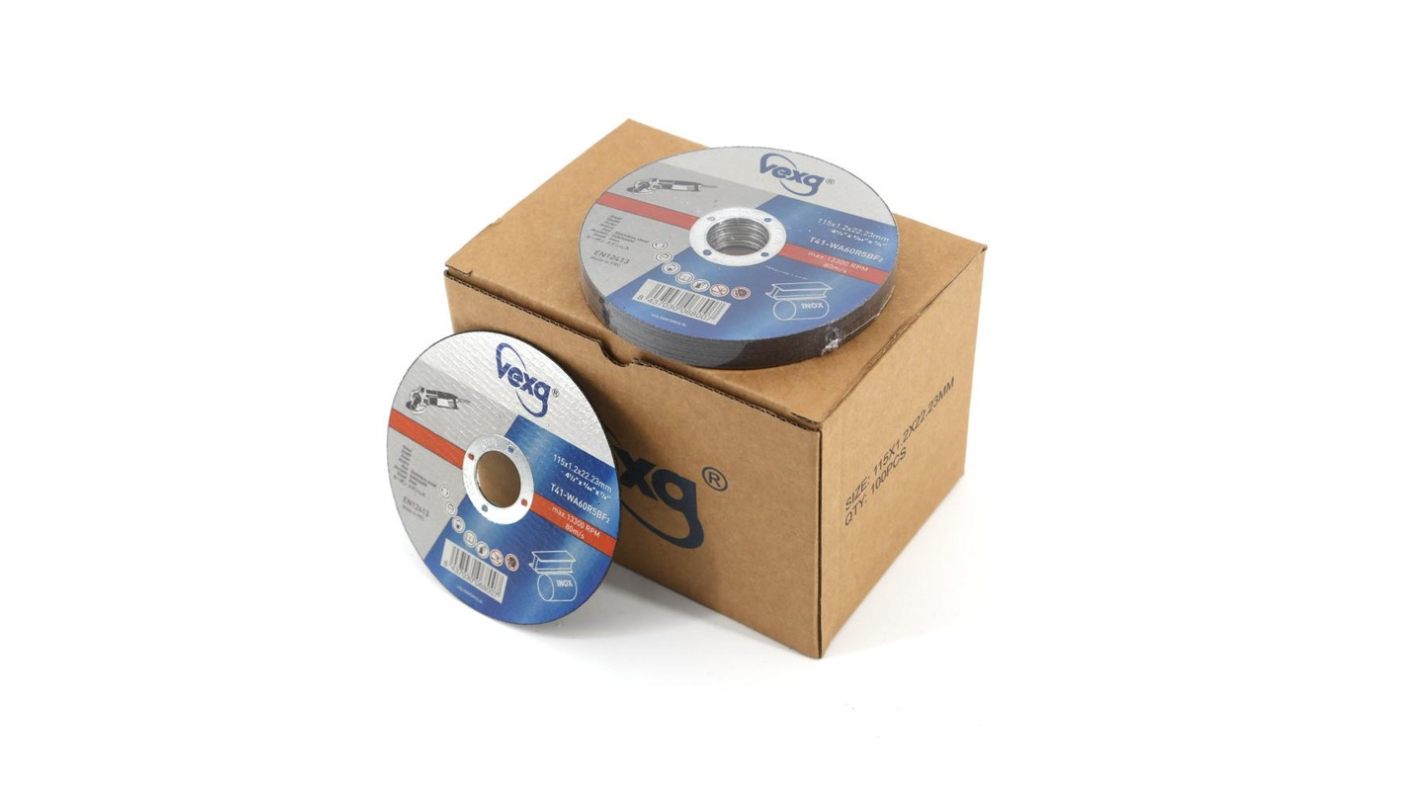
Every one of our 115 mm cutting discs ships a hundred to a kraft-paper box, six boxes to a carton, six hundred discs to the carton. The 180 mm comes twenty-five to a box, eight boxes to a carton. The 230 mm comes twenty-five to a box, four boxes to a carton. Inside the box, the product is sealed in film — a stack at a time, not a disc at a time. The film carries no printing at all.
That order matters, and it is the part almost nobody states out loud. The kraft box is transport protection: it stops impact, edge chipping, dust and light, and it is good at all four. It is not, and never claimed to be, a vapour barrier — paper takes up and releases water with the air around it. The film is the barrier.
Which makes the film the most consequential object in this note and the least recorded. Until it is cut, the bond inside is living in the condition it was packed in. The moment it is cut, the exposure clock starts, and nothing anywhere records when that happened. A stack still in its film is a dated, protected object. The same stack, film cut and sitting open beside the grinder, is neither.
The film is not a vacuum, and it would be dishonest to pretend otherwise. Thin polymer passes water vapour slowly rather than not at all, seams and folds are not perfect, and a pack sealed on a humid afternoon holds that afternoon's air in with the discs. What the film buys is time, not immunity. That is precisely why the date matters more than the barrier does.
Consider one sealed stack. The film is cut on the first morning, and from then on discs come out of it as the work needs them.
Here is the part that gets missed. The film seals a stack, not a disc. So that one cut does not start one clock per disc — it starts a single clock, shared by everything in the stack. Every disc in it — including the one at the bottom you will not reach for until weeks later — begins breathing shop air on the same morning.
Which means the disc at the bottom of the stack carries the same open date as the one you used first. It did not age less for having queued. It aged the same, and was then used later.
That is the whole case for buying smaller and more often, and it is arithmetic rather than opinion.
A stack cut this month is not the same object as a stack cut before the last humid season. Both are normal. Nothing on either of them tells you which is which.
The date is on the disc. Read it before you buy anything
Every disc we ship carries two things on its label: the date it was made, and the batch it came from. The carton carries neither. That much is simply the fact of the packaging, and the film carries no printing either — the label is the only place a date exists anywhere in the chain.
That turns out to be the right place for it. The carton is not the unit that goes on the machine. Discs get decanted, split across jobs, moved into a drawer, and the carton does not follow them. The label does.
So the age of any disc on your rack is recoverable, and the procedure is not exotic.
Read the date on the disc in your hand. Subtract. That is the age of the part that produced the surface you are unhappy about.
Then use the number as a filter, not as a verdict. A disc thirty months old that is both dull and glazed is a storage story before it is a batch story. A disc three months old with the same symptoms is not: at that age the bond has barely moved, and the cause is in the machine, the material or the technique. Two minutes of reading decides which conversation you are having.
Our published validity is three years from production. That is a policy period, and I want to be exact about which kind of number it is: it is how long we will stand behind the product, not the output of a degradation curve measured on a hundred cartons. It is a commitment, in the same way a rated speed is a commitment.
The one date that is printed nowhere, on our discs or on anyone else's, is the day the film was cut. That is when the exposure clock starts, and it exists only if somebody writes it down.
What to do about it
Write the cut date on the pack. Not the production date — that is already on every disc. Write the day the film was cut, month and year, on the pack. From that moment every disc in that stack shares one open date, and that is a fact no label can give you. This is the only step here that requires no cooperation from anyone in the supply chain.
Buy smaller, more often. A carton that is consumed in six weeks never gets old. A carton bought by the pallet to catch a price break will be open for a year, and the saving on the pallet is paid for by the last two hundred discs in it. This is arithmetic, not a sales argument — but it does happen to be why we ship from one box and keep stock on seven-day dispatch rather than requiring a container.
The open stack is the exposed one. A stack still in its film needs nothing at all. Once the film is cut, every disc in it is exposed together, and the stack needs to be off the floor, out of the open, and away from the wet end of the shop. Floor level is where the humidity sits and where the mop goes. A shelf and a pallet are enough. Nothing here needs a climate chamber.
Do not stock up before the wet season. Stock bought in April at a good price and used in August has spent the humid months being humid. If you must hold inventory, hold it through the dry months and draw it down through the wet ones.
Do not discount a disc for being old, and do not protect a disc for being new. The comparison above is the test. Age is a predictor, the cut is the measurement.


