
Five Times Thicker. One Hundred and Twenty-Five Times Stiffer.
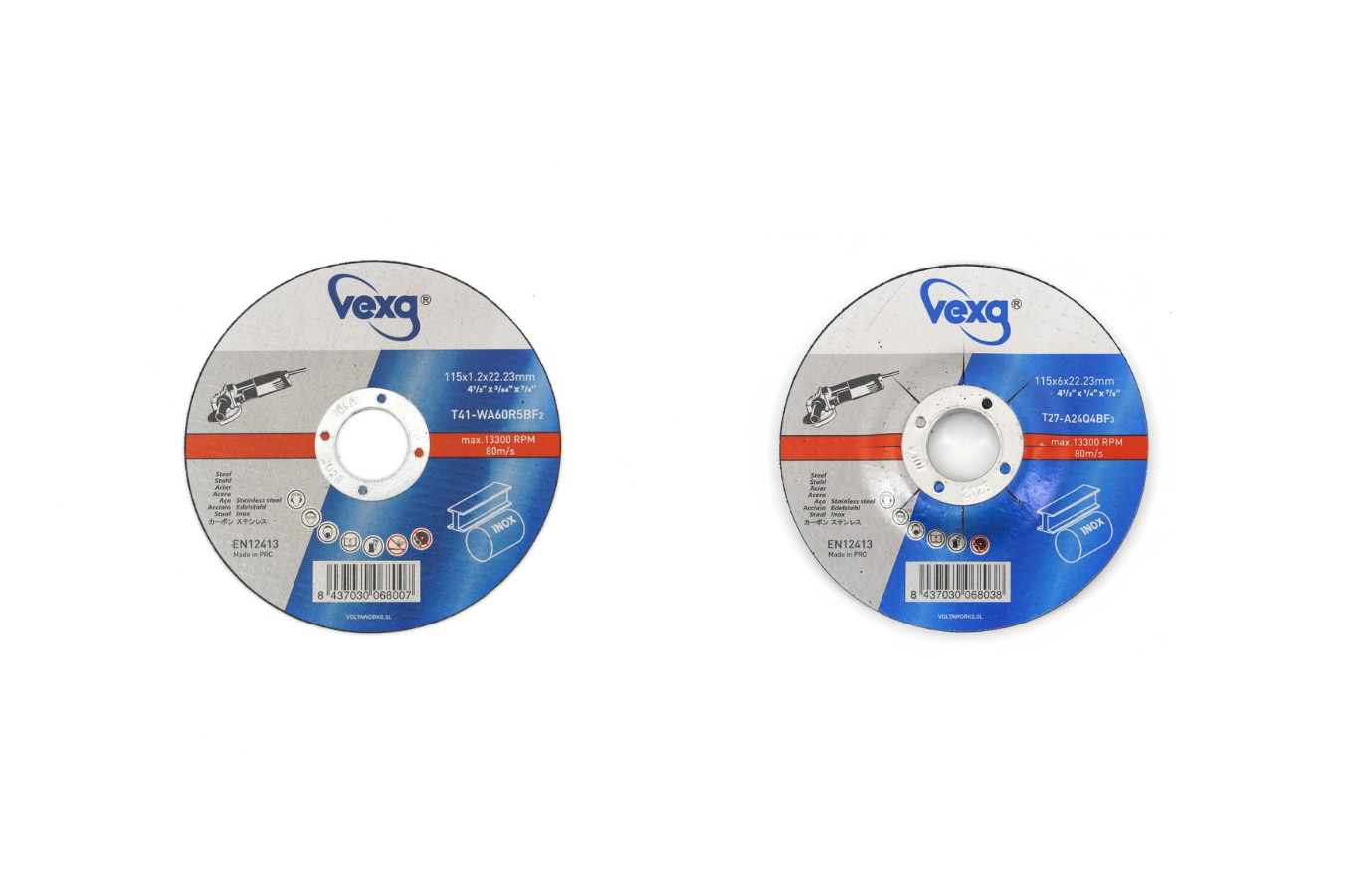
The substitution is easy and it gets made. A burr is standing on an edge, the grinding wheel is in the van, there is a cutting disc already on the machine, so the disc gets tilted and the burr comes off.
That is a mistake, and the reason it survives as a habit is that it rarely announces itself. A wheel used outside its application does not usually fail on the first pass. It produces a result, and the result gets filed away as permission.
The difference between the two products is not a matter of degree. It is a matter of exponent, and it takes two numbers off the catalogue to see it.
Five times, and only one of them is cubed
At 115 mm, our cutting disc is 1.2 mm thick and our depressed-centre wheel is 6 mm thick.
Five times. That is the number that gets quoted, and it is the least informative one, because a wheel loaded on its side is not loaded in tension or compression. It is loaded in bending, and the resistance of a plate to bending does not scale with its thickness. It scales with the cube of it.
Five cubed is one hundred and twenty-five.
That number needs a boundary drawn around it before it is used, because it is easy to quote and wrong to apply. It compares two flat plates of the same material and the same outline, differing only in thickness. Neither product is that plate. A resinoid wheel is fibre-reinforced, and the two types do not carry the same number of reinforcement layers in the same positions — which is why I am not willing to hand either product a rating derived from a plate model.
So take the cube for what it is: the explanation of why these two objects cannot be the same shape and the same thickness with different labels on them. It is not a specification, and nothing later in this note converts it into one.
What the cube does say, and what it cannot
Two things follow, and they get conflated constantly, so they are worth separating.
First, stiffness and deflection are the same statement read from opposite ends. A plate a hundred and twenty-five times stiffer deflects a hundred and twenty-five times less under the same sideways load, which is where the number in the title comes from and the only sense in which it is being used. In the model, at 115 mm.
The bending moment that can be carried before the surface stress runs out goes with the square, because the section modulus only grows with thickness squared. At 115 mm that is twenty-five.
So the honest pair is 125 and 25, not 125 twice. Both are large, neither is infinite, and neither is a measurement of either product.
Our own cutting disc makes the same point without any arithmetic. Its face reads T41-WA60R5BF2, and the BF in that specification is a resinoid bond with fibre reinforcement. The cutting disc is reinforced too. Both products depend on glass fibre for the property this note is about; they differ in how much of it there is and where it sits, and that schedule is not printed on a box, is not in a price list, and is not in front of me while I write this.
Which is exactly why the cube has to stay in the model. A large part of what decides how either wheel behaves under a side load is the arrangement of its reinforcement, and that is not a number the cube can produce.
These two products are not interchangeable
A type 41 wheel is a cutting tool. Its application is the cut: through the periphery, with the load radial and the wheel square to the work.
A type 27 wheel is a grinding tool. Its application is the surface, worked with part of its face, which is the reason it is dished and the reason it is thick.
Those are two applications, not two settings of one application. Tilting a cutting wheel to reach a burr does not convert it into a grinding wheel. It applies a lateral load to a part built to be loaded around its rim, and the substitutes in that sentence are not equivalent in either direction.
The comparison in this note explains why the two respond so differently to that load. It does not make the substitution acceptable, and no part of the arithmetic below should be read as a tolerance. What governs mounting and application is the marking on the wheel and the instructions that shipped with it.
What the depressed centre is for
The thickness is half the story. The other half is the shape.
A type 41 disc is flat across its whole face. Lay it against a plate and the entire annulus can touch, which is fine as long as the load stays radial and the disc stays square to the cut. Tilt it and the flat face cannot follow: the contact collapses from an annulus to an edge, and the wheel is now being pushed on a line a fraction of a millimetre wide.
A type 27 wheel is dished. The hub is recessed, so the working face stands proud of the mounting flange. That recess exists so the face can be presented to the work at a small angle without the hub or the flange fouling the plate. The wheel is allowed to work on part of its face rather than on its rim alone.
So the shape permits the tilt and the thickness survives it. Remove either and the operation stops being grinding. A flat wheel that is tilted has the geometry of grinding and the structure of cutting, which is the one combination with nothing going for it.
The price does not follow the cube
Across the three diameters, in our own list and at the same FOB terms, the grinding wheel costs roughly twice what the cutting disc of the same size costs. Not five times. Not twenty-five. About double.
That is a statement about this catalogue, not a law of the trade. A different quantity, a different market and a different set of terms will move it, and anyone quoting it as an industry ratio is quoting something I did not write.
What survives the caveat is the shape of it. The saving from substituting one product for the other is on the order of half of one consumable. What is traded away is a structural property measured in two digits and three digits — and, separately, the fact that the wheel is now doing a job it was not made for, which no ratio prices.
There is a detail in the range that makes the same point from the other direction. Our 230 mm grinding wheel exists in 6 mm and in 7 mm, the thicker one for nodular cast iron. When the application gets harder, the catalogue answers with thickness — not with more speed, and not with a different grit alone. Thickness is the variable that carries the load.
Where the tilt actually goes wrong
Not in a sudden event. In a slow one, and it looks like three ordinary things.
The contact area collapses. A wheel presented at a tilt touches on a crescent near the rim instead of across an annulus. The same hand force over a much smaller area is a much higher local pressure, and pressure is what generates the heat that discolours a cut face.
The edge stops being round. A thin wheel used on its rim wears on the rim; a thin wheel used on its edge wears unevenly around the circumference, so the true running circle is no longer a circle. Every cut after that is a fraction out, and the correction is to push harder, which loads the edge further.
And the wheel wanders. Bending under a sideways load means the plane of the wheel is no longer the plane of the cut. A wheel being bent follows the path of least resistance in the material rather than the line that was drawn — which gets read as a bad disc, or a bad operator, or a bad batch.
None of the three announces itself. Together they produce the sentence that starts most abrasive complaints: this disc is not cutting straight any more.
What this note does not claim
It does not claim that anything in it is a measurement. The 125 and the 25 are geometry and arithmetic, applied to two thicknesses off our own catalogue.
It does not put a load figure on either wheel, in newtons or in anything else. Numbers of that kind belong in a standard and in the manufacturer's data, and their absence here is deliberate rather than an oversight: I have not read the table they come from, and a number I cannot check is worse in this context than no number at all.
It does not claim that thickness is the only difference between the two products. It is the difference that explains the failure, which is a smaller and more useful claim.
And it does not claim that a grinding wheel is the right tool for every burr. A 6 mm wheel removes stock fast and leaves a coarse scratch pattern on anything thin, and there are jobs where a flap disc is the correct answer and both of these are wrong.
If this note has one practical use, it is the least technical sentence in it: when the grinding wheel is in the van, the answer is to go and get it.


