

The Micro-fracture Engine — Why “Controlled Failure” Creates a Better Ceramic Abrasive
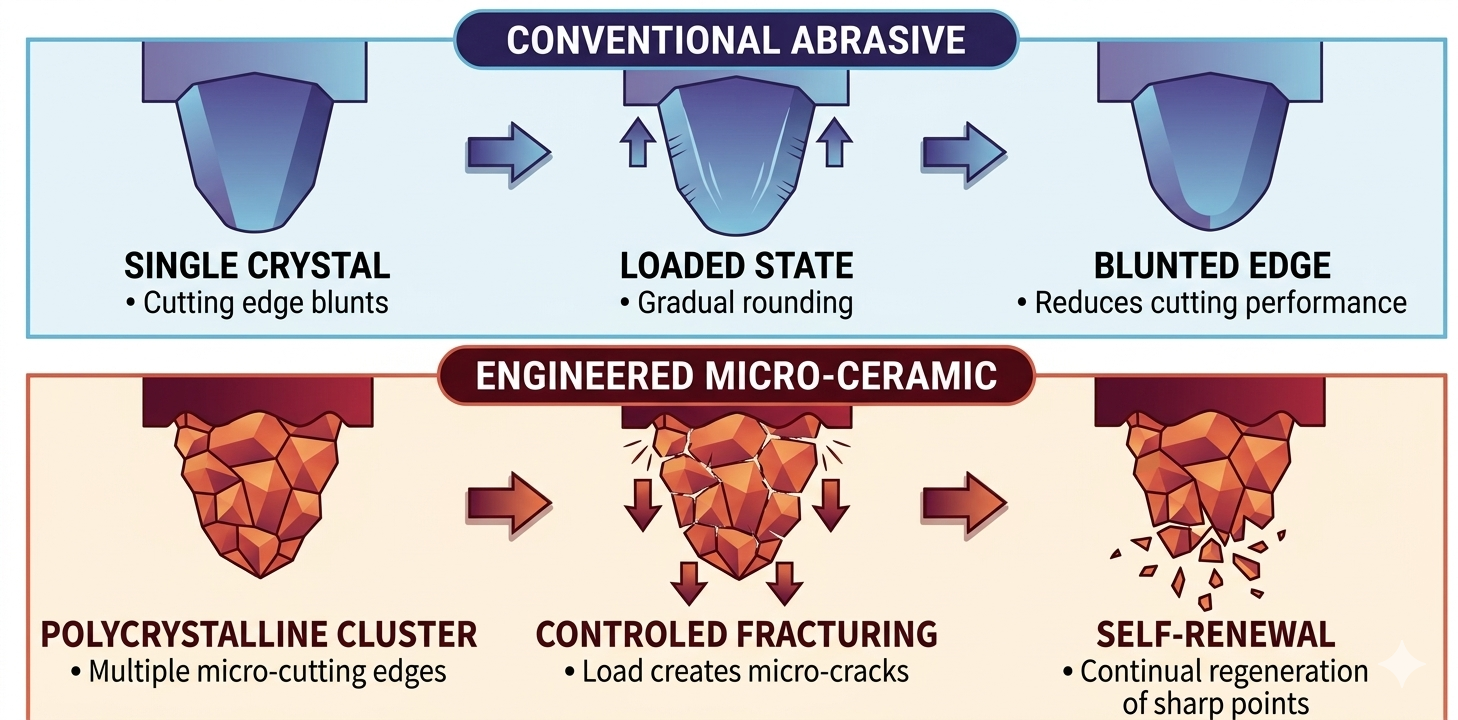
In modern metal fabrication, the true performance benchmark of an abrasive is not simply hardness — it is the ability to maintain a stable and efficient cut over time.
Many conventional abrasives fail through edge rounding: the grain gradually becomes dull, friction increases, heat accumulates, and cutting efficiency rapidly declines. The result is glazing, inconsistent finishes, operator fatigue, and reduced productivity.
VEXA Ceramic Abrasives are engineered differently.
Instead of resisting fracture, they are designed for Controlled Micro-fracturing — a process where the grain continuously renews its own cutting edges during operation.
1. The Science of Self-Sharpening
A ceramic abrasive grain is not a single solid particle.
Under a microscope, it is a highly engineered crystalline structure composed of countless sub-micron micro-crystals.
When grinding pressure reaches a critical threshold, the grain does not simply wear flat. Instead, microscopic sections fracture selectively along crystalline boundaries, exposing fresh sharp edges beneath the surface.
This process creates three critical advantages:
Continuous cutting efficiency instead of progressive dulling
Lower friction generation at the contact zone
More stable grinding pressure and surface consistency
In industrial applications, this means the disc keeps “cutting aggressively” for a significantly longer portion of its working life.
2. Heat Management: Why Sharpness Matters
A dull abrasive converts energy into heat.
A sharp abrasive converts energy into material removal.
This distinction directly affects:
Surface discoloration
Heat-Affected Zone (HAZ) formation
Stainless steel burning
Workpiece distortion
Operator pressure requirements
Because ceramic grains continuously regenerate sharp cutting points, the grinding process remains in a lower-friction “Cool Cut” state.
Instead of rubbing the surface, the grain maintains efficient chip formation and evacuation, reducing unnecessary thermal load on the workpiece.
For fabricators, this translates into:
✔ Higher removal rate
✔ Longer disc life
✔ Reduced rework
✔ More consistent finish quality
3. The Engineering Principle: Durability Through Controlled Fracture
One of the biggest misconceptions in abrasives is that a grain should “never break.”
In reality, a grain that never fractures eventually becomes smooth and inefficient.
The best ceramic abrasives are engineered to break precisely and progressively.
At VEXA, we focus on synchronizing:
Grain fracture threshold
Grinding pressure
Feed rate
Thermal stability
Bond retention
The goal is not maximum hardness alone — but predictable cutting persistence throughout the abrasive’s active life.
This is especially critical in:
Stainless steel fabrication
Heavy-pressure robotic grinding
Automated production cells
Precision weld blending
High-efficiency industrial sanding systems
The VEXA Engineering Perspective
A premium ceramic abrasive is not defined by how long it survives untouched.
It is defined by how intelligently it renews itself under load.
True grinding efficiency comes from controlling the relationship between:
fracture mechanics, thermal management, and cutting geometry.
That is the difference between an abrasive that merely lasts…
and one that consistently performs.


