

Interfacial Adhesion Dynamics — Why High Diamond Concentration Is Often an Engineering Compromise.
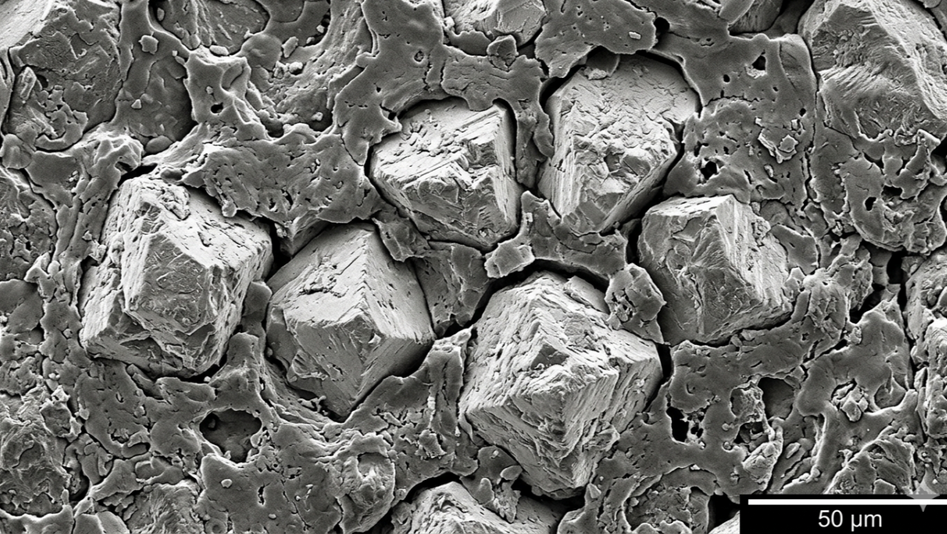
In the diamond tool industry, “higher concentration” is frequently marketed as higher performance.
But in real industrial cutting environments, overloaded concentration often creates the opposite result: more heat, unstable wear, premature grain pull-out, and lower cutting efficiency.
The true determinant of tool performance is not simply how many diamonds exist inside the segment — but how effectively each crystal participates in the cut.
The Physics of Grain Interference
As diamond concentration increases beyond a critical threshold, the spacing between adjacent crystals becomes too narrow for stable cutting dynamics.
Instead of cutting independently, neighboring diamonds begin competing for chip space, coolant access, and thermal dissipation.
At the microscopic level, the metallic bond matrix loses the necessary surface area required to maintain stable grain retention. The result is increased frictional heat, localized bond fatigue, and premature diamond pull-out.
Paradoxically, adding more diamonds can reduce actual cutting efficiency.
More density does not always mean more usable cutting energy.
Beyond Mechanical Locking: Interfacial Adhesion Engineering
In high-load applications such as reinforced concrete, quartzite, and engineered stone, simple mechanical compression during sintering is no longer sufficient.
Modern high-performance diamond tools rely on engineered interfacial adhesion between the crystal and the metallic bond system.
VEXA Diamond Series utilizes surface-engineered diamonds designed to improve metallurgical interaction within the bond matrix. This creates a stronger and more thermally stable interface, helping the segment maintain grain retention under aggressive feed rates and elevated temperatures.
The objective is not maximum density —
it is controlled persistence.
Ordered Distribution and Constant Chip Load
Another major evolution in diamond engineering is the transition from random distribution toward patterned grain geometry.
When diamonds are distributed with controlled spacing, each crystal maintains a more stable chip load and cutting path. Cooling fluid and debris evacuation also become significantly more efficient.
This reduces localized overheating and prevents “glazing,” where the metallic bond softens and covers the diamonds before they are fully utilized.
In industrial cutting, consistency is often more valuable than peak aggressiveness.
A predictable segment is a productive segment.
The VEXA Engineering Philosophy
True cutting performance is not determined by how many diamonds are packed into a segment.
It is determined by how efficiently each diamond converts energy into controlled material removal.
Engineering is not about maximizing density.
It is about maximizing usable cutting energy, thermal stability, and grain persistence throughout the entire tool lifecycle.


