

The Active Cutting Zone: Engineering Contact Efficiency in Flap Disc Grinding
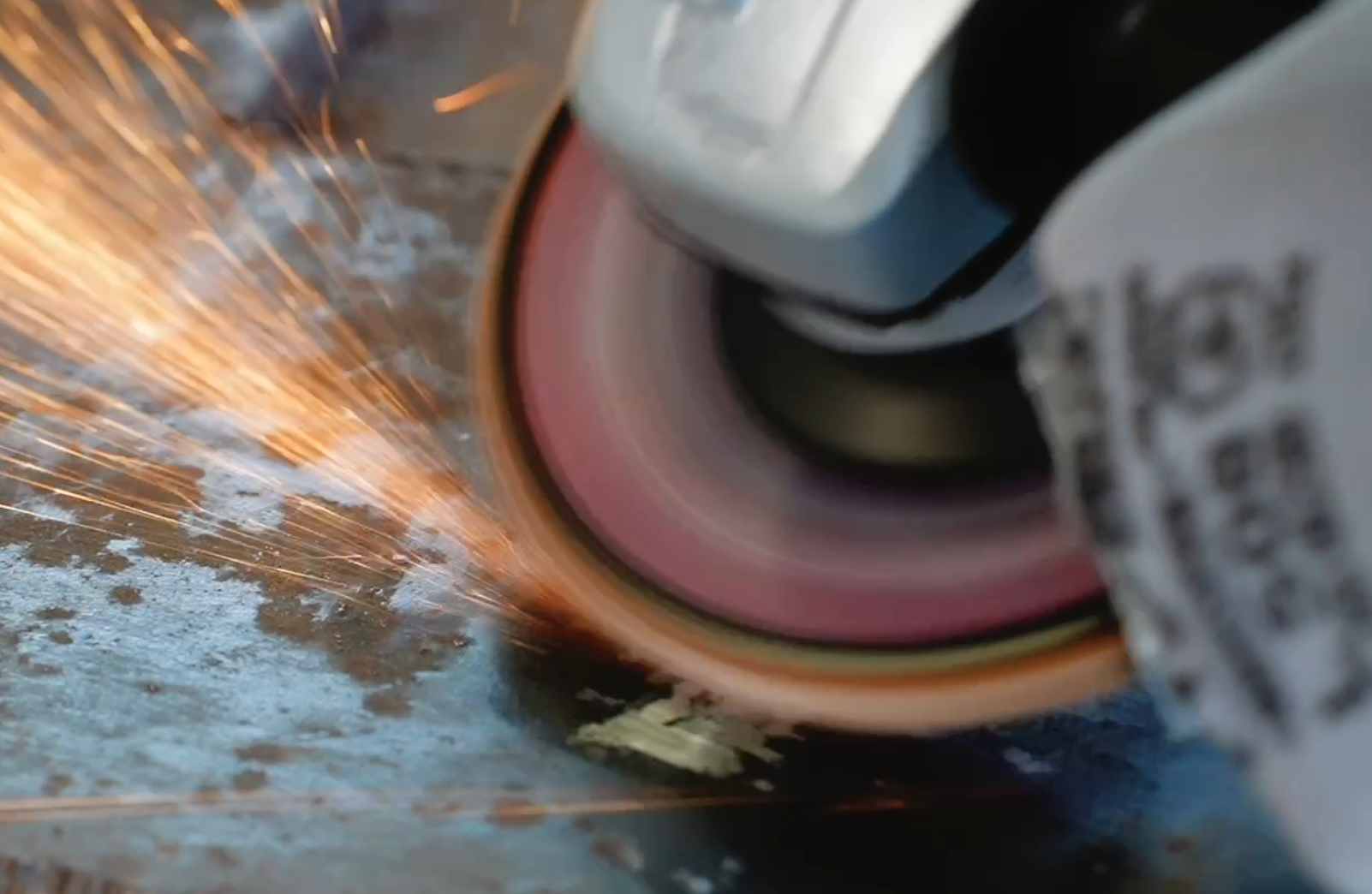
Most grinding operators judge a flap disc by how aggressively it cuts.
Engineers evaluate something different:
How much of the abrasive surface is actually cutting at any given moment?
Contrary to intuition, a flap disc never uses its entire abrasive surface simultaneously. During grinding, only a relatively small portion of the disc is actively removing material. Everything else is approaching, leaving, or recovering from the contact zone.
This small area—the Active Cutting Zone—determines nearly every aspect of grinding performance.
1. Contact Area Is Not Cutting Area
A flap disc may contain dozens of abrasive flaps, yet only a limited number of abrasive grains are engaged with the workpiece at any instant.
As rotational speed increases, the contact zone becomes a continuously moving interface where three events occur simultaneously:
New grains enter the cut.
Active grains remove material.
Worn grains leave the contact zone and cool before the next engagement.
The objective is not to maximize contact area.
It is to maximize effective cutting density within the contact area.
An excessively large contact patch increases friction, heat generation, and operator effort without proportionally increasing material removal.
2. Pressure Distribution Determines Grain Efficiency
Grinding pressure is never distributed uniformly.
The leading edge of the contact zone carries the highest mechanical load, while the trailing edge primarily experiences friction and thermal accumulation.
When flap geometry is poorly designed, pressure concentrates on a limited number of abrasive grains.
The result is predictable:
Premature grain fracture
Uneven flap wear
Localized overheating
Reduced metal removal consistency
A well-engineered flap disc distributes mechanical load progressively across multiple abrasive layers, allowing thousands of grains to share the cutting work rather than overloading only a few.
3. Abrasive Utilization Is the Real Performance Indicator
Many purchasing decisions still focus on grit type, ceramic percentage, or disc price.
From an engineering perspective, a more meaningful metric is abrasive utilization.
The question is not:
"How many abrasive grains are on the disc?"
The better question is:
"How many of those grains actually participate in cutting before the disc reaches the end of its service life?"
Higher utilization means:
More consistent cutting efficiency
Lower grinding temperature
Longer usable life
Better cost per part
In industrial production, utilization is often more valuable than simply increasing abrasive density.
4. Engineering the Active Cutting Zone
At VEXA, flap disc development extends beyond abrasive selection.
We optimize the entire contact system, including:
Flap overlap geometry
Abrasive exposure angle
Flexible backing support
Pressure distribution across the grinding arc
The objective is to maintain a stable Active Cutting Zone throughout the life of the disc, allowing fresh abrasive grains to engage continuously while minimizing unnecessary friction and heat generation.
Rather than increasing abrasive quantity, we focus on increasing effective abrasive participation.
That distinction is what separates a grinding disc from an engineered grinding system.
Engineering Insight
Grinding efficiency is rarely determined by the size of the abrasive surface.
It is determined by the percentage of that surface that performs useful cutting work.
The most productive flap discs are not those with the most abrasive—they are those that convert the highest proportion of abrasive into effective material removal.
VEXA Grinding System Engineering Series
Professional through focus.


