

The Architecture of a Cutting Disc: Safety and Performance Start Inside the Wheel
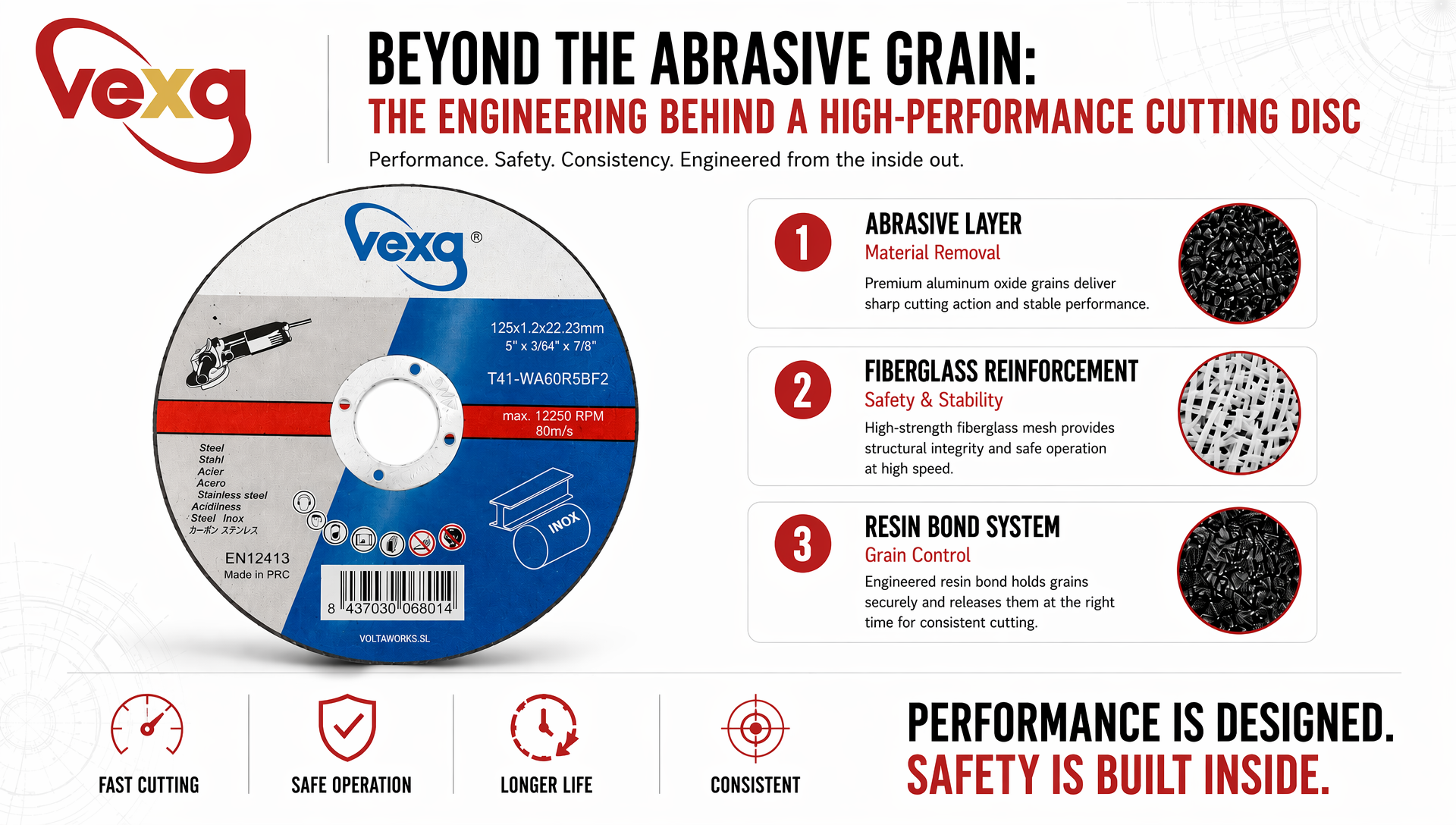
1. A Cutting Disc Is a Precision-Engineered Composite
During operation, a cutting disc experiences extremely demanding conditions.
A typical 125 mm cutting disc may rotate at more than 12,000 RPM, generating significant:
Centrifugal forces
Cutting stress
Vibration
Localized heat
At this speed, every layer inside the disc has a specific role.
The abrasive grain creates the cutting action.
The resin bond controls abrasive performance.
The fiberglass reinforcement provides structural stability.
The final performance comes from how these elements interact.
2. Abrasive Grain: The Starting Point of Cutting Performance
For resin bonded cutting discs, aluminum oxide remains the most widely used abrasive due to its balanced performance in metal applications.
Different aluminum oxide formulations can influence:
Cutting speed
Wear behavior
Material compatibility
Grinding feel
For general steel cutting, abrasive selection focuses on achieving a balance between:
Efficient material removal and controlled consumption.
A cutting disc is not designed simply to cut faster.
It must also maintain stable performance throughout its working life.
3. Resin Bond: Controlling the Cutting Process
The resin bond is more than a material that holds abrasive grains together.
It controls how the abrasive grains participate in cutting.
A well-designed bond system must achieve a precise balance:
Strong enough to retain grains during cutting
Ensuring effective material removal under operating stress.
Controlled enough to release worn grains
Allowing fresh abrasive edges to become active.
If the bond is too aggressive:
Dull grains remain trapped
Cutting efficiency decreases
Heat generation increases
If the bond releases too quickly:
Disc consumption increases
Working life decreases
The ideal resin system creates a controlled cutting cycle.
4. Fiberglass Reinforcement: The Foundation of Safety
One of the most critical components inside a cutting disc is the fiberglass reinforcement layer.
Its role is to provide:
Mechanical strength
Impact resistance
Rotational stability
Different cutting applications require different reinforcement strategies.
Ultra-thin cutting discs
Focus on:
Lower cutting resistance
Faster penetration
Reduced material loss
Heavy-duty cutting discs
Require:
Higher structural strength
Better resistance to side loads
Stable performance under demanding conditions
The challenge is achieving the right balance between:
Cutting efficiency and operational safety.
5. Why Ultra-Thin Cutting Discs Require More Engineering
A thinner cutting disc may appear simple.
In reality, reducing thickness increases the requirements for manufacturing precision.
A high-performance ultra-thin disc requires careful control of:
Abrasive distribution
Resin bonding consistency
Reinforcement positioning
Disc balance
The goal is not only making the disc thinner.
It is maintaining reliable cutting performance while reducing:
Cutting force
Heat generation
Material waste
6. VEXA Engineering Approach: Designing the Balance Between Speed, Life and Safety
A high-performance cutting disc is always the result of engineering compromises.
Increasing cutting speed usually requires a more aggressive abrasive structure.
Extending wheel life requires stronger grain retention.
Improving safety requires sufficient reinforcement strength.
These goals often compete with each other.
The challenge is not maximizing one single performance factor.
The challenge is finding the right balance.
Abrasive Structure: Optimizing Cutting Efficiency
A cutting disc must generate enough cutting action without creating excessive friction.
The abrasive system is engineered to achieve:
Effective penetration into the workpiece
Stable cutting performance
Controlled abrasive consumption
The objective is not the fastest initial cut.
It is maintaining efficient cutting throughout the operation.
Bond System: Managing Abrasive Release
The resin bond determines how the abrasive surface evolves during cutting.
A balanced bond system allows:
Secure grain retention under cutting load
Controlled release of worn abrasive
Continuous exposure of fresh cutting edges
This prevents two common failures:
Premature grain loss
→ Excessive disc consumption
Over-retention of dull grains
→ Increased force and heat generation
Reinforcement Design: Maintaining Safety Under Stress
A cutting disc must remain structurally stable while operating at high rotational speed.
Fiberglass reinforcement design influences:
Disc strength
Resistance to impact
Dimensional stability
For ultra-thin discs, the engineering challenge becomes even greater:
Achieving lower cutting resistance without compromising safety.
Manufacturing Consistency: The Difference Between a Product and a Solution
Even with the correct formulation, performance depends on manufacturing precision.
Critical factors include:
Uniform abrasive distribution
Consistent resin mixing
Accurate reinforcement positioning
Stable disc balance
Because in professional cutting applications, reliability comes from reducing variation.
At VEXA, cutting disc engineering is not focused on creating the most aggressive wheel.
It is focused on creating a predictable cutting system where speed, durability, and safety remain balanced.
Engineering Perspective
A cutting disc may only be a few millimeters thick.
But inside this thin structure exists a complex engineering system.
Performance does not come from one individual component.
It comes from the precise interaction between abrasive, bond, reinforcement, and design.
Because professional cutting is not only about removing material.
It is about controlling the entire cutting process.
VEXA — Professional through focus.


