

The Hidden Cost of Grinding - Productivity Lost Between Two Wheel Changes
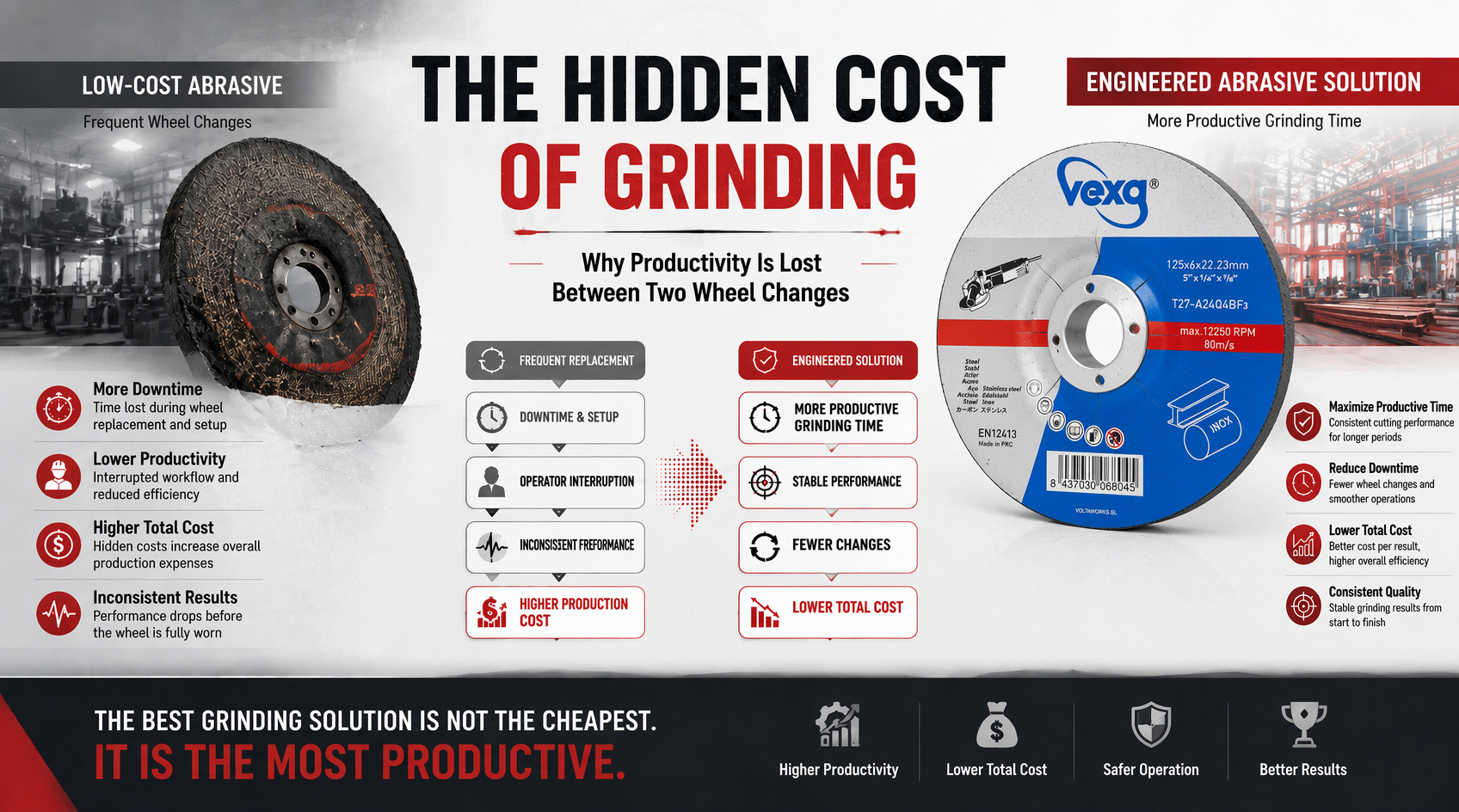
In industrial grinding, abrasive cost is often viewed as a simple purchasing decision.
A lower-priced grinding wheel appears to provide immediate savings.
However, in heavy-duty applications, the price of the abrasive itself is rarely the largest cost.
The real cost is hidden in the time between two wheel changes.
Every replacement represents more than a new wheel.
It represents lost productivity.
1. The True Cost Behind a Grinding Wheel
When a grinding wheel reaches the end of its useful life, the visible cost is easy to calculate:
New wheel → New purchase → Replacement
But the actual production impact includes much more:
Machine downtime during replacement
Operator interruption
Restart and adjustment time
Reduced production continuity
Variation in grinding results
In many industrial environments, the minutes spent changing and adjusting tools can cost more than the abrasive itself.
The wheel price is visible.
The productivity loss is hidden.
2. Why Low-Cost Abrasives Can Become Expensive
A lower purchase price does not always mean lower grinding cost.
Abrasives with unstable wear behavior may create additional operational losses:
Faster cutting decline
The wheel still has remaining material, but cutting efficiency decreases.
Operators compensate by increasing pressure.
Higher consumption rate
Frequent wheel replacement increases:
Inventory requirements
Tool management workload
Production interruptions
Reduced process consistency
Different wear stages create different grinding behavior:
Initial aggressive cutting
Mid-life performance drop
Excessive force near the end
This variation affects both productivity and surface quality.
3. The Right Measurement: Cost Per Result
Abrasive performance should not be measured only by:
Cost per wheel
A more meaningful evaluation considers:
Material Removed Per Wheel
How much work can one abrasive actually complete?
Productive Grinding Time
How much time does the wheel spend efficiently removing material?
Total Cost Per Operation
Including:
Abrasive consumption
Labor input
Machine utilization
Production efficiency
The most economical abrasive is not necessarily the cheapest product.
It is the one that delivers the lowest cost per finished result.
4. Engineering for Productivity, Not Just Tool Life
At VEXA, heavy-duty grinding solutions are developed around a simple principle:
Maximize productive grinding time.
This requires balancing multiple engineering factors:
Abrasive Structure
Maintaining effective cutting ability under high mechanical load.
Bond Performance
Providing controlled grain retention and predictable wear behavior.
Reinforcement System
Supporting safe and stable operation during demanding applications.
The objective is not simply creating a wheel that lasts longer.
It is creating a wheel that continues to perform efficiently throughout its working cycle.
5. From Abrasive Product to Production Solution
In heavy fabrication, foundry processing, and metal preparation, every additional wheel change creates an opportunity loss.
The best grinding solution is not defined by the lowest unit price.
It is defined by:
Stable performance
Reduced interruption
Predictable consumption
Higher overall productivity
Because industrial grinding is not only about removing metal.
It is about optimizing the entire production process.
Engineering Perspective
A grinding wheel should not be evaluated by how much it costs when purchased.
It should be evaluated by how much value it creates before replacement.
The difference between a consumable abrasive and an engineered grinding solution is the ability to deliver consistent productivity throughout the process.
VEXA — Professional through focus.


