

Productivity Is Built Process by Process, Not Tool by Tool
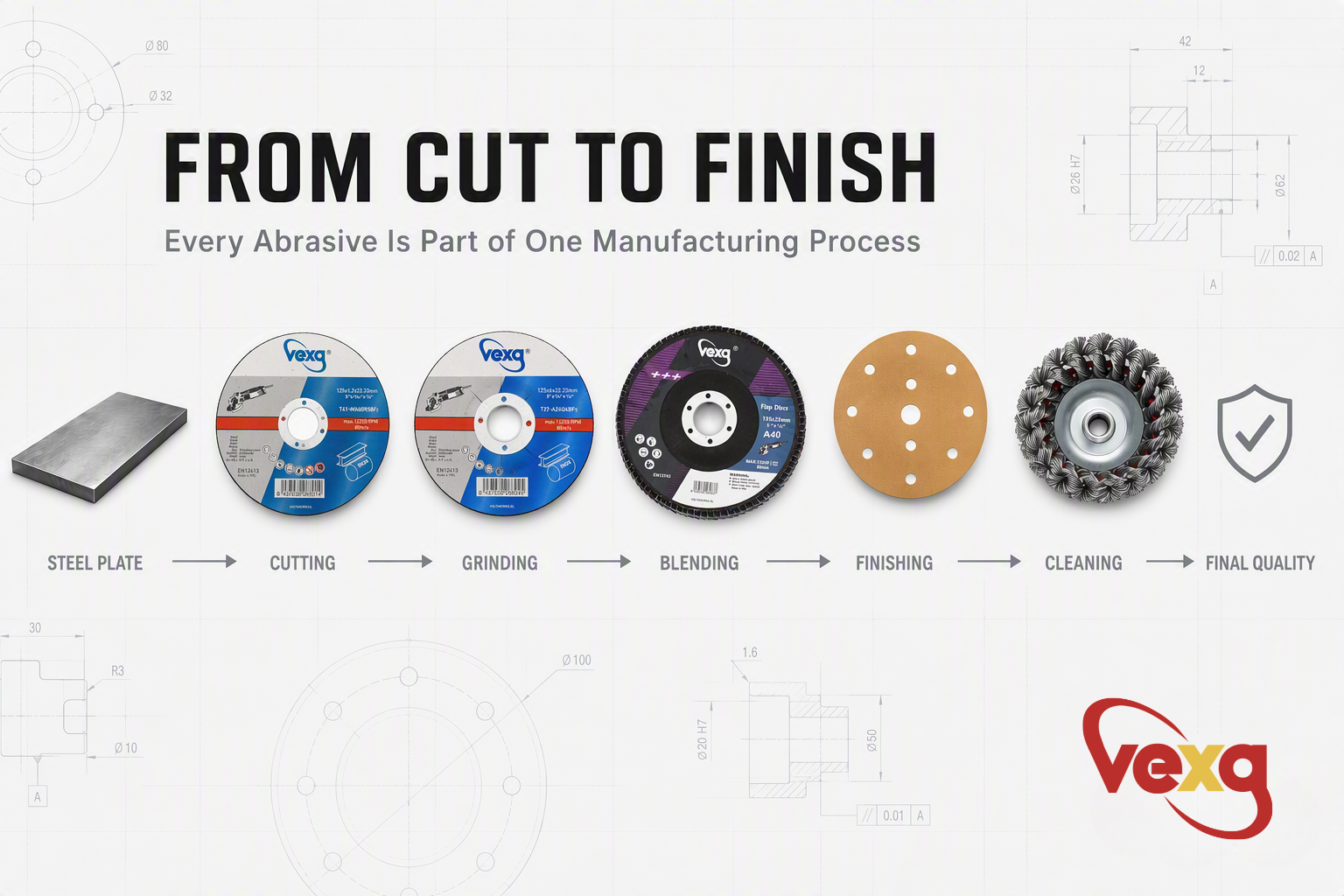
In many fabrication shops, abrasive tools are purchased individually.
A cutting disc is ordered.
A grinding wheel is replaced.
A flap disc is selected.
Each tool is evaluated on its own.
From a purchasing perspective, this seems logical.
From a manufacturing perspective, it often leads to hidden inefficiencies.
Because abrasive tools do not operate independently.
They form a complete manufacturing process.
Every stage influences the next.
1. Every Manufacturing Process Begins with Material Removal
A typical steel fabrication workflow rarely consists of a single operation.
Instead, it follows a sequence of interconnected processes.
For example:
Cutting → Edge Preparation → Weld Grinding → Surface Blending → Surface Finishing → Inspection
Each stage changes the condition of the workpiece.
Every decision made upstream directly affects the efficiency of the following operation.
Improving only one step rarely produces the greatest productivity gain.
Optimizing the entire process does.
2. Faster Cutting Does Not Always Mean Higher Productivity
Cutting speed is often used as the primary benchmark when selecting a cutting disc.
However, a faster cut is not necessarily a more productive cut.
Consider two scenarios.
Disc A completes the cut slightly faster but leaves a rough edge that requires extensive grinding.
Disc B takes a few seconds longer but produces a cleaner edge with less burr formation.
The total manufacturing time may actually be shorter with Disc B because downstream grinding and finishing are reduced.
This is the difference between operation efficiency and process efficiency.
Professional manufacturing measures the second.
3. Every Surface Carries Information into the Next Process
The condition of the workpiece after each operation determines how much work remains.
A rough grinding pattern increases blending time.
Deep scratches require additional finishing passes.
Excessive heat may alter the surface and create discoloration or distortion.
Poor surface preparation can even reduce coating or welding quality.
Material removal is not only about removing metal.
It is about preparing the surface for the next operation.
4. Tool Matching Is More Important Than Individual Tool Performance
High-performing tools do not automatically create a high-performing process.
Imagine pairing:
An aggressive cutting disc
A coarse grinding wheel
An unsuitable flap disc
Each tool may perform well individually.
Together, they may generate unnecessary rework, inconsistent surface quality, and frequent tool changes.
A productive workflow requires each abrasive tool to complement the previous and the next process.
The objective is continuity—not isolated performance.
5. The Hidden Cost Is Between Two Tool Changes
Most manufacturers calculate the cost of an abrasive by the purchase price.
Few calculate the cost created between two abrasive operations.
That hidden cost includes:
Additional handling
Extra grinding passes
Rework
Operator fatigue
Machine downtime
Surface inconsistency
These costs are rarely visible on an invoice.
But they often exceed the value of the abrasive itself.
In many production environments, the greatest opportunity for improvement is not using a cheaper tool.
It is reducing unnecessary process steps.
6. VEXA Engineering Approach
At VEXA, we view abrasives as components of a manufacturing system rather than standalone consumables.
When developing a product portfolio, we consider how each tool contributes to the next stage of production.
Our objective is to help manufacturers build a process that is:
Efficient from the first cut to the final finish
Consistent across different operators and production batches
Optimized for total productivity rather than individual tool performance
Because the best abrasive is not simply the one that removes material fastest.
It is the one that helps complete the entire process more efficiently.
Engineering Takeaway
Manufacturing productivity is rarely determined by a single tool.
It is determined by how well every process connects to the next.
When abrasive tools are selected as part of a complete workflow rather than independent products, manufacturers gain more than better cutting or grinding performance.
They gain shorter cycle times, more consistent quality, and lower total production cost.
Professional manufacturing is not built tool by tool.
It is built process by process.
VEXA — Professional through focus.


