

Every Tool Leaves a Surface Behind - Surface Quality Is Determined Long Before the Final Finish
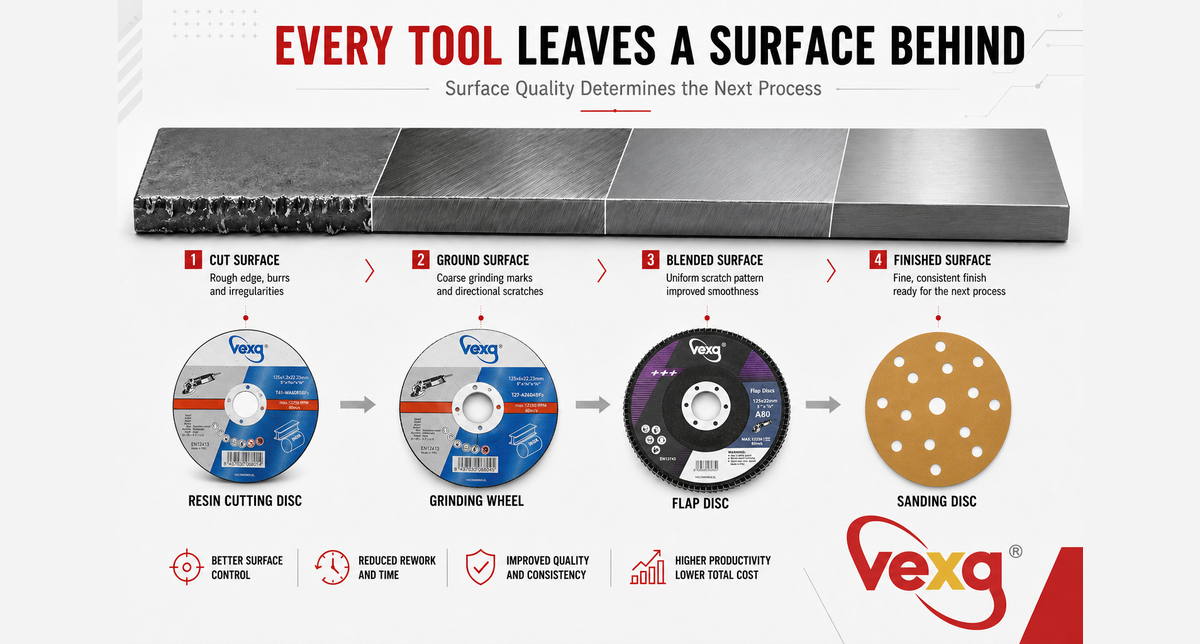
When evaluating abrasive tools, most attention is given to material removal.
How fast does it cut?
How long does it last?
How much material can it remove?
These are important questions—but they tell only part of the story.
Every abrasive operation leaves behind a surface.
And that surface becomes the starting point for the next manufacturing process.
Whether the next step is welding, coating, painting, polishing, or assembly, the quality of the previous surface directly influences the quality of the final product.
Professional manufacturing is not simply about removing material.
It is about creating the right surface for what comes next.
1. Every Abrasive Process Creates a Surface Condition
Cutting leaves an edge.
Grinding leaves a profile.
Flap discs blend transitions.
Sanding refines the scratch pattern.
Wire brushes expose clean base material.
Each tool changes more than geometry—it changes the condition of the surface itself.
That condition determines how efficiently the next operation can be completed.
2. Surface Quality Is Cumulative
Manufacturing errors rarely appear suddenly.
More often, they accumulate.
A rough cut requires additional edge preparation.
Deep grinding scratches demand extra blending.
Excessive heat may discolor stainless steel and increase finishing time.
Poor surface preparation can reduce coating adhesion or affect weld consistency.
Every unnecessary defect carries forward into the next process.
The later it is corrected, the more expensive it becomes.
3. Good Surface Preparation Reduces Rework
Many manufacturers try to improve productivity by increasing cutting speed or applying more pressure.
In reality, reducing rework often creates a greater improvement.
A cleaner cut can shorten grinding.
A controlled grinding pattern can reduce flap disc wear.
A consistent finish can eliminate unnecessary polishing.
The objective is not to make one operation faster.
It is to reduce the work required in every operation that follows.
4. Abrasive Selection Should Consider the Entire Workflow
Choosing an abrasive only by purchase price or removal rate can be misleading.
The better question is:
What surface does this tool leave behind?
A tool that removes material slightly slower may produce a surface that requires significantly less downstream processing.
When evaluated across the entire production cycle, it often becomes the more productive choice.
This is why process engineering always looks beyond the current operation.
5. VEXA Engineering Perspective
At VEXA, we believe every abrasive should be evaluated not only by how it performs today, but by how it influences tomorrow's operation.
Whether developing cutting discs, grinding wheels, flap discs, sanding discs, or wire brushes, our focus is the same:
Create stable, predictable surface conditions that support the entire manufacturing process.
Because manufacturing efficiency is built one process at a time—and every process begins with the surface left by the previous one.
Engineering Takeaway
Every abrasive removes material.
The best abrasives also prepare the next operation.
That is the difference between completing a task and improving a manufacturing process.
The quality of the final product often begins with the surface created by the very first tool.
VEXA — Professional through focus.


