

Wire Brush Life Is Not Determined by Wire Thickness Alone The Engineering Behind Filament Fatigue, Cleaning Efficiency and Tool Life
A common assumption in industrial wire brushing is simple:
Thicker wire = longer brush life.
It sounds logical.
A thicker filament is stiffer, more resistant to deformation, and capable of delivering a more aggressive brushing action.
But wire brush performance is not determined by diameter alone.
The real engineering problem is much more dynamic:
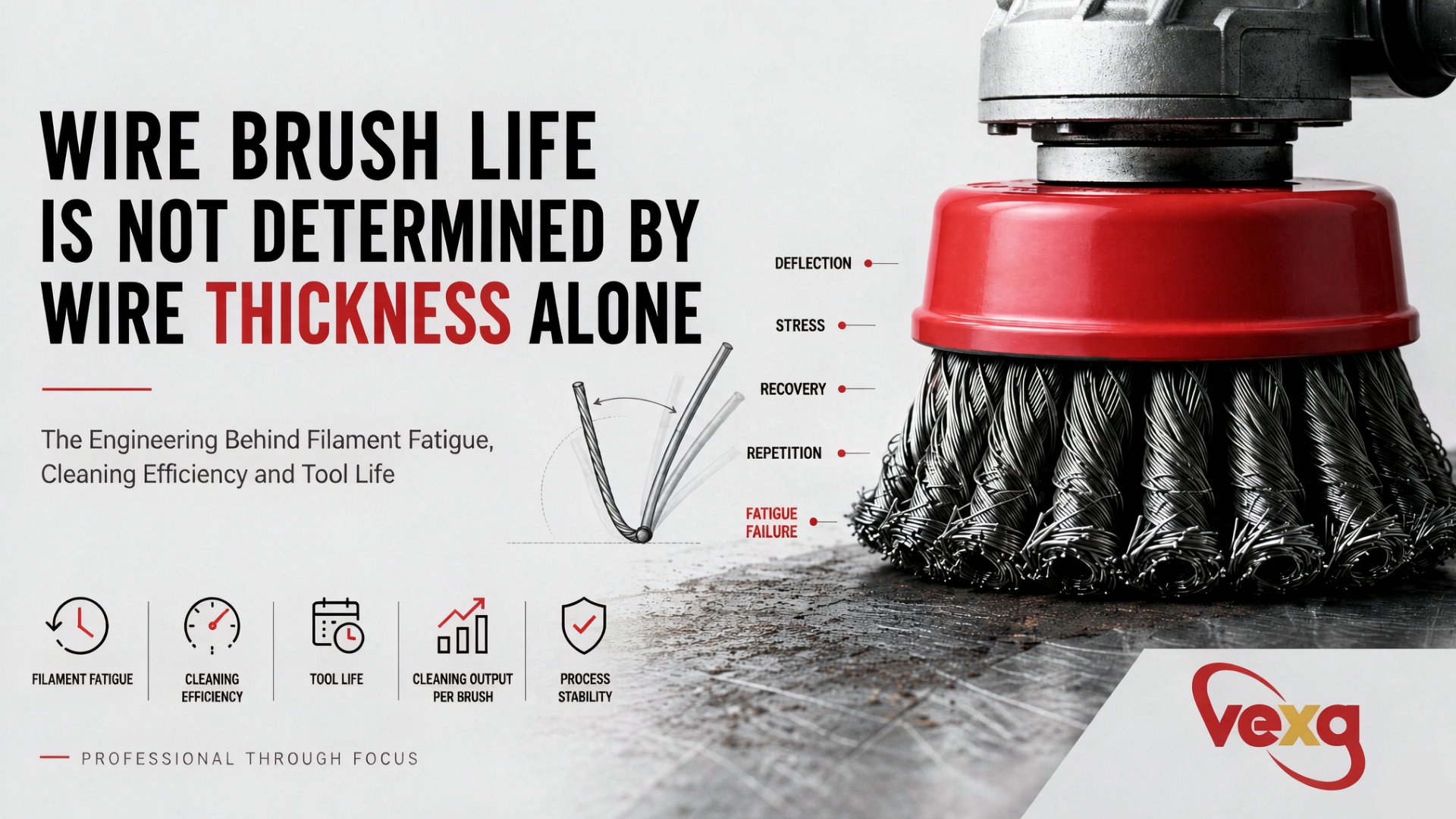
Deflection → Stress → Recovery → Repetition → Fatigue
Every filament experiences this cycle thousands of times during operation.
And eventually, that cycle determines both cleaning performance and brush life.
1. A Wire Filament Is a Flexible Mechanical Element
During brushing, a filament bends as it contacts the workpiece.
It then attempts to recover its original position as it moves away from the contact zone.
This happens continuously.
The greater the deflection, the greater the mechanical stress experienced by the filament.
Under repeated loading, the filament is subjected to a fatigue cycle rather than a single mechanical event.
This means that brush life depends not only on how strong the wire is, but also on:
Filament diameter
Unsupported length
Deflection
Rotational speed
Contact pressure
Working conditions
The brush is effectively operating as a large collection of miniature flexural elements.
2. More Pressure Can Create a False Sense of Productivity
When cleaning becomes slower, increasing pressure is often the first response.
Initially, this can increase contact force and material removal.
But beyond an optimal working range, the additional pressure produces diminishing returns.
Higher pressure can cause:
Greater filament deflection
→ higher cyclic stress
→ accelerated fatigue
→ increased wire breakage
→ shorter brush life
At the same time, excessive pressure can reduce the ability of individual filament tips to move efficiently across the surface.
The result can be a paradox:
More force, but not proportionally more cleaning.
This is one reason aggressive brushing should not be confused with efficient brushing.
3. Wire Diameter Is a Stiffness Variable — Not a Simple Life Indicator
Increasing wire diameter changes filament stiffness.
A thicker wire can provide stronger mechanical contact and greater resistance to bending.
This can be beneficial for:
Heavy rust
Weld residue
Scale
Foundry contamination
But stiffness also changes how the filament interacts with the workpiece.
If the filament is too stiff for the application, the brush may become less conformable and concentrate contact more aggressively at the tips.
If it is too flexible, mechanical energy may be dissipated through excessive deflection instead of effective surface removal.
The objective is therefore not:
Maximum wire diameter.
It is:
The correct stiffness for the required cleaning mechanism.
4. Trim Length Changes the Mechanical Response
Two brushes can use the same wire diameter and still behave very differently.
The reason can be trim length.
A longer unsupported filament has greater freedom to deflect.
A shorter filament behaves as a stiffer mechanical element.
This creates an important engineering relationship:
Wire diameter + trim length = filament stiffness and flexibility
That relationship influences:
Contact behavior
Surface conformity
Cleaning aggression
Fatigue rate
Brush life
This is why evaluating wire diameter without considering brush construction provides only part of the picture.
5. Tool Life Is Not the Same as Production Productivity
Consider two brushes.
Brush A
Longer service life.
Lower cleaning rate.
Brush B
Shorter service life.
Higher cleaning rate.
If Brush A cleans 100 parts before replacement while Brush B cleans 180 parts in the same production time, the longer-lasting brush is not necessarily the more productive solution.
This changes how brush performance should be evaluated.
Instead of asking:
“How many hours does the brush last?”
A production engineer should also ask:
“How much useful work does the brush produce before replacement?”
That can include:
Parts cleaned
Surface area processed
Kilograms of contamination removed
Production time saved
The meaningful metric is not simply brush life.
It is cleaning output per brush.
6. The Real Optimization Is a Balance
Industrial wire brush design involves several competing variables.
More aggressive contact can increase removal rate—but may accelerate fatigue.
Higher stiffness can improve mechanical action—but may reduce conformity.
Higher pressure can increase force—but may reduce efficiency beyond the optimal range.
Longer trim can improve flexibility—but may reduce concentrated contact.
There is no single parameter that determines the best result.
The engineering objective is to find the operating window where:
Cleaning rate + Surface control + Filament life + Process stability
are balanced.
That is where a wire brush becomes a production tool rather than simply a consumable.
7. How VEXA Approaches Wire Brush Development
At VEXA, we evaluate wire brushes as mechanical systems rather than collections of individual specifications.
Our development process considers the interaction between:
Filament diameter
× Trim length
× Construction
× Fill density
× Working speed
× Contact conditions
The goal is not to maximize one parameter.
It is to achieve a controlled mechanical response that matches the application.
For industrial customers, this becomes particularly important when dealing with:
Premature wire breakage
Short brush life
Slow cleaning
Inconsistent surface results
Excessive operator pressure
Frequent brush replacement
These symptoms can indicate a mismatch between the brush construction and the actual application.
Engineering Takeaway
A wire brush does not fail simply because the wire becomes “too thin.”
Its working life is determined by the mechanical history of thousands of filaments undergoing repeated deformation.
That is why:
Wire diameter is only one variable.
Real brush performance comes from the interaction between stiffness, deflection, stress, fatigue, contact conditions, and cleaning output.
The best brush is therefore not necessarily the one that lasts the longest.
It is the one that delivers the highest useful output within the required process conditions.
Have a wire brush that breaks too quickly, cleans too slowly, or wears unpredictably?
Send us:
Material + Contamination + Machine + RPM + Current Brush Construction + Target Result
We can evaluate the application and recommend a suitable brush construction for real-world testing.
VEXA — Professional through focus.


