

When a Sanding Disc Stops Cutting, the Abrasive May Not Be the Problem: The Hidden Role of Dust Evacuation in Sanding Performance
A sanding disc can still look abrasive.
The grains are still visible.
The backing is still intact.
Yet the cutting rate has already dropped significantly.
Operators often respond by applying more pressure.
The disc gets hotter.
The surface begins to load.
And productivity continues to fall.
In many sanding applications, the problem is not abrasive wear.
It is what happens to the material removed from the surface.
1. Sanding Creates a Continuous Waste-Removal Problem
During sanding, abrasive grains fracture and cut the workpiece.
At the same time, the process generates:
Abrasive particles
Paint dust
Coating residue
Wood dust
Metal particles
Composite material debris
These particles must leave the cutting interface.
If they remain between the abrasive and the workpiece, they begin to occupy the spaces around the abrasive grains.
The cutting interface gradually becomes less open.
This is the beginning of loading.
Once loading increases, the disc can transition from an efficient cutting mechanism toward a friction-dominated mechanism.
The operator may still feel pressure against the workpiece.
But less of that energy is being converted into effective material removal.
2. This Is Where the Structure of a Mesh Disc Becomes Important
A conventional sanding disc has a relatively continuous backing.
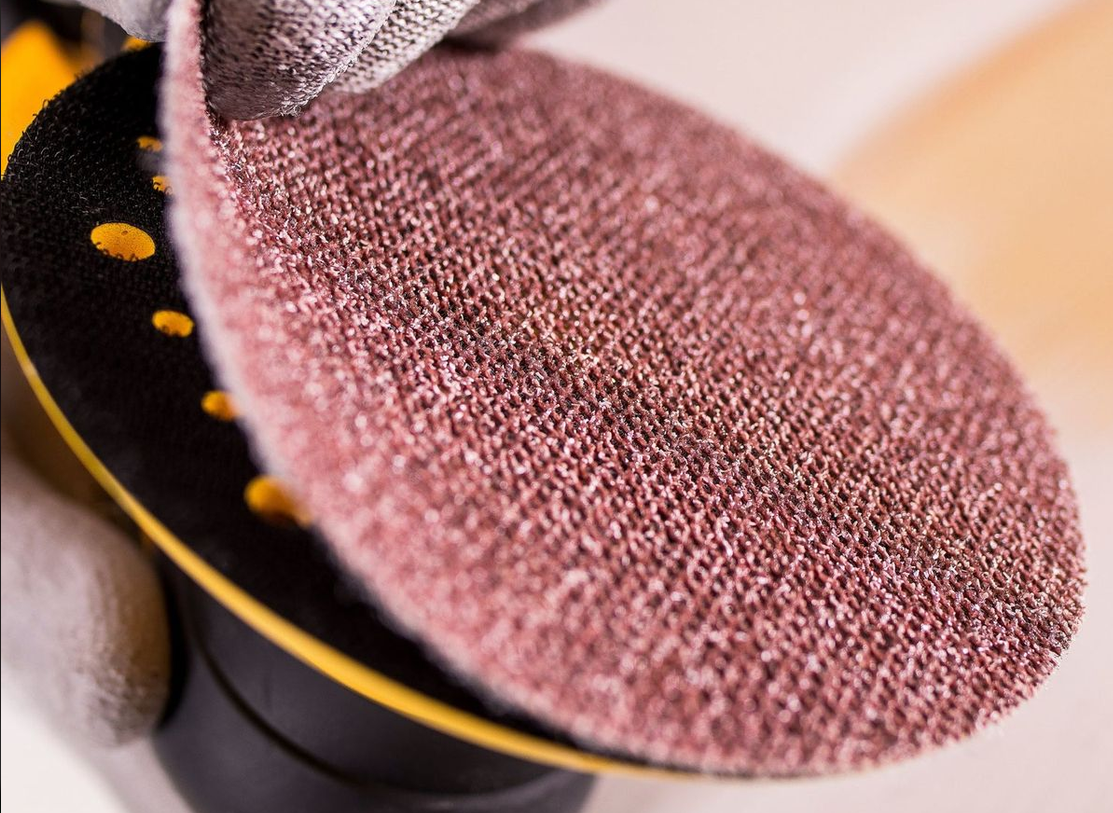
A mesh sanding disc uses an open abrasive structure that creates pathways through the disc.
The objective is not simply to make the disc “look like a mesh.”
The engineering objective is to maintain a more open material-removal environment around the abrasive interface.
During sanding, removed particles have more opportunities to move away from the contact zone.
This can reduce the tendency for debris to accumulate directly around the cutting points.
The result is a fundamentally different wear environment.
Instead of:
Cut → Debris accumulates → Loading increases → Friction rises → Cutting efficiency falls
the objective becomes:
Cut → Debris evacuates → Abrasive remains more exposed → Cutting continues
That difference becomes increasingly important during long sanding cycles.
3. Loading Changes the Energy Balance
Consider what happens when an abrasive surface begins to load.
The exposed cutting points become partially covered.
The effective cutting geometry changes.
More energy is converted into friction.
Friction generates heat.
Heat can soften coatings, accelerate loading, and further reduce cutting efficiency.
This creates a feedback loop:
Loading → Friction → Heat → More Loading → Lower Cutting Efficiency
This is why a disc can suddenly feel “dead” even though a significant amount of abrasive material remains.
The issue is not necessarily that the abrasive has disappeared.
The abrasive may simply no longer be operating under an efficient cutting condition.
4. Open Structure Does Not Automatically Mean Better Performance
This is an important distinction.
A mesh backing alone does not guarantee a high-performance sanding disc.
The final result depends on the interaction between:
**Abrasive grain
Grain distribution
Bonding system
Mesh structure
Open area
Backing strength
Dust evacuation
Application**
If the abrasive structure is poorly engineered, increasing the open area can also reduce effective abrasive coverage or structural stability.
The challenge is therefore not to create the most open structure possible.
It is to create the right balance between abrasive density, openness, flexibility, and structural integrity.
That is where mesh sanding becomes an engineering problem rather than simply a different backing material.
5. The Real Productivity Advantage Appears During the Wear Cycle
A sanding disc should not be evaluated only during its first few minutes.
The more meaningful question is:
How does its cutting behavior change as sanding continues?
A conventional disc may begin with strong cutting performance.
As loading increases, its effective cutting rate can decline.
A well-engineered mesh disc can maintain a more open cutting interface for longer, particularly in applications where dust generation and loading are major limiting factors.
This changes the performance curve.
The value is not necessarily a dramatically higher peak cutting rate.
It can be a slower performance decline over the usable life of the disc.
For production users, that difference matters.
6. Pressure Is Not a Substitute for Abrasive Efficiency
When a disc begins to cut slowly, increasing pressure often feels like the obvious solution.
But pressure cannot permanently compensate for a loaded abrasive surface.
Higher pressure can increase contact force, but it can also increase:
Friction
Heat
Operator fatigue
Surface risk
Abrasive wear
The better solution is to maintain an efficient cutting interface in the first place.
This is one reason dust evacuation should be considered part of sanding performance—not simply a cleanliness issue.
7. Where Mesh Sanding Discs Make the Most Sense
Mesh sanding becomes particularly interesting when loading and dust management are major limitations.
Typical applications can include:
Automotive refinishing
Primer, filler, paint, and bodywork materials can generate significant sanding debris.
Woodworking
Wood dust can rapidly accumulate on conventional abrasive surfaces.
Composite materials
Fiberglass and composite dust can create challenging loading conditions.
Drywall and surface preparation
Large amounts of fine particulate matter can reduce the effectiveness of conventional sanding surfaces.
The exact abrasive construction should still be matched to the substrate and application.
Mesh is not a universal replacement for conventional sanding discs.
It is a different engineering approach to managing the sanding interface.
8. The VEXA Engineering Perspective
At VEXA, we look at mesh sanding from the perspective of effective cutting time.
The question is not simply:
How much abrasive is on the disc?
It is:
How long can that abrasive remain in an efficient cutting condition?
That requires balancing:
Abrasive performance
Open structure
Dust evacuation
Grain exposure
Backing strength
Flexibility
Wear behavior
A sanding disc becomes valuable when it continues to produce useful work—not simply when abrasive material remains visible on the surface.
Engineering Takeaway
A sanding disc does not necessarily stop working because the abrasive has worn away.
Sometimes, it stops working because the cutting interface has become inefficient.
That is why loading control, heat management, and dust evacuation can be just as important as abrasive aggressiveness.
For mesh sanding, the real engineering objective is simple:
Keep the cutting interface open for longer.
Because in sanding, usable abrasive life is not only about how much abrasive remains.
It is about how long that abrasive remains effective.
Testing a mesh sanding disc in your application?
If you are experiencing:
Rapid loading
Declining cutting performance
Excessive dust accumulation
High sanding temperature
Short effective disc life
send us:
Material + Grit + Machine + Application + Current Sanding Disc
We can evaluate the application and recommend a suitable mesh sanding construction for testing.
VEXA — Professional through focus.


