

Why a Stainless Cutting Disc Stops Working After One Carbon Steel Job
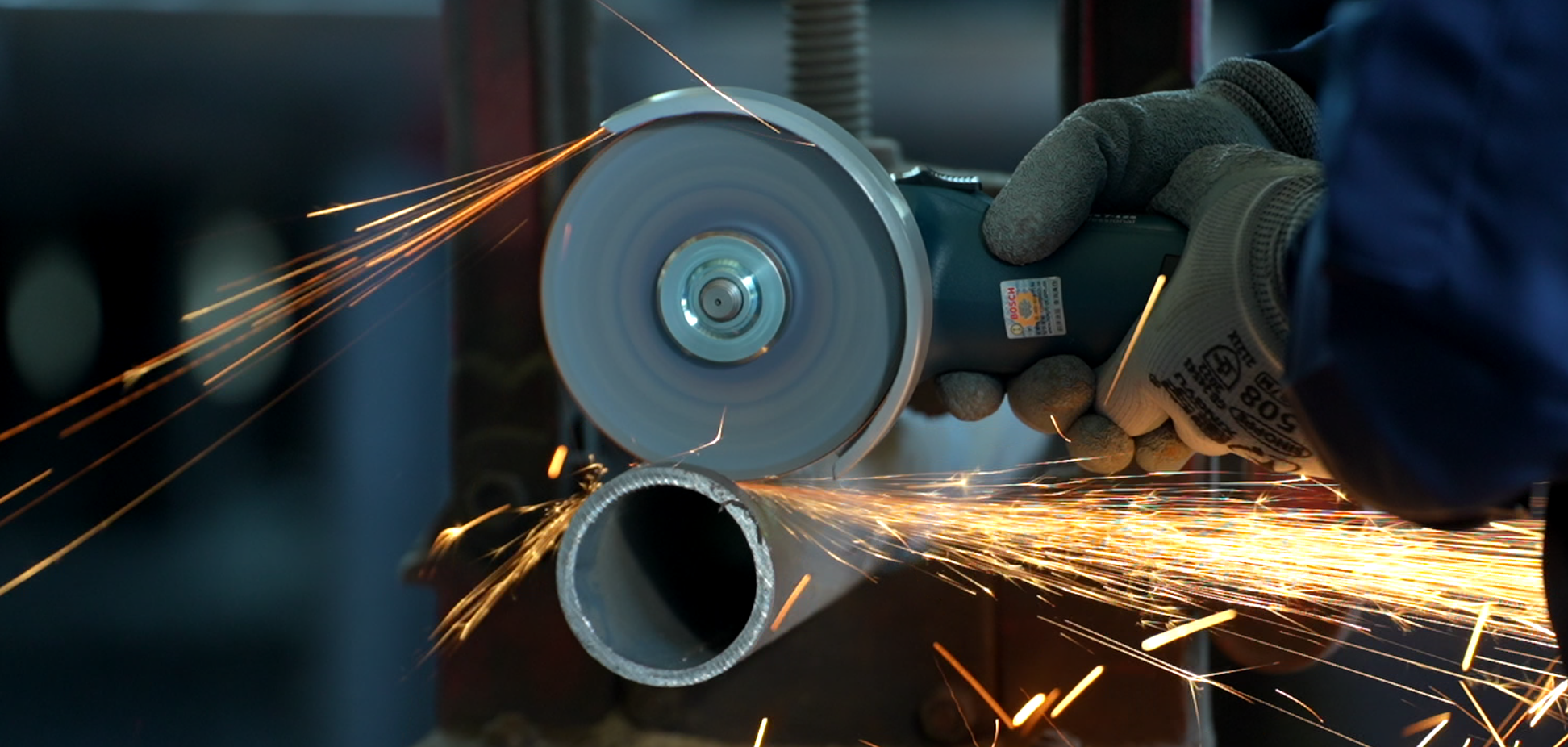
An INOX cutting disc can cut stainless steel perfectly on Monday.
Then someone uses it on a piece of mild steel on Tuesday.
On Wednesday it is back on stainless — and the cut edge starts showing rust spots within days.
The disc is not worn out.
The problem started on Tuesday.
1. Stainless Steel Is Not "Harder Steel"
The instinct is to treat stainless as a tougher version of carbon steel.
It is not. It is a different thermal system.
Austenitic stainless conducts heat away from the cutting zone substantially more slowly than carbon steel does. The heat generated at the contact point therefore has fewer places to go. More of it stays in the disc, in the workpiece, and in the immediate cut edge.
That is the first half of the problem.
The second half is chemistry.
2. Why a Standard Disc Works Fine on Carbon Steel
On mild steel, the cutting system is forgiving:
The workpiece pulls heat away quickly
Chips carry a meaningful share of the thermal load out of the kerf
A discoloured cut edge is usually still perfectly serviceable
A standard aluminium oxide disc is designed around those conditions. It is not a bad disc. It is a disc matched to a different thermal environment.
Put it on stainless and the same wheel begins working against its own design assumptions.
3. The Failure Mode Most People Miss: Contamination
Here is the part that never shows up in a hardness or grit comparison.
An abrasive disc that has cut carbon steel carries ferrous particles — embedded in the bond, lodged between grains, and sitting on the surface.
Press that disc into a stainless workpiece and those particles transfer.
The stainless surface now has free iron sitting on it. Free iron oxidises. And because stainless relies on a passive chromium oxide layer to resist corrosion, contamination gives corrosion a place to start — typically as small rust spots along the cut edge, appearing days after the job is finished.
The disc looks fine. The cut looks fine.
The problem shows up later, at the customer's site.
4. Three Contaminants, Not One
Ferrous transfer is the visible one. There are two more that are just as consequential and far less obvious.
Iron. Transferred from tooling, from a previously cut workpiece, or from a contaminated workbench. Shows up as rust spotting.
Sulphur. Present in some bond fillers. In stainless, sulphur can take part in sensitisation reactions at elevated temperature, which affects corrosion resistance at the grain boundaries.
Chlorine. Also bond- and filler-related. Chlorine is a well-known contributor to stress corrosion cracking in austenitic stainless — which is why stainless fabricators are careful about what touches the surface at every step of the process.
This is why the "INOX" designation on a cutting disc is not marketing language. It is a declaration about what the disc does not contain — and about what it has not been previously used on.
Discs declared for stainless service are commonly published as free of iron, sulphur and chlorine, with ≤0.1% stated as standard range data by European suppliers. When you buy, ask for that declaration in writing — not as a logo on the blotter.
5. Why 1.2 mm Matters More Here Than Anywhere Else
Thin discs are usually sold on speed.
On stainless, the stronger argument is heat.
A cutting disc removes material along a contact arc. That arc has an area, and the heat generated is distributed across it. A thinner disc means a narrower contact area and less abrasive mass entering the cut. That shifts the thermal balance in two ways: less bond material to absorb heat, and less contact surface generating friction heat per unit of travel.
The practical result is less heat going into the workpiece, and a narrower heat-affected zone along the cut edge.
That matters more on stainless than on mild steel, for the reason in section 1: there is less thermal capacity downstream to absorb the mistake.
VEXA's stainless-capable cutting discs run a 1.2 mm profile at Ø115 and Ø125 for exactly this reason.
6. Heat Tint Is Not a Cosmetic Complaint
A straw-to-blue discolouration along a cut edge is commonly accepted as normal.
It is a record of temperature. Those colours correspond to oxide film thickness, which corresponds to how hot the material became and for how long.
In austenitic stainless, sustained time in the sensitisation temperature range can precipitate chromium carbides at the grain boundaries — pulling chromium out of solid solution and locally reducing corrosion resistance.
A discoloured edge on stainless is therefore a process signal, not a finish issue.
The fix is not to polish it out. It is to reduce the heat that produced it.
7. What the Marking Already Tells You
Before any of this reaches a specification discussion, the disc itself already carries the information.
Under EN 12413, hand-held cut-off and grinding wheels of Type 27, 28, 29, 41 and 42 are required to be marked with:
Manufacturer, supplier or importer identification
Nominal dimensions in mm, including the bore
The specification mark, in accordance with ISO 525
Maximum operating speed, in m/s
Maximum permissible rotation speed, in rpm
Declaration of conformity (EN 12413)
Restriction of use
A traceability code
Safety signs
The oSa logo, where applicable
Private label number, where applicable
Two of these deserve a check when goods arrive.
The speed. 80 m/s is the common maximum operating speed for hand-held cut-off wheels, taken from Annex E of EN 12413. On a Ø115 disc that corresponds to approximately 13,300 rpm — comfortably above the output of a standard 115 mm angle grinder, which is the point. Under-marked or unmarked product is a compliance problem before it becomes a performance problem.
The date. Bonded products with B and BF bonds for hand-held machines must carry an expiry date — at the longest, three years from date of manufacture, expressed as month and year. An expiring disc is not a bargain, whatever the price per piece says.
Note also the bore figure: 7/8" is 22.23 mm. Not 22.2 mm, and not 22 mm. An undersized bore is a fit and runout problem on the machine.
8. The VEXA Engineering Perspective
We treat stainless cutting as a contamination control problem first, and a cutting performance problem second.
That changes the order in which specification decisions get made:
What can this disc put into the workpiece?
How much heat does the cut put into the edge?
And only then — how fast does it cut?
A fast disc that transfers iron into a stainless edge has not solved the customer's problem. It has moved it downstream, to their customer, several weeks later.
9. Engineering Takeaway
If a stainless cut starts rusting, the first question is not "was the disc sharp enough?"
Ask instead:
Is this disc designated for INOX service?
Has it ever touched carbon steel?
Is the discolouration along the edge a heat record rather than a finish defect?
A stainless cutting disc is not a sharper disc.
It is a disc whose bond chemistry and service history both stay out of the workpiece.
10. Choosing for a Specific Stainless Job?
If you are comparing discs for a particular application, these are the parameters that change the answer:
Material grade (304 / 316 / duplex) + Material thickness + Disc diameter + Machine type and power + Required edge quality + Daily cutting volume + Whether the disc is dedicated to stainless, or shared with carbon steel
Send us those seven. We can tell you whether the limiting factor is the disc, the machine, or the process.
11. Resin Bonded Cutting Discs — T41/T42, WA Alumina, EN12413
Maximum operating speed 80 m/s · INOX service designation · Shelf life 3 years from date of manufacture · MPA / EN12413 · OEM and ODM available
Free samples (up to 3 pieces, freight at buyer's cost) · MOQ from 1 box · Stock items ship within 7 days
VEXA — Professional through focus.
#StainlessSteel #CuttingDisc #INOX #MetalFabrication #AbrasiveEngineering #SurfacePreparation #EN12413 #VEXAAbrasives


