

The Wheel Stopped Biting. The Backing Told Us Why.
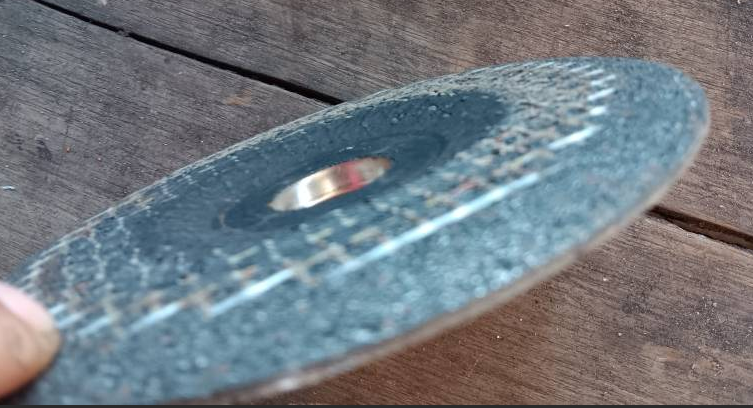
A fabricator sends four photos and one sentence: the wheel doesn't bite anymore — do you have anything sharper?
It is the most common grinding complaint there is. It is also, most of the time, a message about something other than the wheel.
Here is the process we run before we change anything.
THE WRONG FIRST ANSWER
The reflex is to ship a different wheel. Cheaper, or "sharper". It usually changes nothing, because the sentence "it stopped cutting" has at least four different causes — and only one of them is the wheel.
A wheel that has stopped biting is a data point. Read it before you replace it.
WHAT A USED WHEEL TELLS YOU
The wheel in the photos was a T27 depressed-centre, 125 x 6 x 22.23 mm. Two things were visible on it.
The face was glassy: bright, patchy, reflecting light instead of holding a cutting surface.
And the fibreglass backing was exposed — not at one spot, but across the working face.
That second detail is the one that matters.
You cannot expose the backing across the whole face by grinding on the edge of a wheel. Edge grinding removes material from the rim; if the wheel is used on its edge, the face stays intact and the backing never comes through. Full-face backing exposure means the wheel was laid flat against the workpiece and pushed — used like a sanding disc, not like a grinding wheel.
That is not a defect. It is a technique signature, and it is legible on the part.
There were no cracks. No delamination. No off-centre wear, no soft spots, no uneven density. Nothing in the four photos pointed to a structural failure of the wheel.
WHAT HAPPENED AT THE INTERFACE
Glazing is a loop, and it is worth reading it as one.
The operator feels the wheel slow down and pushes harder. Contact area grows. Heat builds faster than it can leave the contact zone. The grain dulls — but with a hard bond it does not release. Dulled grain rubs instead of cutting, so the wheel feels slower still, and pressure goes up again.
At the end of that loop you have a face that polishes the workpiece. The operator's experience is "the wheel is not abrasive any more". The workpiece's experience is a hard, shiny surface passing over it.
Two conditions make the loop much worse.
Soft, sticky workpiece material. Painted carbon steel flat bar is close to the worst case available: low hardness, high ductility, and a coating that softens and smears under heat instead of clearing as a chip.
And running the wheel flat. A large contact patch under pressure is the textbook condition for heat build-up and grain retention. The two feed each other.
WHY THE WHEEL WAS HARD IN THE FIRST PLACE
This part is usually missed, and it is the part that turns a complaint into an argument.
Bond hardness is not a quality grade. It is a fit to the job. A hard bond holds grain longer, which is exactly what you want on hard, brittle work: the grain is expensive, the workpiece is unkind to it, and you want it used up before it is thrown away. A free-cutting bond lets grain go early, which is what you want on soft, ductile work, where dulled grain stops cutting long before it is worn out.
The same wheel that is efficient on one workpiece will glaze on another. Nothing about the wheel changed. The workpiece did.
This is also why the standard catalogue page cannot answer the question. On paper there is one grinding wheel at 125 x 6 x 22.23 mm. In the cut there are several — depending on what is under it.
ONE SYMPTOM, FOUR CAUSES
Cause | What it looks like | What to change |
Technique — wheel laid flat, heavy pressure | Full-face backing exposure; bright, patchy, glassy face | Grind on the edge at 15-30 degrees, light pressure, let the grain cut |
Bond too hard for the workpiece | Face glazes early and stays glazed; the wheel "polishes" | A free-cutting bond and a grain that stays sharp on soft steel |
Rim speed too low | Wheel feels dull from the first minute; worse on battery tools as charge drops; a worn-down wheel also drops rim speed | Check the machine's no-load rpm; the wheel is rated to 80 m/s and needs a spindle fast enough to hold rim speed in the cut |
Workpiece harder or stickier than assumed | Standard wheel performs badly on stainless or alloy steel | Confirm the material before choosing the specification |
One of the four is the wheel. Two are the machine and the material. One is the hand holding it.
That is why "send me a sharper wheel" so often produces a second complaint instead of a solved problem.
WHAT THE JOB TELLS YOU
There is a second read available, and it is not on the wheel — it is on the workpiece.
The bars in the photos were identical, and there were hundreds of them: a repeated cycle, the same operation on the same part, all day. A job like that does not care about cost per disc. It cares about pieces per disc, because every disc change is a stopped machine and a stopped operator, and a stop is the most expensive event in the shop.
On a repeated cycle, a wheel that survives but stops cutting is worse than a wheel that wears out honestly. The first one hides its cost in lost time, which nobody writes down.
THE QUESTIONS WE ASK
Before proposing a specification, six answers do most of the work:
Material — carbon, stainless, or cast iron? Grade or hardness if known.
Machine — brand, model, no-load rpm, wattage. Corded or battery?
Technique — edge at an angle, or flat against the workpiece? Roughly how much pressure?
Reference — the wheel you are comparing against. Brand and model.
Numbers — how many parts per wheel? Remaining diameter and thickness, ideally with calipers in the photo.
Video — 15 seconds of the wheel working, with sound.
Numbers 3 and 6 do more than the other four combined. Fifteen seconds of footage tells you speed and pressure in a way that no written description does.
WHAT ACTUALLY CHANGES THE RESULT
Three levers, in order of cost.
Zero cost — technique. Grind on the edge at 15-30 degrees, with light pressure. The correct feel is grain shearing material away, not the wheel being forced into the work. On painted or rusty stock, strip the coating in a first pass and finish in a second — the coating is what loads the face. If the face turns bright, a few seconds on a piece of scrap steel opens the grain again.
The specification — match the bond to the workpiece. On soft, sticky, painted carbon steel the answer is a free-cutting bond and a grain that keeps exposing fresh edges. It is a different wheel from the one that suits hard, brittle work, and it is chosen from the workpiece, not from the catalogue page.
The wrong lever — price. A cheaper wheel of the same specification glazes the same way, because nothing in the loop changed. Replacing a wheel that glazes with a cheaper wheel that glazes is a saving on paper and a loss on the floor.
THE WHEEL WE MAKE
VEXA T27 depressed-centre grinding wheels run 100, 115, 125, 180 and 230 mm, in 6 mm and 7 mm thickness, 16 and 22.23 mm bore. Aluminium oxide grain. Rated 80 m/s. EN 12413, MPA and CE marking, three-year shelf life from production date, with expiry and traceability code marked on every wheel.
125 x 6 x 22.23 mm: 25 pieces per box, 4 boxes per carton, 100 pieces per carton, 18 kg, 26 x 21 x 26 cm.
MOQ is one box. Stock items ship within seven days. Samples are free — up to three pieces — with freight paid by the buyer. OEM and private label are supported.
Send us the workpiece material, the machine, and fifteen seconds of footage. We will match the specification to the job.


