

Diamond Retention in Sintered Metallic Matrices.
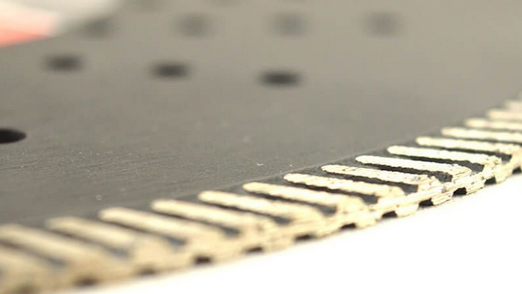
In industrial diamond tools, the cutting efficiency is fundamentally governed by the mechanical and chemical adhesion between the diamond crystal and the surrounding metal alloy. The common industry focus on "Diamond Concentration" often overlooks the primary driver of tool longevity: the Interfacial Bond Strength (IBS).
The Mechanical Locking Mechanism During the hot-pressing or vacuum-Sintering process, the metallic matrix (typically composed of Cobalt, Nickel, and Iron powders) undergoes thermal contraction. This contraction generates intense compressive stress around the diamond grains. This "mechanical locking" is the primary force preventing Pull-out (premature diamond loss). A high-Performance blade is characterized by a matrix that maintains this compressive tension even as localized temperatures at the cutting edge exceed 700°C.
Coating Technology and Chemical Adhesion Mechanical locking alone is insufficient for high-load applications such as reinforced concrete or hard quartzite. The introduction of Titanium or Chromium coatings on the diamond surface facilitates a chemical reaction during sintering, forming a thin layer of carbides. This carbide bridge transforms the interface from a simple physical contact to a metallurgical bond. The result is a 30% increase in the critical pull-out force, allowing for significantly higher feed rates without sacrificing tool life.
Fluid Dynamics of "Tail Formation" Effective diamond retention is visually evidenced by the presence of a "Comet Tail" — a ridge of metal bond that remains protected behind the diamond grain during the cutting process. This tail formation is a result of synchronized erosion kinetics. If the matrix lacks sufficient hardness or "hot hardness," the tail erodes too quickly, leaving the diamond unsupported and prone to fracture.
The VEXA Engineering Standard VEXA’s Diamond Series utilizes a Granular Gradient Strategy, matching the bond’s thermal expansion coefficient to the specific impact torque of the target material. Engineering focus is shifted from the hardness of the grit to the stability of the interface, ensuring that each diamond grain reaches its maximum volumetric utilization before the matrix releases it.


