

Managing Peripheral Deformation: How Segment Design Ensures High-Speed Cutting Precision
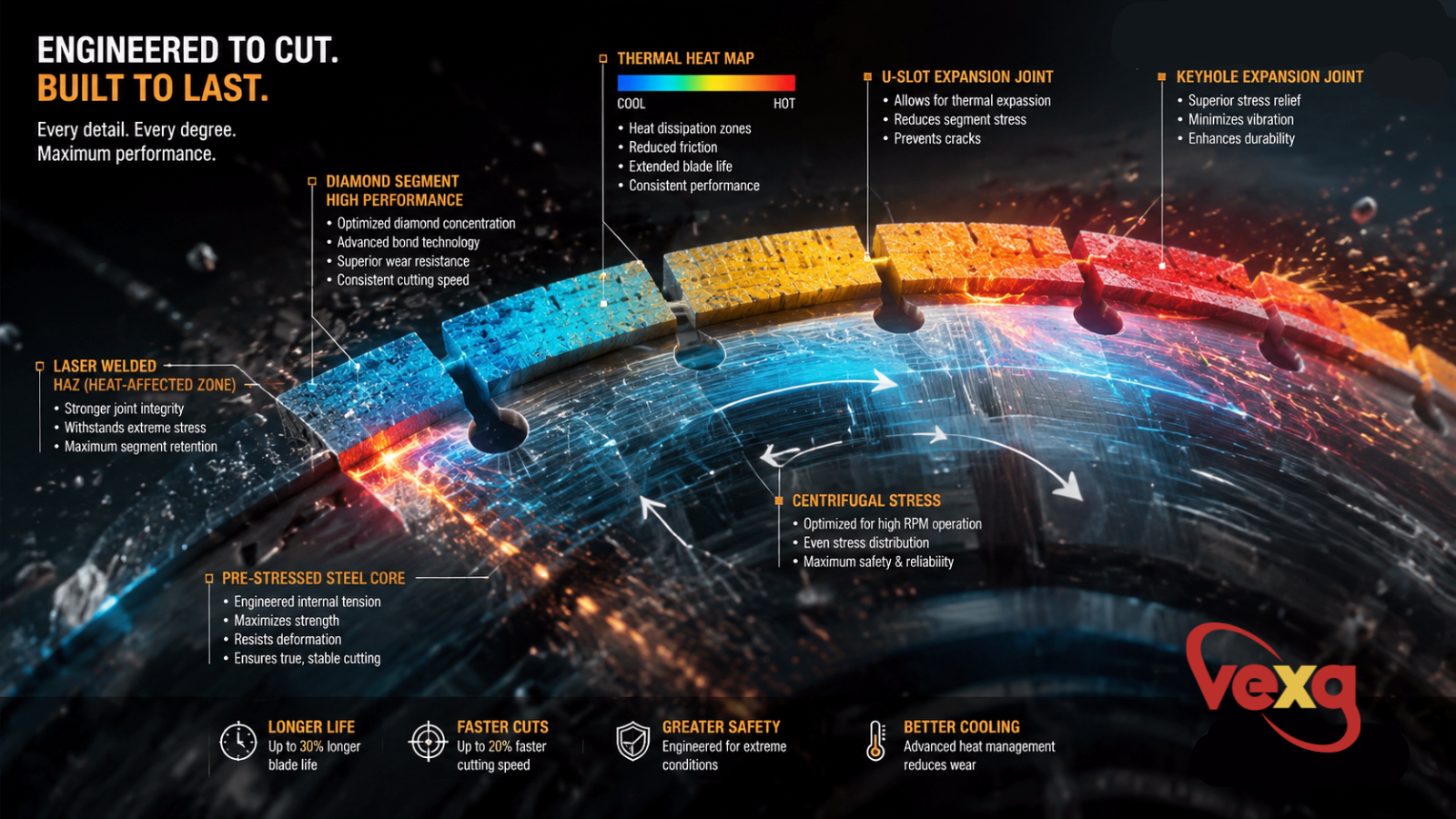
High-speed diamond blades are deceptively complex: even when diamonds themselves are sharp, poor segment geometry or thermal mismanagement can cause wobble, edge deviation, and inconsistent kerf width. These subtle failures translate directly into rework, scrap, and lost productivity.
At VEXA, we engineer every segment to maintain stability under extreme conditions.
1. Mechanical Expansion Management: U-Slots & Keyhole Patterns
Segment expansion is inevitable at high peripheral speeds (80m/s+).
The Concept: U-slots and keyhole patterns act like “expansion joints in a bridge,” absorbing thermal stress within the steel core while isolating forces from the metallic matrix.
The Effect: Even at 4,500+ RPM, compressive stress does not compromise structural integrity. Kerf width remains predictable, and cutting precision is maintained across the blade’s lifecycle.
2. Metallurgical Fusion: Laser Welding vs. Sintered Attachment
High-load industrial applications demand both strength and thermal control.
Laser Welding: Creates a deep-penetration joint between segment and core, minimizing the Heat-Affected Zone (HAZ).
Why It Matters: Joint strength exceeds that of the core, ensuring the segment withstands CNC spindle vibration and high rotational stress.
Outcome: Reduced warping and vibration for precision-critical operations.
3. Cold-Tensioning & Centrifugal Compensation
Operational precision relies on a pre-stressed steel core.
Mechanism: Cold-tensioning generates a radial stress gradient, counteracting centrifugal expansion at high rotation speeds.
Benefit: Prevents axial deviation (“snaking”) and maintains uniform kerf width throughout the tool’s life.
Think of it as “engineering the spring inside the blade” to absorb the forces that would otherwise distort performance.
The VEXA Engineering Standard
Precision cutting is not just about diamonds — it’s about systemic design.
By optimizing expansion geometry, welding, and core tension, VEXA blades deliver consistent cutting performance from the first cut to the last, across reinforced concrete, high-density ceramic, and other challenging materials.
Next in the Series:
Why Diamond Distribution Patterns Determine Cutting Efficiency and Surface Finish.


