

Every Grinding Wheel Has a Sweet Spot. Most Operators Never Find It.
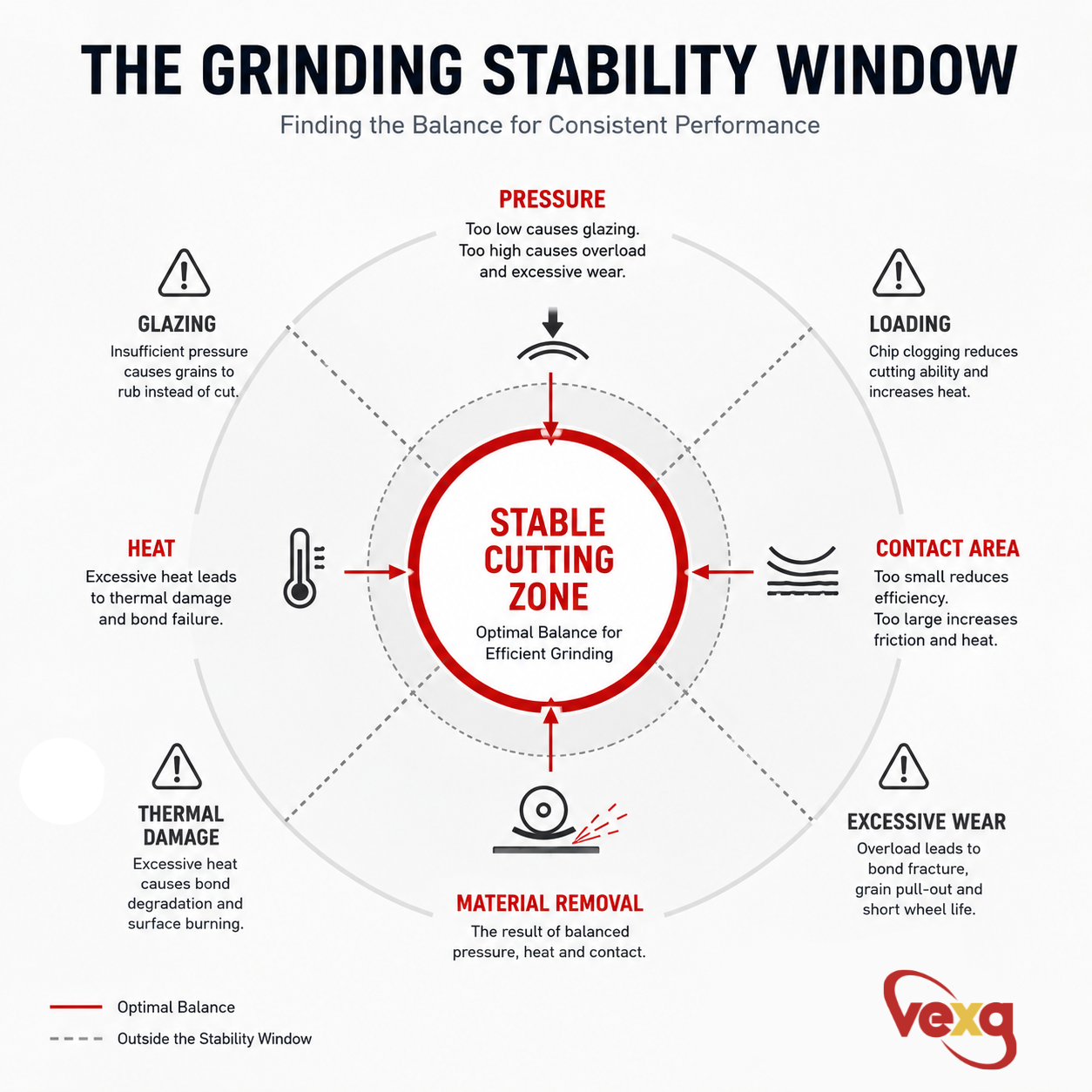
Most discussions about grinding wheels focus on hardness, grit size or abrasive type.
In reality, none of those determines performance by themselves.
A grinding wheel performs best only inside a specific operating window—a balance of pressure, contact area, wheel speed and feed rate.
Outside this window, even a premium wheel can lose cutting efficiency long before the abrasive grains are actually worn out.
At VEXA, we call this the Grinding Stability Window.
Understanding this window is often more valuable than simply upgrading to a more expensive wheel.
Stability Is an Energy Balance
Every abrasive grain removes material by converting mechanical energy into controlled micro-cutting.
For this process to remain stable, three conditions must stay in equilibrium:
• Cutting energy must exceed rubbing energy.
• Heat generation must remain below the bond's thermal tolerance.
• The resin bond must wear at approximately the same rate as fresh abrasive edges are exposed.
When these three mechanisms remain synchronized, grinding feels smooth, sparks remain uniform, vibration stays low, and the wheel continues cutting predictably.
When the balance is lost, performance begins to decline—even if the wheel still appears almost new.
Three Typical Ways the Stability Window Is Lost
1. Insufficient Pressure
When contact pressure is too low, abrasive grains cannot penetrate the workpiece.
Instead of cutting, they slide.
The grain tips gradually polish themselves.
Operators often describe this as:
"The wheel stopped cutting."
In reality, the wheel is still rotating.
Only the cutting mechanism has disappeared.
2. Excessive Pressure
Applying more force does not always increase productivity.
Beyond a certain point, chip thickness becomes unstable.
Individual abrasive grains experience overload, causing excessive bond fracture, vibration and localized thermal spikes.
The result is:
• Faster wheel consumption
• Higher operator fatigue
• Rougher surface finish
• Lower overall material removal efficiency
More pressure is not equal to more productivity.
Controlled pressure is.
3. Excessive Contact Area
Many operators instinctively use as much of the wheel face as possible.
Mechanically, this is one of the least efficient grinding strategies.
A larger contact patch distributes force across thousands of grains.
The load carried by each grain decreases, making effective penetration more difficult while simultaneously increasing frictional heat.
This is why experienced operators often grind using only a controlled portion of the wheel edge rather than the entire face.
The objective is not maximum contact.
It is maximum cutting energy per active grain.
Engineering Implication
Selecting the correct grinding wheel is only half of the equation.
The other half is operating the wheel inside its designed stability window.
At VEXA, wheel formulation, grain structure and bond characteristics are developed together with expected operating parameters—not as isolated material properties.
Because the best grinding wheel is not simply the hardest, sharpest or longest-lasting.
It is the one that remains stable throughout the entire grinding cycle.
Engineering Takeaway
Grinding performance is governed less by the wheel itself than by the interaction between the wheel and the process.
When pressure, contact area and bond wear reach equilibrium, cutting becomes predictable, wheel life improves, and productivity follows naturally.
Engineering is not about making a wheel that survives every condition.
It is about designing a wheel that performs consistently within the conditions it was created for.


