

The Wear Curve: Engineering Consistent Grinding Performance Through the Entire Tool Life
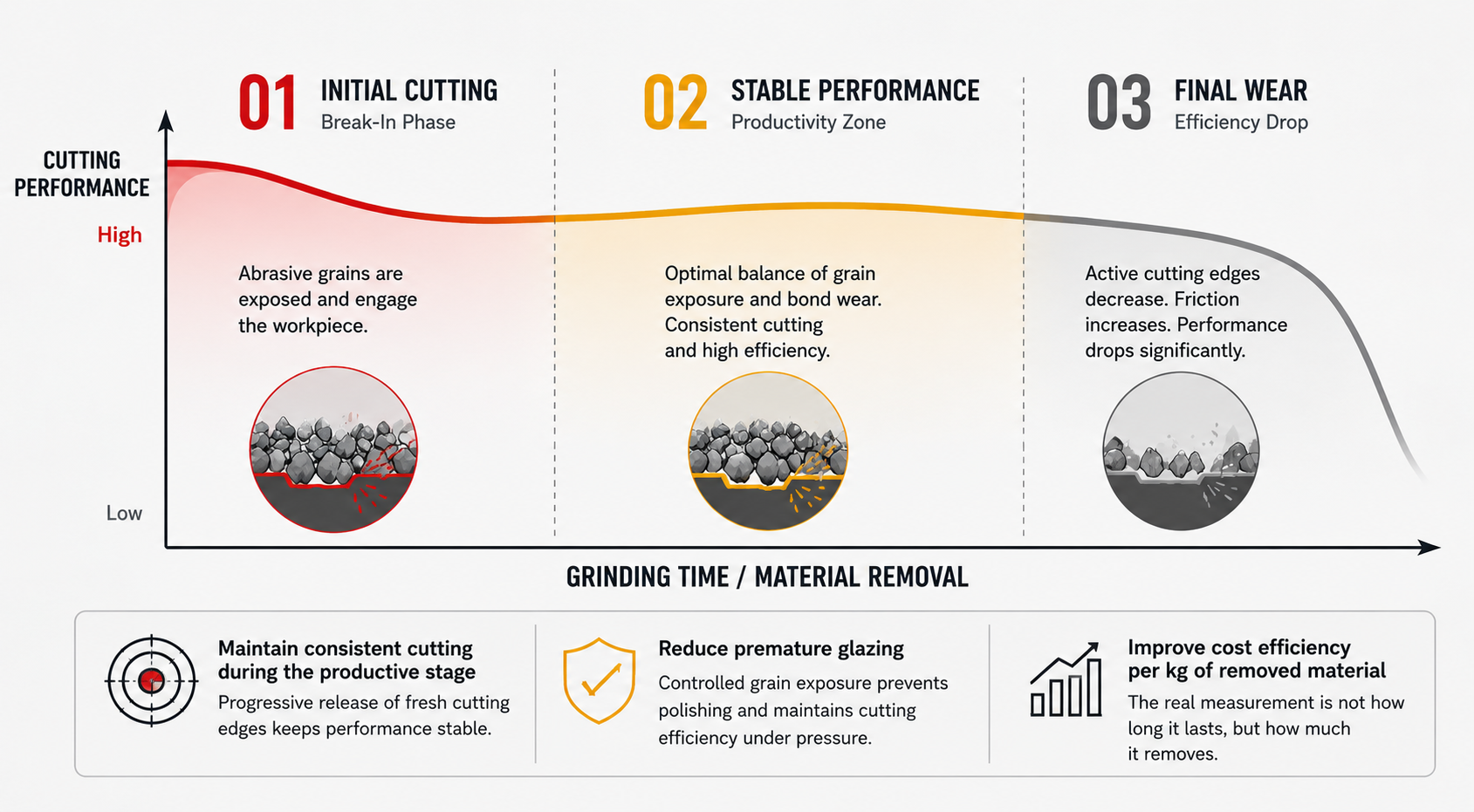
In heavy-duty grinding applications, abrasive selection is often evaluated by a simple question:
“How long can this wheel last?”
However, tool life alone does not define grinding efficiency.
A grinding wheel that survives longer but loses cutting ability halfway through its life may create higher labor costs, more heat generation, and unstable productivity.
The real engineering challenge is not only extending abrasive life — it is controlling the wear curve.
1. The Three Stages of Abrasive Wear
Every grinding wheel experiences a performance evolution during operation.
But different abrasive technologies create completely different wear behaviors.
Stage 1 — Initial Cutting: The Break-In Phase
At the beginning of grinding, abrasive grains are exposed and begin engaging with the workpiece.
A well-designed abrasive system should achieve:
Fast initial material removal
Stable grain exposure
Controlled grain fracture
However, if the bond is too strong or the grain structure is too passive, the abrasive edge becomes polished instead of refreshed.
The result:
Reduced cutting efficiency and increased friction.
Stage 2 — Stable Performance: The Productivity Zone
The most valuable period of an industrial grinding wheel is not the first minute.
It is the long middle section where:
Cutting rate remains consistent
Operator pressure remains stable
Heat generation stays controlled
Wheel consumption is predictable
This is where abrasive engineering creates real value.
VEXA Heavy Duty Grinding Series focuses on balancing:
Grain retention × Controlled release × Cutting aggression
The objective is not maximum hardness.
The objective is maintaining the optimum cutting condition for as long as possible.
Stage 3 — Final Wear: The Efficiency Drop
Eventually, every abrasive tool reaches the point where:
Active cutting edges decrease
Friction increases
Grinding force rises
Material removal rate declines
The mistake in many applications is continuing to use a wheel beyond its efficient working zone.
A low-cost wheel that requires excessive pressure or longer grinding time can become more expensive than a premium abrasive.
The Engineering Behind a Better Wear Curve
At VEXA, we design heavy-duty grinding products around controlled wear behavior.
Through optimized abrasive formulation and resin bond technology, our grinding wheels are engineered to:
1. Maintain aggressive cutting during the productive stage
The abrasive structure releases fresh cutting edges progressively instead of wearing away unpredictably.
2. Reduce premature glazing
Controlled grain exposure helps prevent the surface from becoming smooth and ineffective under heavy pressure.
3. Improve cost efficiency per kilogram of removed material
The real measurement of an abrasive tool is not:
“How many minutes did the wheel survive?”
The better question is:
“How much material can it remove before replacement?”
Beyond Tool Life: Engineering Predictability
In foundry cleaning, structural steel fabrication, and heavy metal processing, productivity depends on consistency.
A predictable wear curve means:
✔ Stable grinding performance
✔ Reduced operator adjustment
✔ Lower downtime from wheel changes
✔ More accurate production planning
The future of abrasive engineering is not simply creating longer-lasting wheels.
It is creating wheels that perform predictably from the first cut to the final stage.
VEXA — Professional through focus.


