
The Mechanics of Reinforcement: Why Fiberglass Mesh Density Determines the "Dynamic Life" of an Ultra-Thin Disc.
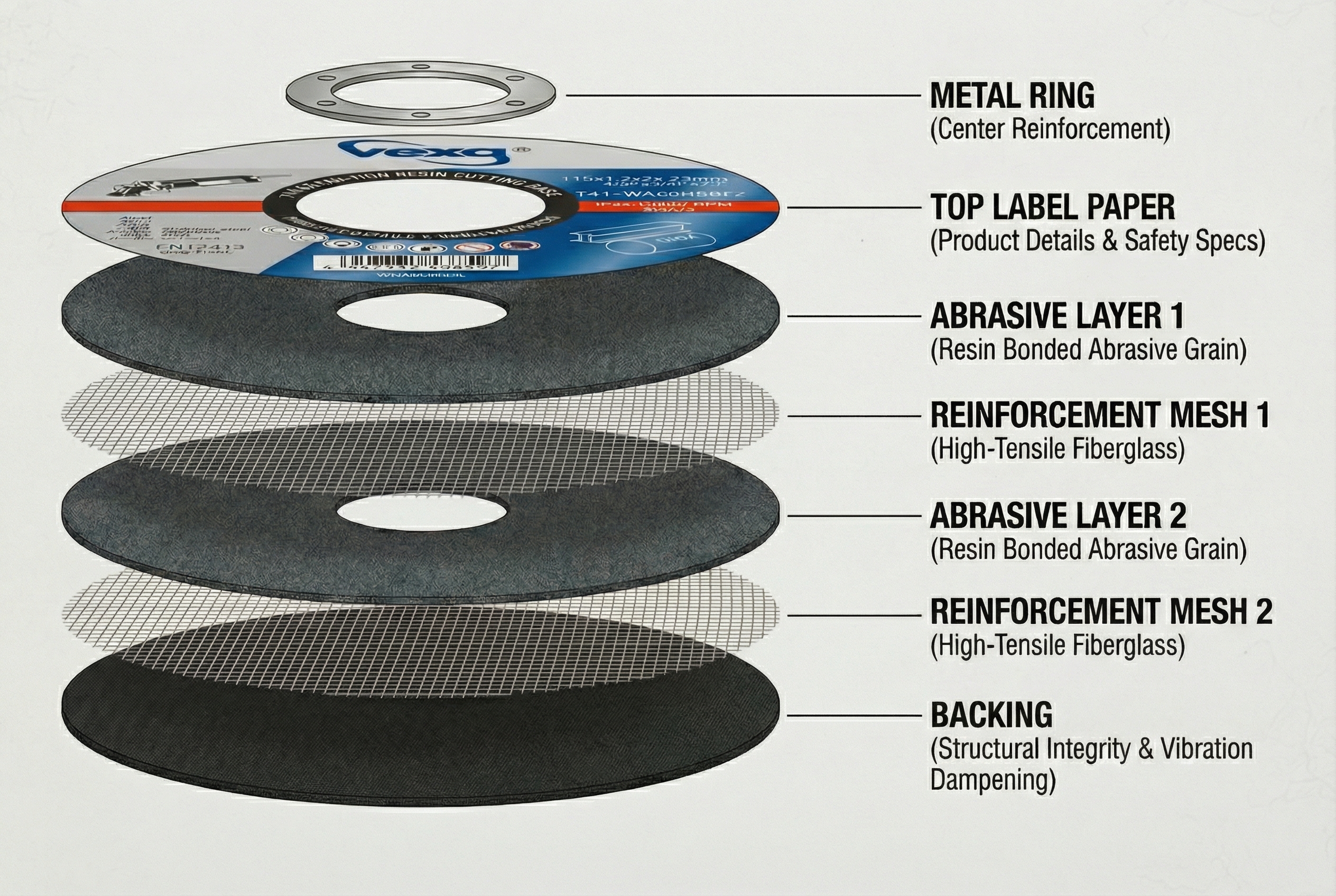
Why do ultra-thin cutting discs fail — even when everything looks “premium”?
At high speed, failure rarely starts on the surface.
It starts inside the structure — in the fiberglass reinforcement.
In a 1.2mm ultra-thin disc running at 80m/s, the mesh isn’t just support.
It’s the only thing holding the entire structure together under extreme stress.
Here’s what actually determines whether a disc stays stable — or breaks under load:
1. Controlling Hoop Stress at High RPM
At 12,000 RPM, the disc is constantly being pulled outward by massive circumferential (hoop) stress.
If the reinforcement isn’t properly engineered, the structure begins to deform.
Many standard discs use lower-density fiberglass (typically 150–180g/m²) and are not pre-tensioned.
→ The result: vibration, wobble, and instability under load.
A high-modulus, pre-tensioned mesh (e.g. 220g/m²) ensures the fibers respond uniformly in all directions.
→ This means smoother rotation, less vibration, and more stable cutting performance.
2. Chemical Stability: The Hidden Cause of “Silent Failures”
One of the most overlooked issues in abrasives is long-term bonding degradation.
Phenolic resins are inherently alkaline.
Standard fiberglass, when exposed over time, undergoes alkali-silica reaction (ASR) — leading to fiber embrittlement and layer separation.
→ This is why some discs don’t fail immediately, but degrade and break unexpectedly.
With proper alkali-resistant treatment and silane coupling, the fiberglass forms a stable chemical bridge with the resin.
→ Result: stronger bonding, no delamination, and consistent performance over time.
3. Thermal Expansion Matching Under Real Working Conditions
During stainless steel cutting, temperatures at the disc surface can rise rapidly.
If the fiberglass and resin expand at different rates (CTE mismatch), micro-cracks form at the interface.
→ These cracks are a primary cause of edge chipping and unstable cuts.
A properly calibrated reinforcement system expands and contracts in sync with the abrasive matrix.
→ Result: cleaner cuts, better edge control, and longer usable life.
What does this mean for you?
✔ Less vibration at high RPM
✔ Reduced risk of sudden failure
✔ More consistent cutting quality
✔ Longer tool life in demanding applications
The takeaway:
A professional abrasive disc isn’t just about grains or thickness.
It’s a synchronized material system — and fiberglass is its backbone.
If you're currently testing ultra-thin cutting discs, I’m happy to provide samples for real-world comparison.
Let’s test what really makes the difference.


