

The Chemical Muscle — Why the "Curing Curve" of Phenolic Resin Determines Cutting Efficiency.
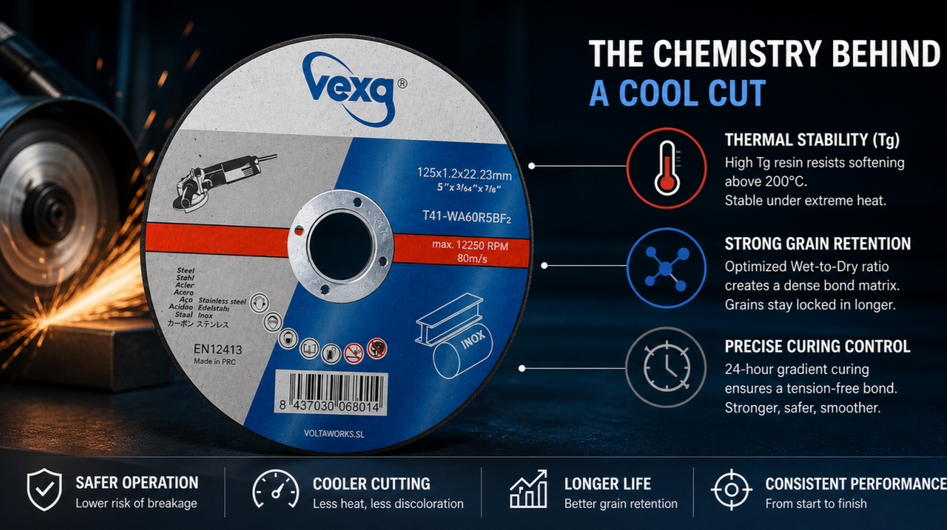
After the center ring and the fiberglass structure, there’s one final piece that determines whether a cutting disc performs — or fails:
The resin bonding system.
If the grains are the teeth, and the fiberglass is the skeleton,
then the resin is what holds everything together under heat, load, and speed.
And this is where many “premium-looking” discs break down.
1. Thermal Stability: Why Tg Matters
A common issue in high-speed cutting is this:
The disc starts strong… then suddenly stops cutting and begins to burn the material.
This usually comes down to a low glass transition temperature (Tg) in the resin.
When Tg is too low, the bond softens under heat.
→ The disc stops cutting and starts rubbing
→ Heat builds up
→ You get slower cuts, discoloration (blueing), and loss of control
A high-crosslinking phenolic system maintains rigidity even above 200°C.
→ Result: clean grain fracture, faster cutting, and stable performance under load
2. Grain Retention: The Role of Wet-to-Dry Ratio
Grain retention isn’t just about the abrasive — it’s about how the resin matrix is built.
In many standard discs, inconsistent liquid-to-powder ratios create a porous structure.
→ Result: weak grain anchoring and premature grain loss
A controlled wet-to-dry ratio forms a dense, uniform matrix.
→ Every grain stays in place until it has fully done its job
→ This means longer life, more consistent cutting, and less waste
3. Curing: Where Quality Is Locked In
A professional disc isn’t just “heated” — it’s cured under a controlled cycle.
If curing is rushed, internal gases create micro-voids inside the structure.
→ These become weak points under high RPM
→ Leading to vibration, instability, and even breakage
A controlled, gradual curing process ensures a tension-free molecular structure.
→ Result: smoother cutting feel, reduced vibration, and higher safety margins
So what actually defines a high-performance cutting disc?
Not one component — but a system.
It’s the integration of:
• A precise center interface
• A stable fiberglass structure
• A high-performance resin bond
Remove one — and performance collapses.
If you're working with stainless steel or high-heat cutting applications,
I’m happy to provide samples for real-world comparison.
Let’s test what really makes the difference.


