

More Open Does Not Always Mean Better: The Engineering Trade-Off Behind Mesh Sanding Discs
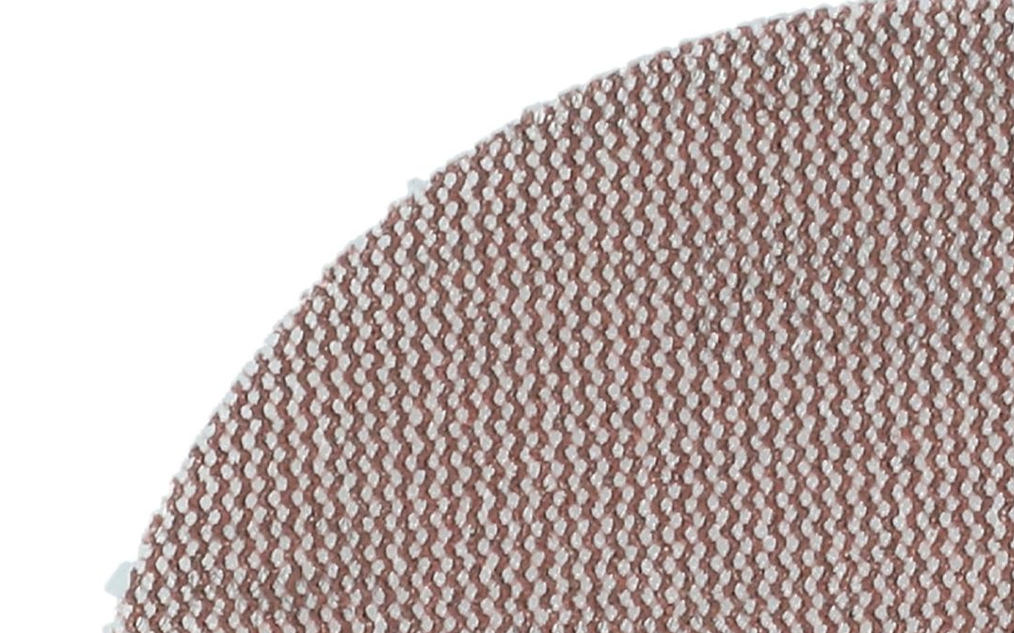
When mesh sanding discs are discussed, one specification often gets attention:
Open area.
More open structure appears to mean better dust evacuation.
And better dust evacuation should mean less loading.
The logic sounds straightforward.
But abrasive engineering is rarely that simple.
If the structure becomes too open, abrasive coverage can decrease.
If abrasive coverage decreases too much, cutting performance can suffer.
If the mesh structure becomes too weak, the disc may lose dimensional stability during sanding.
The engineering challenge is therefore not to create the most open sanding disc.
It is to create the right balance between openness and abrasive performance.
1. The Sanding Interface Has Competing Requirements
A sanding disc needs to perform several functions simultaneously.
It must provide enough abrasive grain to generate effective cutting.
It must provide sufficient open space for dust and debris to escape.
It must maintain structural integrity during repeated flexing.
And it must remain stable enough to transfer working pressure efficiently.
These requirements can compete with each other.
Increasing open space can improve debris evacuation.
But reducing abrasive coverage too far can reduce the number of active cutting points.
Increasing abrasive density can increase cutting potential.
But excessive density can create a more congested cutting interface and increase the tendency toward loading.
This is the fundamental design trade-off behind mesh sanding.
2. Abrasive Coverage Determines How Many Cutting Points Are Available
Sanding is not performed by the backing.
It is performed by exposed abrasive grains interacting with the workpiece.
The distribution of those grains influences:
Number of active cutting points
Contact pressure per grain
Scratch density
Material removal rate
Wear behavior
If too few grains are available in the working area, the load carried by individual abrasive points can increase.
If too many grains are concentrated into a relatively closed structure, removed material has fewer pathways to escape.
The objective is therefore not maximum grain density.
It is effective grain utilization.
3. Open Structure Changes the Way Debris Moves
A conventional abrasive surface tends to collect removed particles around the cutting interface.
A mesh structure introduces pathways through which particulate matter can move away from the contact zone.
But dust evacuation is influenced by more than simply the presence of holes.
Actual performance depends on:
**Mesh geometry
Open area
Abrasive distribution
Hole pattern
Dust particle size
Sanding pressure
Vacuum airflow**
This is why two mesh discs can look very similar and still behave differently in real applications.
The visual structure tells only part of the engineering story.
4. The Vacuum System Becomes Part of the Abrasive System
This point is often overlooked.
A mesh disc is designed to facilitate dust evacuation.
But the actual evacuation process depends heavily on the sanding machine and extraction system.
If airflow is insufficient, open structure alone cannot guarantee effective dust removal.
The complete system becomes:
Abrasive → Mesh → Backing → Sanding Pad → Machine → Extraction
Performance is therefore determined by the interaction of the components.
This is particularly important in automotive refinishing, woodworking, composites, and other applications where large quantities of fine particulate are generated.
5. Flexibility Creates Another Engineering Constraint
A mesh disc must also deform appropriately during sanding.
Too rigid:
→ Poor contour conformity
Too flexible:
→ Reduced pressure stability
Too weak:
→ Structural deformation
Too dense:
→ Reduced openness
Too open:
→ Potential loss of abrasive coverage
This is why mesh sanding disc design is not simply a matter of punching holes into an abrasive backing.
The mesh structure, abrasive layer, bonding system, and backing must function as one mechanical system.
6. Performance Should Be Measured Across the Entire Sanding Cycle
A mesh disc should not be judged only by its initial cutting speed.
A more useful evaluation looks at the entire working cycle:
Initial Cutting
↓
Dust Generation
↓
Debris Evacuation
↓
Loading Development
↓
Heat Generation
↓
Cutting Retention
↓
Final Usable Life
A disc with slightly lower initial aggression may outperform a more aggressive disc if it maintains a higher effective cutting rate for longer.
This is especially important in production sanding.
The objective is not to maximize the first few minutes.
It is to maximize useful cutting time.
7. The Engineering Target Is Effective Abrasive Utilization
This leads to a more meaningful way of evaluating mesh sanding.
Instead of asking:
How open is the disc?
Ask:
How efficiently does the disc use its available abrasive throughout its working life?
That requires balancing:
Abrasive Coverage
with
Debris Evacuation
while maintaining:
Structural Stability
and:
Controlled Wear
The best mesh structure is therefore not necessarily the one with the highest open area.
It is the one that keeps enough abrasive actively engaged while preventing the cutting interface from becoming congested.
8. The VEXA Engineering Perspective
At VEXA, we view mesh sanding as a system-level engineering problem.
Our focus is not simply on creating an open backing.
We look at the interaction between:
Abrasive grain
Grain distribution
Mesh geometry
Open area
Bonding
Backing strength
Flexibility
Dust evacuation
Wear behavior
The goal is to create a sanding interface that remains productive throughout the working cycle.
Because a mesh disc is only as good as the balance between the abrasive it carries and the material it allows to escape.
Engineering Takeaway
More open does not automatically mean more efficient.
Too little openness can accelerate loading.
Too much openness can compromise abrasive coverage and structural performance.
The engineering challenge lies in the middle:
Enough abrasive to cut.
Enough openness to evacuate.
Enough structure to remain stable.
That balance determines how effectively a mesh sanding disc converts abrasive material into useful work.
The best mesh is not the one with the most holes.
It is the one that keeps the cutting interface working.
Evaluating mesh sanding performance?
If you are comparing mesh sanding discs and seeing differences in:
Cutting rate
Loading
Dust evacuation
Disc life
Heat
Surface consistency
send us your material, grit, machine, extraction system and current disc.
We can evaluate the application and arrange samples for comparative testing.
VEXA — Professional through focus.


