

A Mesh Sanding Disc Is Only as Good as Its Airflow Path: The Hidden Engineering Behind Effective Dust Evacuation
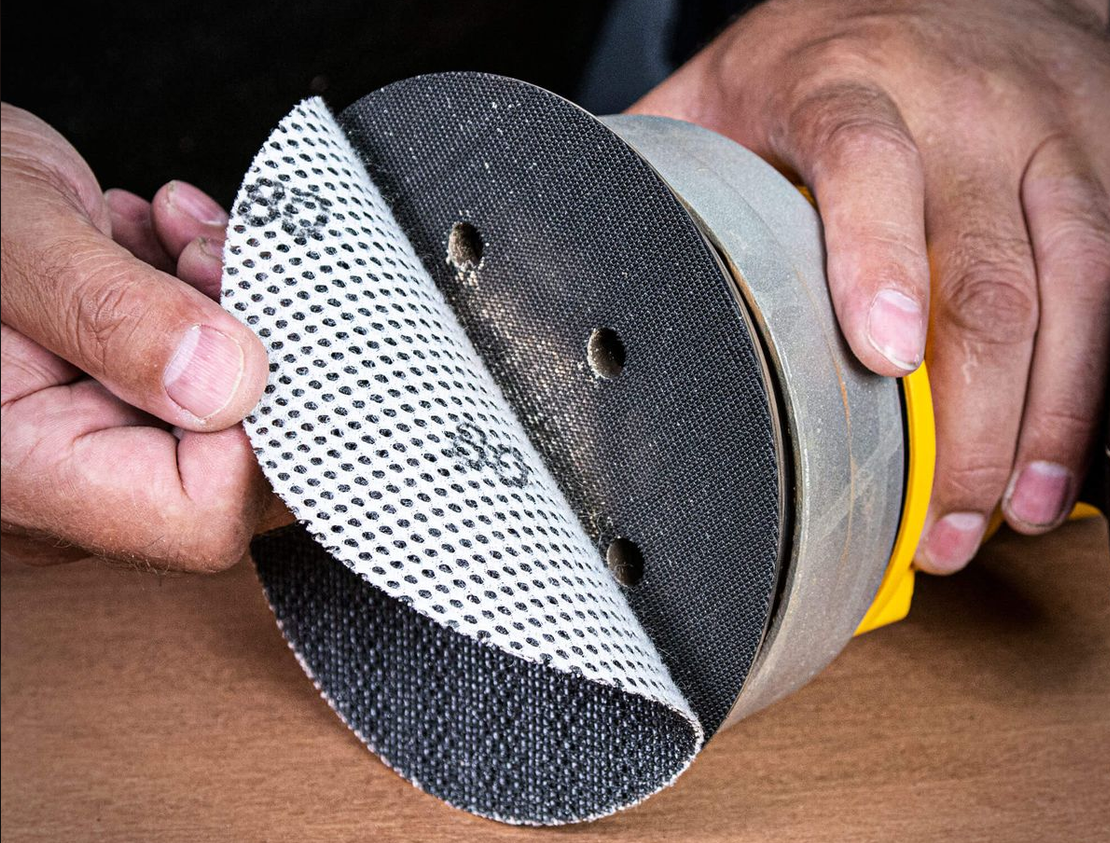
A mesh sanding disc is designed around one fundamental idea:
Give sanding debris a way out.
But an open abrasive structure does not automatically guarantee effective dust evacuation.
The real question is:
Can the dust actually travel through the entire system and leave the sanding interface?
That depends on more than the mesh itself.
The abrasive structure, mesh opening, backing pad, machine interface, and extraction system must work together.
When they do, the mesh can maintain a cleaner cutting interface for longer.
When they do not, part of the potential advantage of mesh sanding can disappear.
1. A Mesh Opening Is Only the Beginning
During sanding, abrasive grains continuously generate particles.
Those particles initially occupy the area immediately surrounding the cutting points.
With a conventional closed backing, the available escape routes are limited.
A mesh structure creates additional pathways through the abrasive surface.
The intended path becomes:
Cutting Interface → Mesh Opening → Pad → Extraction Channel → Vacuum System
This is fundamentally different from simply allowing dust to accumulate on the abrasive surface.
But creating the pathway is only the first step.
The pathway must remain functional during actual sanding.
2. Open Structure Does Not Mean Effective Airflow
It is tempting to assume:
More openings = more airflow = better dust extraction.
In practice, the relationship is more complicated.
Dust evacuation depends on:
Opening geometry
Open area
Abrasive coverage
Pad perforation
Hole alignment
Vacuum airflow
Dust particle characteristics
Contact pressure
If the mesh provides an open path but the pad blocks that path, the system becomes restricted.
If the pad has large openings but the extraction flow is insufficient, particles may still remain around the cutting interface.
The mesh is therefore not an independent dust-management system.
It is the first stage of an airflow pathway.
3. The Pad Interface Can Become the Bottleneck
This is one of the most overlooked aspects of mesh sanding.
Imagine a mesh disc with a highly open structure.
Now place it against a conventional pad with limited or poorly positioned extraction holes.
The mesh may provide excellent particle pathways.
But the particles eventually reach the pad.
If the pad does not allow those particles and airflow to pass efficiently, the pathway becomes partially restricted.
The result can be:
Mesh opening
→ restricted pad interface
→ reduced airflow
→ particle accumulation
→ increased loading
The potential advantage of the mesh structure is therefore not fully realized.
This is why mesh sanding should be evaluated as a disc–pad system, rather than as a disc alone.
4. Hole Alignment Matters More Than It Appears
A sanding system contains several layers.
Abrasive surface
↓
Mesh structure
↓
Backing pad
↓
Machine extraction channels
↓
Vacuum hose
Each layer can influence the movement of air and particles.
If the openings are poorly aligned, the effective flow path becomes more restrictive.
The theoretical open area of the mesh may look impressive on a specification sheet.
But the effective open area of the complete system can be much lower.
This is an important distinction:
Theoretical openness is not the same as effective evacuation.
5. Dust Evacuation Can Influence Loading Indirectly
The purpose of extraction is not simply to make the working environment cleaner.
It also changes the condition of the abrasive interface.
Consider the sequence:
Efficient particle evacuation
↓
Shorter particle residence time
↓
Less debris surrounding abrasive grains
↓
Lower loading tendency
↓
More exposed cutting points
↓
More stable cutting performance
This is why dust management can influence abrasive life and cutting consistency.
The mesh does not necessarily make the abrasive itself stronger.
It can help create an environment in which the abrasive remains effective for longer.
6. Stronger Vacuum Is Not the Only Answer
More suction does not automatically produce better sanding.
The extraction system must be matched to the complete airflow path.
If the interface between disc and pad is restrictive, increasing vacuum power may provide diminishing returns.
Likewise, an extremely open disc cannot compensate for an inefficient extraction system.
The objective is to achieve a continuous, low-resistance path for air and particles.
That requires compatibility between:
**Mesh structure
Pad design
Machine interface
Extraction capacity**
The system must be designed to work as a whole.
7. This Changes How Mesh Sanding Should Be Tested
A mesh sanding disc should not be evaluated only by placing it on a machine and observing initial cutting speed.
A meaningful test should also examine:
Dust evacuation
How much particulate remains around the sanding interface?
Loading
How quickly does the abrasive surface become contaminated?
Cutting retention
How stable is material removal as sanding continues?
Temperature
Does the interface remain thermally controlled?
Disc utilization
How much useful sanding can be achieved before replacement?
And most importantly:
How does performance change when the same disc is used with different pad and extraction configurations?
This is where application testing becomes more informative than specifications alone.
8. The VEXA Engineering Perspective
At VEXA, we view mesh sanding as an integrated abrasive system.
When evaluating a mesh sanding disc, we consider the relationship between:
Abrasive Distribution
× Mesh Geometry
× Open Area
× Pad Interface
× Extraction Path
× Working Conditions
The objective is not simply to produce an abrasive surface with more openings.
It is to create a structure that allows the abrasive to remain effective while supporting continuous particle evacuation.
Because the real advantage of mesh sanding appears only when the entire airflow path remains functional.
Engineering Takeaway
A mesh sanding disc creates the opportunity for better dust evacuation.
It does not guarantee it.
The real performance depends on whether dust can travel through the complete system:
Disc → Mesh → Pad → Machine → Extraction
When that pathway works efficiently, the sanding interface can remain cleaner, cooler, and more productive.
When one part becomes a bottleneck, the advantage of the mesh structure can be significantly reduced.
The engineering goal is not simply to create more openings.
It is to create a continuous path for the material to leave.
Experiencing unexpected loading with a mesh sanding disc?
If your mesh discs are not delivering the expected performance, send us:
Mesh Disc + Grit + Machine + Backing Pad + Extraction System + Material
We can help evaluate whether the limitation is coming from the abrasive construction, the pad interface, or the extraction system—and arrange samples for comparative testing.
VEXA — Professional through focus.


